Review
. 2013 Jan;10(1):55-67.
doi: 10.1007/s13311-012-0147-4.

Daclizumab therapy for multiple sclerosis

Affiliations
Review

Daclizumab therapy for multiple sclerosis

Bibiana Bielekova. Neurotherapeutics. 2013 Jan.

Abstract

Daclizumab is a humanized monoclonal antibody of IgG1 subtype that binds to the Tac epitope on the interleukin-2 (IL-2) receptor α-chain (CD25), thus, effectively blocking the formation of the high-affinity IL-2 receptor. Because the high-affinity IL-2 receptor signaling promotes expansion of activated T cells in vitro, daclizumab was designed as a therapy that selectively inhibits T-cell activation. Assuming the previous statement, daclizumab received regulatory approval as add-on therapy to standard immunosuppressive regimen for the prevention of acute allograft rejection in renal transplantation. Based on its putative mechanism of action (MOA), daclizumab represented an ideal therapy for T-cell-mediated autoimmune diseases and was subsequently tested in inflammatory uveitis and multiple sclerosis (MS). In both of these diseases, daclizumab therapy significantly inhibited target organ inflammation. Mechanistic studies in MS demonstrated that the MOA of daclizumab is surprisingly broad and that the drug exerts unexpected effects on multiple components of the innate immune system. Specifically, daclizumab dramatically expands and activates immunoregulatory CD56(bright) NK cells, which gain access to the intrathecal compartment in MS and can kill autologous activated T cells. Daclizumab also blocks trans-presentation of IL-2 by mature dendritic cells to primed T cells, resulting in profound inhibition of antigen-specific T cells. Finally, daclizumab modulates the development of innate lymphoid cells. In conclusion, daclizumab therapy, which is currently in phase III testing for inflammatory MS, has a unique MOA that does not limit migration of immune cells into the intrathecal compartment, but rather provides multifactorial immunomodulatory effects with resultant inhibition of MS-related inflammation.


Figures
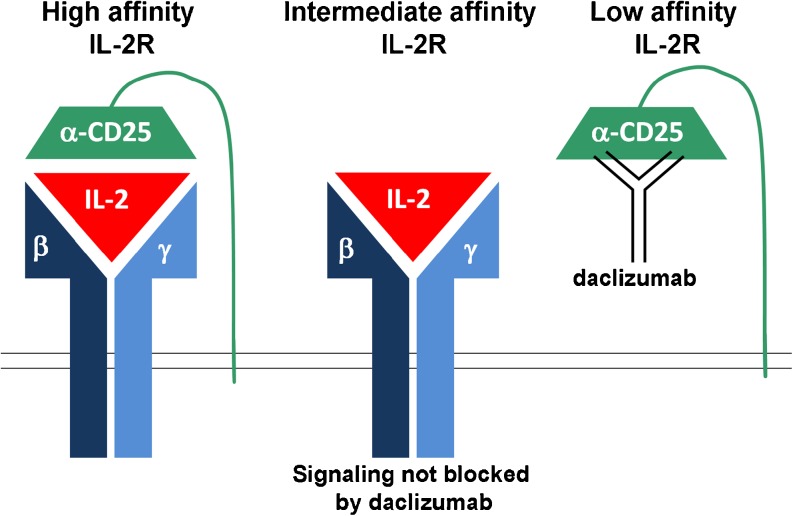
Fig. 1
Fig. 1
Schematics of the 3 interleukin-2 receptors (IL-2R) and daclizumab binding site
Fig. 2
Fig. 2
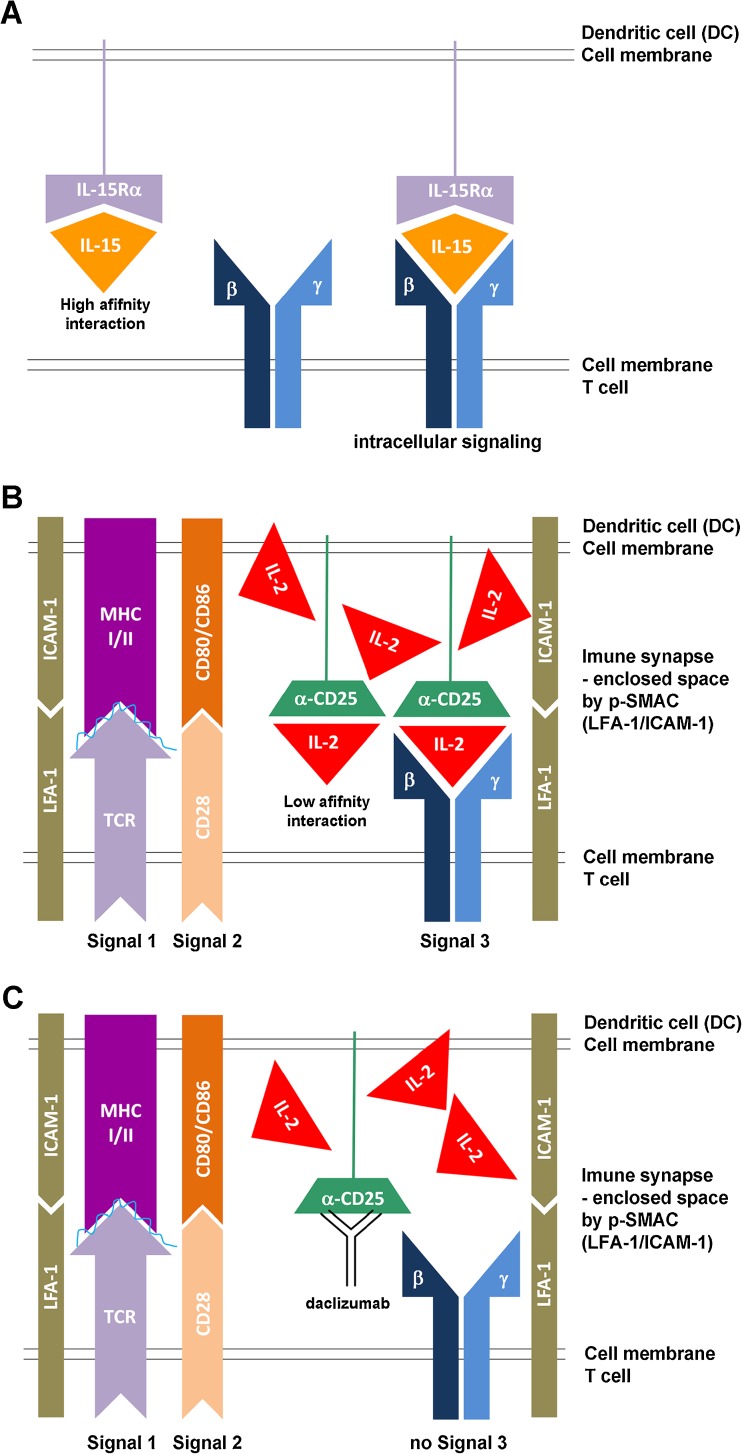
Trans-presentation of interleukin (IL)-15 and IL-2. a Because of very high affinity between interleukin-15 receptors alpha (IL-15Rα) chain and IL-15, IL-15Rα chain can easily capture and hold released IL-15. This IL-15Rα/IL-15 complex can be then easily trans-presented to intermediate-affinity IL-2/IL-15 receptor, expressed on T cells or NK cells. b In contrast, CD25 (IL-2Rα chain) has only low affinity for IL-2, so it is highly unlikely that CD25 would be able to effectively capture small concentrations of IL-2 and create stable CD25/IL-2 complexes for trans-presentation, if IL-2 can easily diffuse to the environment. However, if instead the IL-2 is released into the synaptic cleft, which represents an enclosed space between the peripheral supramolecular activation cluster (p-SMAC) formed by adhesion molecules, such as lymphocyte function associated antigen-1 (LFA-1) and intercellular adhesion molecule-1 (ICAM-1), then its diffusion is limited and high IL-2 concentrations can be achieved. Under those circumstances, CD25 expressed on the surface of the dentritic cells (DC), which formed stable immune synapse (IS) with antigen-specific T cell, can effectively capture released IL-2 and trans-present it to the T cell at the time when T cell does not yet express CD25. This cytokine signal (signal 3), delivered concomitantly with the signal 1, provided by T-cell receptor (TCR), specifically recognizing peptide loaded on the major histocompatibility complex (MHC) and the co-stimulatory signal 2 (e.g., provided by interaction of CD28 with CD80 or CD86) seems to be necessary for efficient activation of human T cells. c When CD25 on the DC is blocked by daclizumab, then primed T cell cannot receive IL-2 signal (signal 3) concomitantly with its signal 1 and 2, resulting in suboptimal stimulation of T cell. The functional consequences are inhibition of antigen-specific T cell activation, formation of antigen-specific effector and memory T cells

References

    1. Ruscetti FW, Morgan DA, Gallo RC. Functional and morphologic characterization of human T cells continuously grown in vitro. J Immunol. 1977;119:131–138. - PubMed
    1. Mizel SB, Farrar JJ. Revised nomenclature for antigen-nonspecific T-cell proliferation and helper factors. Cell Immunol. 1979;48:433–436. doi: 10.1016/0008-8749(79)90139-4. - DOI - PubMed
    1. Feinerman O, Jentsch G, Tkach KE, et al. Single-cell quantification of IL-2 response by effector and regulatory T cells reveals critical plasticity in immune response. Mol Syst Biol. 2010;6:437. doi: 10.1038/msb.2010.90. - DOI - PMC - PubMed
    1. Waldmann TA, Kozak RW, Tsudo M, Oh-ishi T, Bongiovanni KF, Goldman CK. IL-2 receptors in adult T-cell leukemia: a target for immunotherapy. Hamatol Bluttransfus. 1987;31:110–115. - PubMed
    1. Waldmann TA, O'Shea J. The use of antibodies against the IL-2 receptor in transplantation. Curr Opin Immunol. 1998;10:507–512. doi: 10.1016/S0952-7915(98)80215-X. - DOI - PubMed

Publication types

MeSH terms