


Correlation of interferon-inducible chemokine plasma levels with disease severity in systemic sclerosis
- PMID: 23055137
- PMCID: PMC3687352
- DOI: 10.1002/art.37742
Correlation of interferon-inducible chemokine plasma levels with disease severity in systemic sclerosis
Abstract
Objective: To measure interferon (IFN)-inducible chemokines in the plasma of patients with systemic sclerosis (SSc) and investigate whether the chemokine levels are correlated with disease severity.
Methods: Plasma levels of the IFN-inducible chemokines IFNγ-inducible protein 10 (IP-10/CXCL10), IFN-inducible T cell α chemoattractant (I-TAC/CXCL11), and monocyte chemoattractant protein 1 (CCL2) were measured in SSc patients and examined for correlation with the IFN gene expression signature. A composite IFN-inducible chemokine score was generated for chemokines showing a correlation with the IFN gene signature (IP-10 and I-TAC), and this score was compared between 266 patients with SSc enrolled in the Genetics versus Environment in Scleroderma Outcome Study (GENISOS) cohort and 97 matched control subjects. Subsequently, the correlation between the IFN-inducible chemokine score at baseline and markers of disease severity was assessed. In addition, the course of the IFN-inducible chemokine score over time was examined.
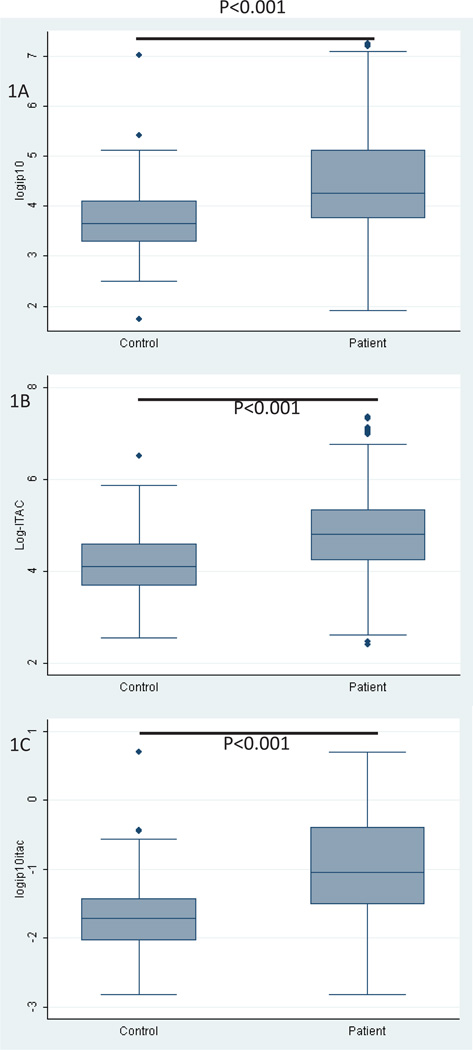
Results: The plasma IFN-inducible chemokine score correlated with the IFN gene expression signature, and this score was higher in SSc patients compared to controls. The IFN-inducible chemokine score was also associated with the absence of anti-RNA polymerase III antibodies and presence of anti-U1 RNP antibodies, but not with disease duration, disease type, or other autoantibodies. The chemokine score correlated with concomitantly obtained scores on the Medsger Severity Index for muscle, skin, and lung involvement in SSc, as well as the forced vital capacity, diffusing capacity for carbon monoxide, and creatine kinase levels. The association of the chemokine score with disease severity was independent of the presence of anti-U1 RNP or other potential confounders (age, sex, ethnicity, disease duration, and treatment with immunosuppressive agents). Finally, there was not a significant change in the IFN-inducible chemokine score over time.
Conclusion: The IFN-inducible chemokine score is a stable serologic marker of a more severe form of SSc and may be useful for risk stratification of patients, regardless of disease type (limited or diffuse) or duration of disease.
Copyright © 2013 by the American College of Rheumatology.
Figures
References
-
- York MR, Nagai T, Mangini AJ, Lemaire R, van Seventer JM, Lafyatis R. A macrophage marker, Siglec-1, is increased on circulating monocytes in patients with systemic sclerosis and induced by type I interferons and toll-like receptor agonists. Arthritis Rheum. 2007;56(3):1010–1020. - PubMed
-
- Tan FK, Zhou X, Mayes MD, Gourh P, Guo X, Marcum C, et al. Signatures of differentially regulated interferon gene expression and vasculotrophism in the peripheral blood cells of systemic sclerosis patients. Rheumatology (Oxford) 2006;45(6):694–702. - PubMed
-
- Higgs BW, Liu Z, White B, Zhu W, White Wl, Morehouse C, et al. Patients with systemic lupus erythematosus, myositis, rheumatoid arthritis and scleroderma share activation of a common type I interferon pathway. Ann Rheum Dis. 2011;7011:2029–2036. - PubMed
-
- Duan H, Fleming J, Pritchard DK, Amon LM, Xue J, Arnett HA, et al. Combined analysis of monocyte and lymphocyte messenger RNA expression with serum protein profiles in patients with scleroderma. Arthritis Rheum. 2008;58(5):1465–1474. - PubMed
-
- Bos CL, van Baarsen LG, Timmer TC, Overbeek MJ, Basoski NM, Rustenburg F, et al. Molecular subtypes of systemic sclerosis in association with anti-centromere antibodies and digital ulcers. Genes Immun. 2009 - PubMed
Publication types
MeSH terms
Substances
Grants and funding
- T32 AR052283/AR/NIAMS NIH HHS/United States
- K23-AR-061436/AR/NIAMS NIH HHS/United States
- P50 AR054144/AR/NIAMS NIH HHS/United States
- P50-AR-054144/AR/NIAMS NIH HHS/United States
- N01 AR002251/AR/NIAMS NIH HHS/United States
- M01-RR-00073/RR/NCRR NIH HHS/United States
- K23 AR061436/AR/NIAMS NIH HHS/United States
- TL1-RR-024147/RR/NCRR NIH HHS/United States
- T32-AR-052283/AR/NIAMS NIH HHS/United States
- UL1 RR024148/RR/NCRR NIH HHS/United States
- R01-AR-055258/AR/NIAMS NIH HHS/United States
- UL1-RR-024148/RR/NCRR NIH HHS/United States
- R01 AR055258/AR/NIAMS NIH HHS/United States
- M01 RR001346/RR/NCRR NIH HHS/United States
- N01-AR-2251/AR/NIAMS NIH HHS/United States
- M01-RR-01346/RR/NCRR NIH HHS/United States
- M01 RR000073/RR/NCRR NIH HHS/United States
- TL1 RR024147/RR/NCRR NIH HHS/United States
LinkOut - more resources
Full Text Sources
Other Literature Sources
Medical
Research Materials
