Review
. 2012 Oct 10;32(41):14064-73.
doi: 10.1523/JNEUROSCI.3403-12.2012.

The Hodgkin-Huxley heritage: from channels to circuits

Affiliations
Review

The Hodgkin-Huxley heritage: from channels to circuits

William A Catterall et al. J Neurosci. .

Abstract

The Hodgkin-Huxley studies of the action potential, published 60 years ago, are a central pillar of modern neuroscience research, ranging from molecular investigations of the structural basis of ion channel function to the computational implications at circuit level. In this Symposium Review, we aim to demonstrate the ongoing impact of Hodgkin's and Huxley's ideas. The Hodgkin-Huxley model established a framework in which to describe the structural and functional properties of ion channels, including the mechanisms of ion permeation, selectivity, and gating. At a cellular level, the model is used to understand the conditions that control both the rate and timing of action potentials, essential for neural encoding of information. Finally, the Hodgkin-Huxley formalism is central to computational neuroscience to understand both neuronal integration and circuit level information processing, and how these mechanisms might have evolved to minimize energy cost.


Figures
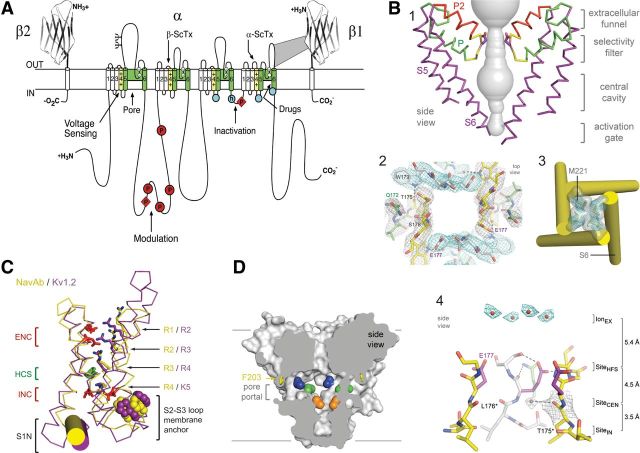
Figure 1.
Figure 1.
Structure of voltage-gated sodium channels. A, Primary structures of the subunits of mammalian voltage-gated sodium channels. Cylinders represent α-helical segments. Bold lines represent the polypeptide chains with length approximately proportional to the number of amino acid residues. The extracellular domains of the β1 and β2 subunits are shown as Ig-like folds. Ψ, sites of probable N-linked glycosylation; P in red circles and diamonds, sites of protein phosphorylation by PKA and PKC, respectively; green, pore-lining segments; white circles, the outer (EEEE) and inner (DEKA) rings of amino residues that form the ion selectivity filter and the tetrodotoxin binding site; yellow, S4 voltage sensors; h in blue circle, inactivation particle in the inactivation gate loop; blue circles, sites implicated in forming the inactivation gate receptor. Sites of binding of α- and β-scorpion toxins (ScTx) and a site of interaction between α and β1 subunits are also shown. B, Architecture of the NaVAb pore. 1, Conformation of the pore-lining S5 and S6 segments and the P loop, containing the conserved P helix and the P2 helix unique to NaV channels. Glu177 side-chains, purple; pore volume, gray. 2, Top view of the ion selectivity filter. Symmetry-related subunits are colored white and yellow; P-helix residues are colored green. Hydrogen bonds between Thr175 and Trp179 are indicated by gray dashes. Electron densities from Fo–Fc omit maps are contoured at 4.0 σ (blue and gray). 3, The closed activation gate at the intracellular end of the pore illustrating the close interaction of Met221 residues in closing the pore. 4, Side view of the selectivity filter. Glu177 (purple) interactions with Gln172, Ser178, and the backbone of Ser180 are shown in the far subunit. Fo–Fc omit map at 4.75 σ (blue); putative cations or water molecules (red spheres, IonEX). Electron density around Leu176 (gray; Fo–Fc omit map at 1.75 σ) and a putative water molecule is shown (gray sphere). Na+-coordination sites: SiteHFS, SiteCEN, and SiteIN. C, Voltage-sensing module. Structures of NaVAb (yellow) and Kv1.2 (purple) are overlapped. ENC, extracellular negative cluster; HCS, hydrophobic constriction site; INC, intracellular negative cluster. R1–R4, gating charges of NaVAb; R2–K5 conserved gating charges of Kv1.2. D, Membrane access to the central cavity in NaVAb. Side view through the pore module illustrating fenestrations (portals) and hydrophobic access to central cavity. Phe203 side chains, yellow sticks. Surface representations of NaVAb residues aligning with those implicated in drug binding and block: Thr206 (blue), Met209 (green), Val213 (orange). Membrane boundaries, gray lines. Electron density from an Fo–Fc omit map is contoured at 2.0 σ.
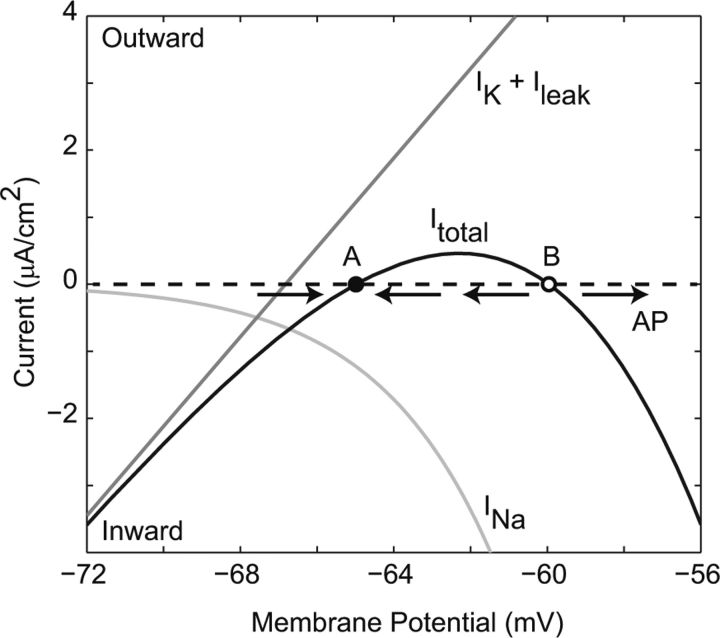
Figure 2.
Figure 2.
The nature of excitability in the Hodgkin-Huxley model. The total membrane current (Itotal) [the sum of steady-state sodium current (INa) and the resting-conductance potassium and leak currents (IK + Ileak)], crosses zero at two points, A (resting potential) and B (threshold). See explanation in the main text. In Hodgkin-Huxley terminology, this could be expressed as Itotal = Kn4(−65)[VEK] + Nam3(V)h(V)[VENa] + gleak[VEleak). If the membrane potential is perturbed only a little from rest, the direction of membrane current is such that it is attracted back to A, while if it exceeds the unstable fixed point B, then the membrane potential has a positive derivative, driving it further away from B, and an action potential (AP) is generated.
Figure 3.
Figure 3.
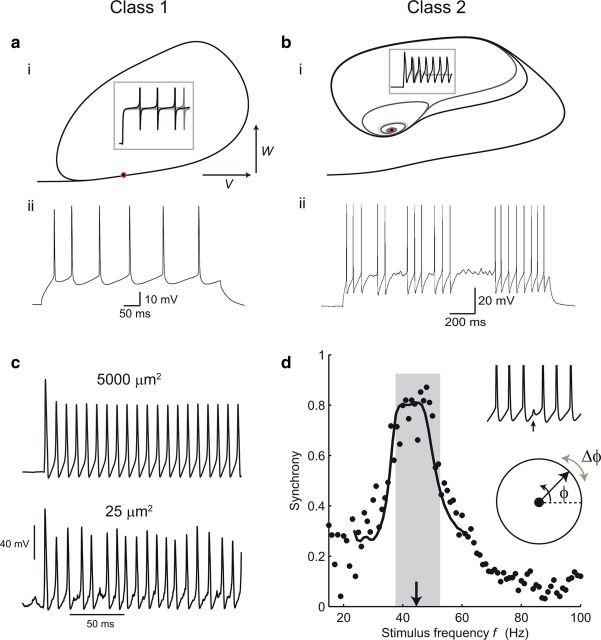
Applications of Hodgkin-Huxley theory to spike generation and timing in cortical neurons. Class 1 (a) and Class 2 (b) threshold dynamics. ai, The phase plane of the Morris-Lecar model with Class 1 dynamics shows an invariant cycle for responses to current steps just below and above threshold (in this case, all the phase plots lie on top of each other). V, Membrane potential; W, potassium activation or recovery variable. Inset, Voltage versus time responses (spikes are curtailed). Red circle indicates the coalesced fixed points at threshold. aii, Stable low-frequency firing in a nonpyramidal regular-spiking interneuron, which has a Class 1 threshold. bi, Morris-Lecar model with Class 2 parameters. Subthreshold responses spiral in to an attracting fixed point at which the Jacobian matrix of the dynamics has complex eigenvalues. Above threshold, this point becomes repelling. bii, A near-threshold response of a fast-spiking inhibitory interneuron switches between spiking at the threshold frequency and subthreshold oscillations, showing Class 2 behavior. c, Spiking in a stochastic Hodgkin-Huxley model simulated according to the method of Chow and White (1996). Reducing the membrane area and channel numbers results in a much more irregular and variable amplitude response. d, Synchronization can be predicted by phase-resetting functions. Periodic spiking is modeled as a phase variable φ with constant angular velocity (bottom inset). It is perturbed (Δφ) by synaptic inputs that change the interval to the next spike (top inset). The synaptic phase resetting function Δφ(φ) can be used to predict how well the cell synchronizes to inputs of different frequencies (main graph, synchrony is the order parameter—magnitude of the average phase vector—at the times of inputs). Black points are measured data, curve shows theoretical prediction. From Gouwens et al. (2010).
Figure 4.
Figure 4.
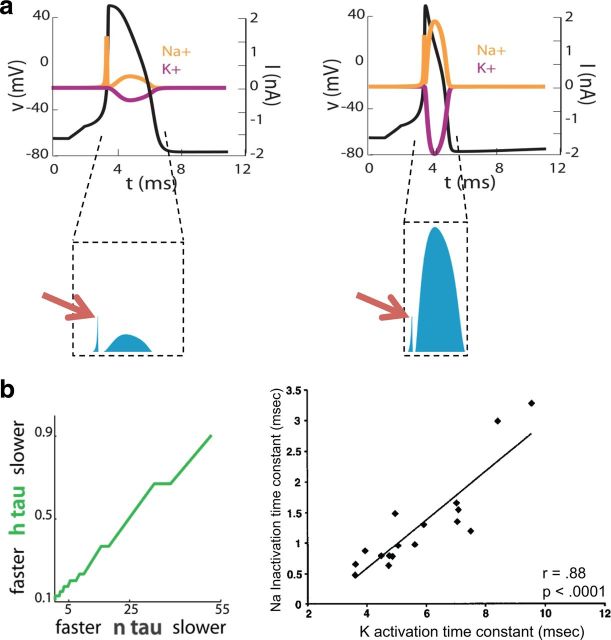
Single thin spikes are more energetically expensive than single thick spikes and the cost of a fast-spike train is minimized with fast sodium inactivation. a, Hodgkin-Huxley model of an action potential with a slow potassium activation superimposed on the resulting sodium (orange) and potassium currents (red), and the total number of transferred ions (blue). Right, Hodgkin-Huxley model of an action potential with a fast potassium activation has a thinner width and larger number of transferred ions (blue). b, The energy cost of a Hodgkin-Huxley model with fast spiking is minimized when the sodium inactivation speed is matched to the potassium activation speed. Adapted from Hasenstaub et al. (2010).

References

    1. Abbott LF. Balancing homeostasis and learning in neural circuits. Zoology (Jena) 2003;106:365–371. - PubMed
    1. Abouzeid A, Ermentrout B. Type-II phase resetting curve is optimal for stochastic synchrony. Phys Rev E Stat Nonlin Soft Matter Phys. 2009;80 011911. - PubMed
    1. Achard P, De Schutter E. Complex parameter landscape for a complex neuron model. PLoS Comput Biol. 2006;2:e94. - PMC - PubMed
    1. Afshari FS, Ptak K, Khaliq ZM, Grieco TM, Slater NT, McCrimmon DR, Raman IM. Resurgent Na currents in four classes of neurons in the cerebellum. J Neurophysiol. 2004;92:2831–2843. - PubMed
    1. Alle H, Roth A, Geiger JR. Energy-efficient action potentials in hippocampal mossy fibers. Science. 2009;325:1405–1408. - PubMed

Publication types

LinkOut - more resources