. 2012 Dec;86(24):13756-66.
doi: 10.1128/JVI.02341-12. Epub 2012 Oct 10.

Diversity and distribution of hantaviruses in South America

Affiliations

Diversity and distribution of hantaviruses in South America

Cadhla Firth et al. J Virol. 2012 Dec.

Abstract

Hantaviruses are important contributors to disease burden in the New World, yet many aspects of their distribution and dynamics remain uncharacterized. To examine the patterns and processes that influence the diversity and geographic distribution of hantaviruses in South America, we performed genetic and phylogeographic analyses of all available South American hantavirus sequences. We sequenced multiple novel and previously described viruses (Anajatuba, Laguna Negra-like, two genotypes of Castelo dos Sonhos, and two genotypes of Rio Mamore) from Brazilian Oligoryzomys rodents and hantavirus pulmonary syndrome cases and identified a previously uncharacterized species of Oligoryzomys associated with a new genotype of Rio Mamore virus. Our analysis indicates that the majority of South American hantaviruses fall into three phylogenetic clades, corresponding to Andes and Andes-like viruses, Laguna Negra and Laguna Negra-like viruses, and Rio Mamore and Rio Mamore-like viruses. In addition, the dynamics and distribution of these viruses appear to be shaped by both the geographic proximity and phylogenetic relatedness of their rodent hosts. The current system of nomenclature used in the hantavirus community is a significant impediment to understanding the ecology and evolutionary history of hantaviruses; here, we suggest strict adherence to a modified taxonomic system, with species and strain designations resembling the numerical system of the enterovirus genus.


Figures
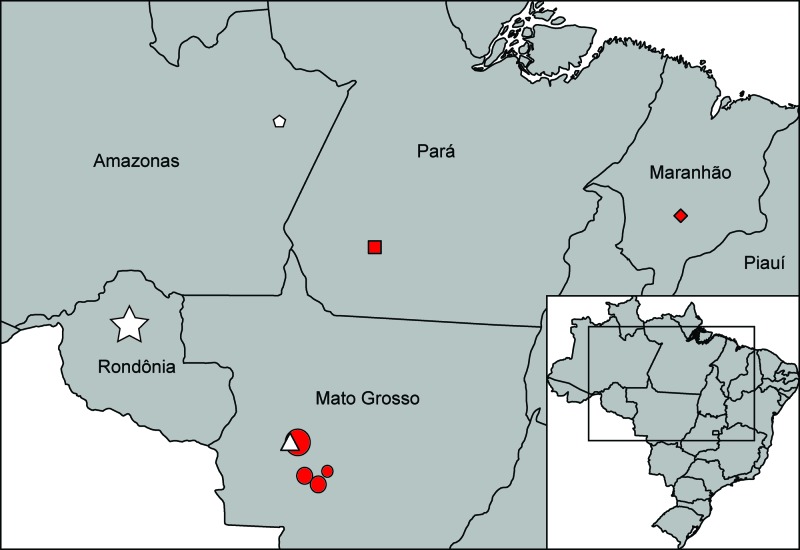
Fig 1
Fig 1
Map of Brazil indicating the sampling locations of the viruses sequenced in this study. HPS cases are indicated in red, and rodent samples are indicated in white. Viruses identified were ANJV (diamond), CASV (square), CASV-2 (triangle), LANV-2 (circle), RIOMV-3 (pentagon), and RIOMV-4 (star), where the size of the symbol is proportional to the number of samples from a given location.
Fig 2
Fig 2
Maximum likelihood phylogeny of the N (A) and GPC (B) genes from representatives of all available Sigmodontinae-borne hantaviruses, including those described here. Sequences generated in this study are shown in red, and the GPC genes with the WAVSA mutational variant in the signal peptidase cleavage site are indicated with an asterisk. Bootstrap values and Bayesian posterior probabilities are given above and below each node, respectively, for those nodes with BSV of ≥70 or BPP of ≥0.7. The tree is rooted relative to the position of Puumala virus (not shown). The viruses included in the N gene tree are as follows: ACPV (Andes Central Plata; GenBank accession no. EU564715, EU564719), ALPA (Alto Paraguay; DQ345762), ANDV (Andes; AF291702, AF004660), ANJV (Anajatuba; HM238887, HM238889), AAIV (Ape Aime Itapua; GU205340), ARQV (Araraquara; AF307325, EU170208), ARAUV (Araucaria; AY740628, HQ337907), BAYV (Bayou; L36929), BMJV (Bermejo; AF482713), BCCV (Black Creek Canal; L39949), BRV (Blue River; DQ090890), CADV (Cano Delgadito; DQ285566, EU939921), CARV (Carrizal; AB620093), CASV (Castelo dos Sonhos; AF307324, HQ719471), CATV (Catacamas; DQ256126), CHOV (Choclo; DQ285046), CCV (Convict Creek; L33816, U47135), ELMC (El Moro Canyon; U11427, U11429), FCV (Four Corners; U18098), ITPV 16 (Itapua 16; AY515594), ITPV 37 (Itapua 37; AY515595), ITPV 38 (Itapua 38; AY515596), JABV (Jabora; GU205339, JN232079), JUQV (Juquitiba; EF492472, GU213197), JUQV-like (Juquitiba-like; EU564724), LANV (Laguna Negra; AF005727), LANV-like (Laguna Negra-like; FJ816031), LECV (Lechiguanas; AF482714, EU564713), LSCV (Limestone Canyon; AF307322), MACV (Maciel; AF482716), MAPV (Maporal; FJ008979), MARV (Maripa; GQ179973), MTNV (Montano; AB620079, AB620092), MULV (Muleshoe; U54575), BMJV-NEBU (Neembucu; DQ345763), NYV (New York; U09488), ORNV (Oran; AF482715), PARV (Paranoa; EU643619, EU643620), PERV (Pergamino; AF482717), RIOMV (Rio Mamore; FJ532244, U52136), RIOMM (Rio Mearim; DQ451828), RIOSV (Rio Segundo; U18100), SNV (Sin Nombre; L25784, L37904), TUNV (Tunari; JF750417).
Fig 3
Fig 3
Maximum likelihood phylogeny of the cytochrome b genes of all available Oligoryzomys rodents. The sequences generated in this study are shown in red.
Fig 4
Fig 4
Geographic distribution of hantaviruses in the Andes clade and their hosts. Andes clade hantaviruses with sequences available in GenBank (black-outlined shapes) or generated in this study (red-outlined shapes) are shown along with corresponding host distributions from iucn.org. Viruses indicated are ACPV (triangle), ANDV (pentagon), ARAUV (hexagon), ARQV (star), BMJV (rounded square), BMJV-NEBU (oval), CASV (circle), CASV-2 (square), ITPV 37 (chevron), ITPV 38 (inverted triangle), JUQV (sun), LECV (rounded ex), MACV (diamond), ORNV (squared ex), PARV (cross), PERV (six-pointed star), TUNV (octagon), where the size of the symbol is proportional to the number of samples from a given location. Samples from HPS cases are indicated in black, while those from rodents are indicated in gray.
Fig 5
Fig 5
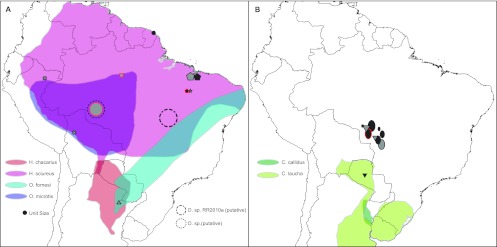
Geographic distribution of hantaviruses of the Rio Mamore (A) and Laguna Negra (B) clades and their hosts. Hantaviruses with sequences available on GenBank (black-outlined shapes) or generated in this study (red-outlined shapes) are shown, along with corresponding host distributions from iucn.org. Viruses indicated are ALPA (triangle), ANJV (pentagon), MARV (hexagon), RIOMMV (star), RIOMV (ex), RIOMV-3 (square), and RIOMV-4 (circle) (A) and LANV (inverted triangle), LANV-like (sun), and LANV-2 (oval) (B), where the size of the symbol is proportional to the number of samples from a given location. Samples from HPS cases are indicated in black, while those from rodents are indicated in gray.

References

    1. Arai S, et al. 2008. Molecular phylogeny of a newfound hantavirus in the Japanese shrew mole (Urotrichus talpoides). Proc. Natl. Acad. Sci. U. S. A. 105:16296–16301 - PMC - PubMed
    1. Baele G, et al. 7 March 2012. Improving the accuracy of demographic and molecular clock model comparison while accommodating phylogenetic uncertainty. Mol. Biol. Evol. [Epub ahead of print.] doi:10.1093/molbev/mss084 - DOI - PMC - PubMed
    1. Bharadwaj M, Botten J, Torrez-Martinez N, Hjelle B. 1997. Rio Mamore virus: genetic characterization of a newly recognized hantavirus of the pygmy rice rat, Oligoryzomys microtis, from Bolivia. Am. J. Trop. Med. Hyg. 57:368–374 - PubMed
    1. Bohlman MC, et al. 2002. Analysis of hantavirus genetic diversity in Argentina: S segment-derived phylogeny. J. Virol. 76:3765–3773 - PMC - PubMed
    1. Campos GM, et al. 2003. Serological survey of hantavirus in Jardinopolis County, Brazil. J. Med. Virol. 71:417–422 - PubMed

Publication types

LinkOut - more resources