


Brain mechanisms underlying automatic and unconscious control of motor action
- PMID: 23055963
- PMCID: PMC3458240
- DOI: 10.3389/fnhum.2012.00265
Brain mechanisms underlying automatic and unconscious control of motor action
Abstract
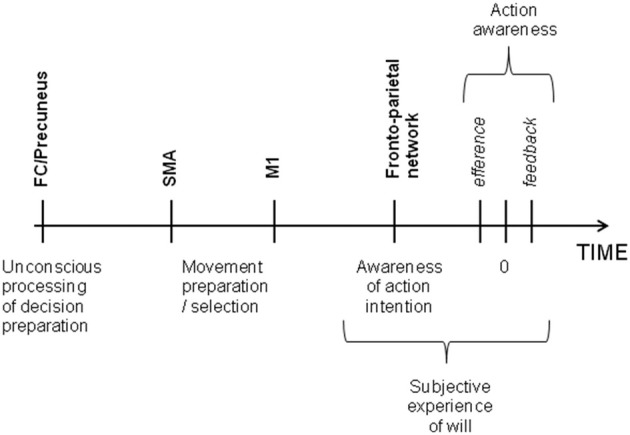
Are we in command of our motor acts?The popular belief holds that our conscious decisions are the direct causes of our actions. However, overwhelming evidence from neurosciences demonstrates that our actions are instead largely driven by brain processes that unfold outside of our consciousness. To study these brain processes, scientists have used a range of different functional brain imaging techniques and experimental protocols, such as subliminal priming. Here, we review recent advances in the field and propose a theoretical model of motor control that may contribute to a better understanding of the pathophysiology of movement disorders such as Parkinson's disease.
Keywords: Parkinson disease; inhibition; motor control; neuroimaging; priming; subliminal; unconscious; volition.
Figures
References
-
- Aron A. R., Schlaghecken F., Fletcher P. C., Bullmore E. T., Eimer M., Barker R., Sahakian B. J., Robbins T. W. (2003). Inhibition of subliminally primed responses is mediated by the caudate and thalamus: evidence from functional MRI and Huntington's disease. Brain 126, 713–723 10.1093/brain/awg067 - DOI - PMC - PubMed
-
- Aron A. R., Wise S. P., Poldrack R. A. (2009). Cognition: basal ganglia role, in The New Encyclopedia of Neuroscience, ed Squire L. R. (Oxford: Academic Press; ), 1069–1077
LinkOut - more resources
Full Text Sources
