. 2012 Sep 26:3:346.
doi: 10.3389/fmicb.2012.00346. eCollection 2012.

Interaction of the pathogenic mold Aspergillus fumigatus with lung epithelial cells

Affiliations

Interaction of the pathogenic mold Aspergillus fumigatus with lung epithelial cells

Nir Osherov. Front Microbiol. .

Abstract

Aspergillus fumigatus is an opportunistic environmental mold that can cause severe allergic responses in atopic individuals and poses a life-threatening risk for severely immunocompromised patients. Infection is caused by inhalation of fungal spores (conidia) into the lungs. The initial point of contact between the fungus and the host is a monolayer of lung epithelial cells. Understanding how these cells react to fungal contact is crucial to elucidating the pathobiology of Aspergillus-related disease states. The experimental systems, both in vitro and in vivo, used to study these interactions, are described. Distinction is made between bronchial and alveolar epithelial cells. The experimental findings suggest that lung epithelial cells are more than just "innocent bystanders" or a purely physical barrier against infection. They can be better described as an active extension of our innate immune system, operating as a surveillance mechanism that can specifically identify fungal spores and activate an offensive response to block infection. This response includes the internalization of adherent conidia and the release of cytokines, antimicrobial peptides, and reactive oxygen species. In the case of allergy, lung epithelial cells can dampen an over-reactive immune response by releasing anti-inflammatory compounds such as kinurenine. This review summarizes our current knowledge regarding the interaction of A. fumigatus with lung epithelial cells. A better understanding of the interactions between A. fumigatus and lung epithelial cells has therapeutic implications, as stimulation or inhibition of the epithelial response may alter disease outcome.

Keywords: Aspergillus fumigatus; innate immunity; lung epithelial cells.


Figures
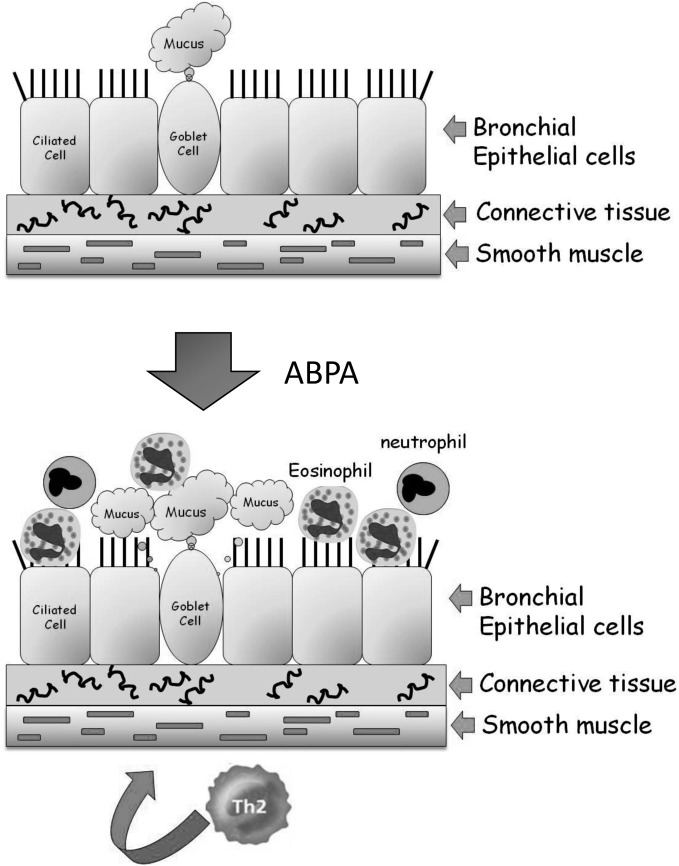
Figure 1
Figure 1
Structure of the lung airways and the development of ABPA. The major epithelial cell types in the airways are the ciliated, goblet, and basal cells. They are attached to connective tissue that is surrounded by a band of smooth muscle cells. In ABPA, a Th2-mediated response to inhaled A. fumigatus conidia results in enhanced mucus production and the influx of eosinophils and neutrophils from the bloodstream into the airway. These cells inflame and damage the airway, resulting in tissue fibrosis and subsequently bronchiectasis.
Figure 2
Figure 2
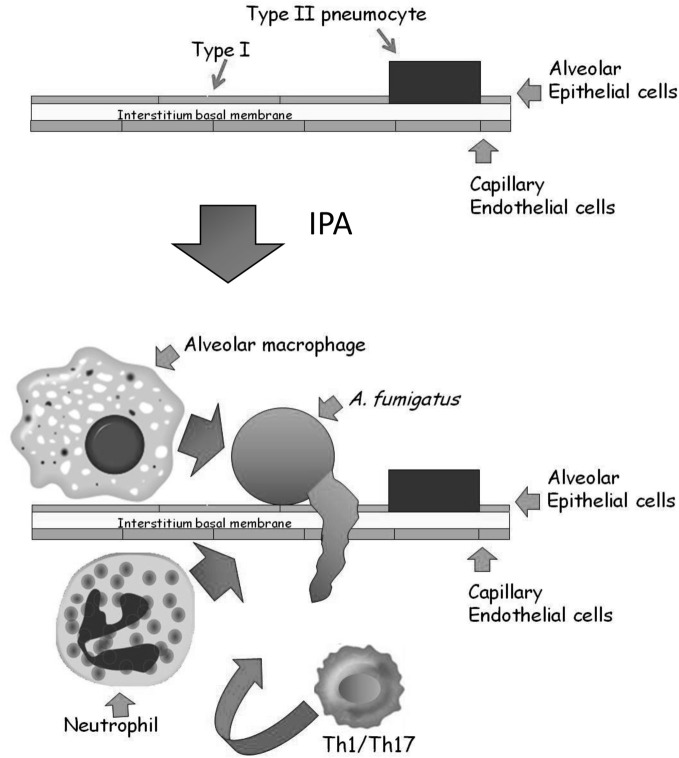
Structure of the alveolus and the development of IPA. The major epithelial cell types of the alveolus are the type I and type II pneumocytes. They are attached to a thin basal membrane composed of laminin, collagen, and fibronectin. A single layer of capillary endothelial cells is attached to the lower side of the basal membrane, lining the blood vessel. In IPA, inhaled conidia germinate on the alveolar surface. Immunocompromised patients cannot mount an effective Th1/Th17 based cellular response involving resident alveolar macrophages and infiltrating neutrophils, resulting in conidial germination and hyphal penetration through the thin alveolar wall. Subsequently, profuse hyphal growth blocks the underlying blood vessels, leading to tissue necrosis and ultimately death.
Figure 3
Figure 3
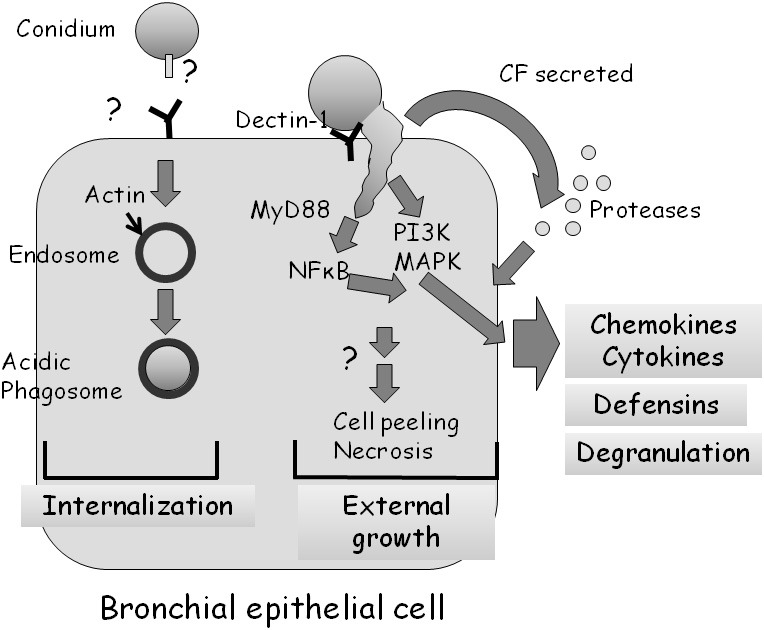
Interaction of A. fumigatus with a bronchial epithelial cell. Approximately 30% of adherent A. fumigatus conidia undergo internalization into endosomes which subsequently fuse to form acidic phagosomes. This process is dependent on the polymerization of actin around the endosome. Most ingested cells remain alive in the acidic phagosomes for up to 20 h. Approximately 70% of adherent A. fumigatus conidia germinate externally, activating MyD-dependent NFkB, PI3 kinase, and MAP kinase signaling, leading to chemokine and cytokine synthesis in a dectin-1 dependent manner. A. fumigatus infection also stimulates, through as yet unknown signaling pathways, the production of antimicrobial defensins and cell degranulation. Proteases secreted by the fungus also activate the production of cytokines.
Figure 4
Figure 4
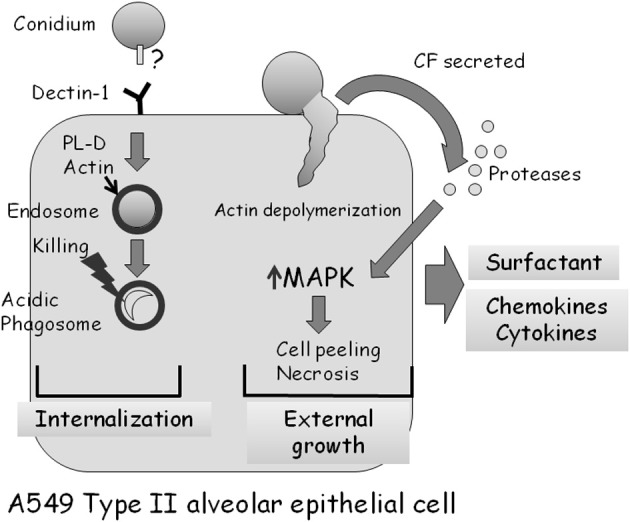
Interaction of A. fumigatus with an A549 type II alveolar epithelial cell. Approximately 30% of adherent A. fumigatus conidia are internalized into endosomes which subsequently fuse to form acidic phagosomes. This process is dependent on dectin 1 receptors on the cell surface, and the phospholipase-D dependent polymerization of actin around the endosome. Most (97%) ingested conidia are killed in the acidic phagosomes after 24 h. Approximately 70% of adherent A. fumigatus conidia germinate externally, causing actin cytoskeleton depolymerization and cell retraction. Proteases secreted by the fungus activate MAP-kinase signaling, leading to the production of cytokines and subsequently cell death by necrosis.

References

    1. Alekseeva L., Huet D., Femenia F., Mouyna I., Abdelouahab M., Cagna A., Guerrier D., Tichanne-Seltzer V., Baeza-Squiban A., Chermette R., Latge J. P., Berkova N. (2009). Inducible expression of beta defensins by human respiratory epithelial cells exposed to Aspergillus fumigatus organisms. BMC Microbiol. 9, 33 10.1186/1471-2180-9-33 - DOI - PMC - PubMed
    1. Al-Nakeeb Z., Sudan A., Jeans A. R., Gregson L., Goodwin J., Warn P. A., Felton T. W., Howard S. J., Hope W. W. (2012). Pharmacodynamics of itraconazole against Aspergillus fumigatus in an in vitro model of the human alveolus: perspectives on the treatment of triazole resistant infection and utility of airway administration. Antimicrobial Agents Chemother. 56, 4146–4153 10.1128/AAC.00141-12 - DOI - PMC - PubMed
    1. Amitani R., Kawanami R. (2009). Interaction of Aspergillus with human respiratory mucosa: a study with organ culture model. Med. Mycol. 47(Suppl. 1), S127–S131 10.1080/13693780802558959 - DOI - PubMed
    1. Amitani R., Taylor G., Elezis E. N., Llewellyn-Jones C., Mitchell J., Kuze F., Cole P. J., Wilson R. (1995). Purification and characterization of factors produced by Aspergillus fumigatus which affect human ciliated respiratory epithelium. Infect. Immun. 63, 3266–3271 - PMC - PubMed
    1. Aujla S. J., Chan Y. R., Zheng M., Fei M., Askew D. J., Pociask D. A., Reinhart T. A., McAllister F., Edeal J., Gaus K., Husain S., Kreindler J. L., Dubin P. J., Pilewski J. M., Myerburg M. M., Mason C. A., Iwakura Y., Kolls J. K. (2008). IL-22 mediates mucosal host defense against gram-negative bacterial pneumonia. Nat. Med. 14, 275–281 10.1038/nm1710 - DOI - PMC - PubMed

LinkOut - more resources