


Microbial control over carbon cycling in soil
- PMID: 23055998
- PMCID: PMC3458434
- DOI: 10.3389/fmicb.2012.00348
Microbial control over carbon cycling in soil
Abstract
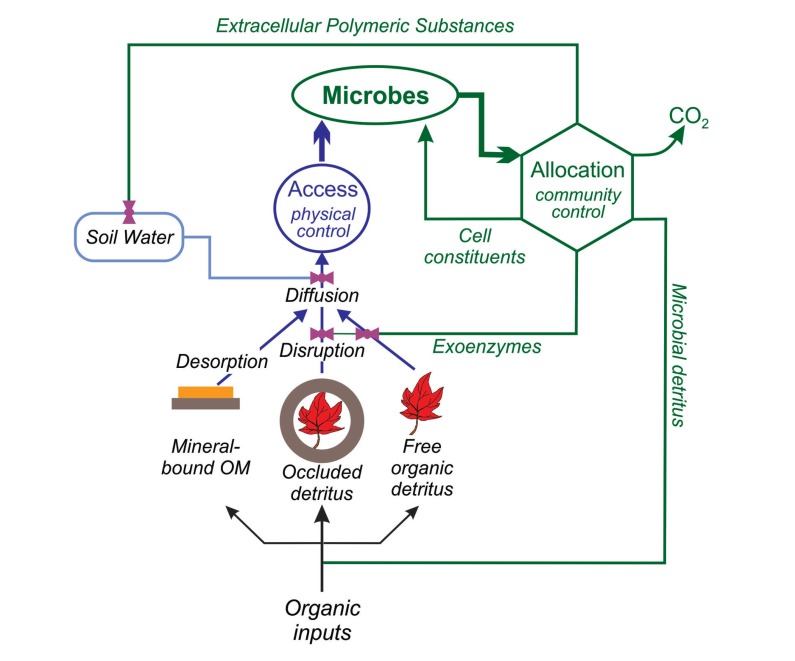
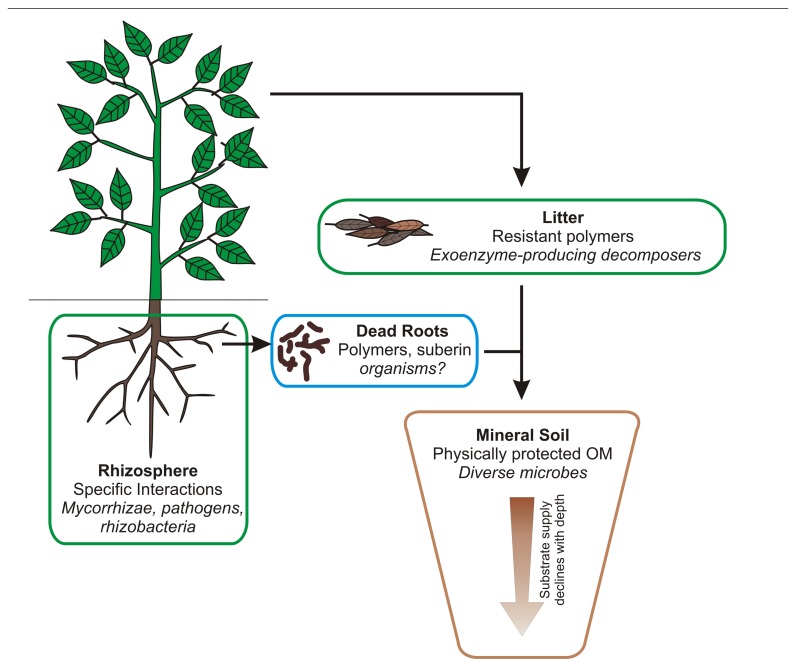
A major thrust of terrestrial microbial ecology is focused on understanding when and how the composition of the microbial community affects the functioning of biogeochemical processes at the ecosystem scale (meters-to-kilometers and days-to-years). While research has demonstrated these linkages for physiologically and phylogenetically "narrow" processes such as trace gas emissions and nitrification, there is less conclusive evidence that microbial community composition influences the "broad" processes of decomposition and organic matter (OM) turnover in soil. In this paper, we consider how soil microbial community structure influences C cycling. We consider the phylogenetic level at which microbes form meaningful guilds, based on overall life history strategies, and suggest that these are associated with deep evolutionary divergences, while much of the species-level diversity probably reflects functional redundancy. We then consider under what conditions it is possible for differences among microbes to affect process dynamics, and argue that while microbial community structure may be important in the rate of OM breakdown in the rhizosphere and in detritus, it is likely not important in the mineral soil. In mineral soil, physical access to occluded or sorbed substrates is the rate-limiting process. Microbial community influences on OM turnover in mineral soils are based on how organisms allocate the C they take up - not only do the fates of the molecules differ, but they can affect the soil system differently as well. For example, extracellular enzymes and extracellular polysaccharides can be key controls on soil structure and function. How microbes allocate C may also be particularly important for understanding the long-term fate of C in soil - is it sequestered or not?
Keywords: carbon; diversity; litter; microbial communities; roots; soil.
Figures
References
-
- Allison S. D. (2005). Cheaters, diffusion and nutrients constrain decomposition by microbial enzymes in spatially structured environments. Ecol. Lett. 8 626–635
-
- Allison S. D., Wallenstein M. D., Bradford M. A. (2010). Soil-carbon response to warming dependent on microbial physiology. Nat. Geosci. 3 336–340
-
- Aneja M. K., Sharma S., Munch J. C., Schloter M. (2004). RNA fingerprinting – a new method to screen for differences in plant litter degrading microbial communities. J. Microbiol. Methods 59 223–231 - PubMed
-
- Austin A. T., Vivanco L. (2006). Plant litter decomposition in a semi-arid ecosystem controlled by photodegradation. Nature 442 555–558 - PubMed
LinkOut - more resources
Full Text Sources
