


Repeatability of and relationship between potential COPD biomarkers in bronchoalveolar lavage, bronchial biopsies, serum, and induced sputum
- PMID: 23056262
- PMCID: PMC3464239
- DOI: 10.1371/journal.pone.0046207
Repeatability of and relationship between potential COPD biomarkers in bronchoalveolar lavage, bronchial biopsies, serum, and induced sputum
Abstract
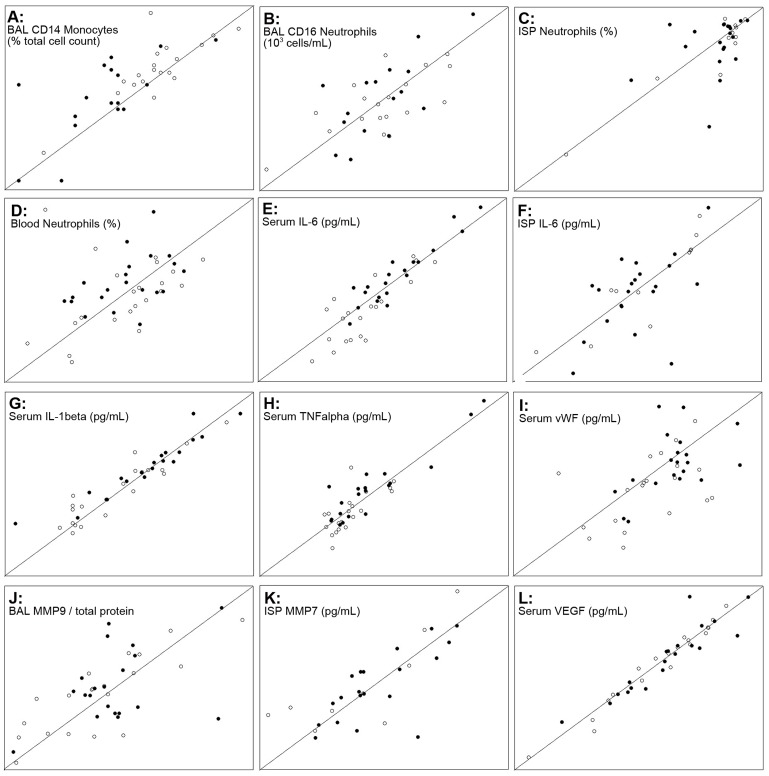
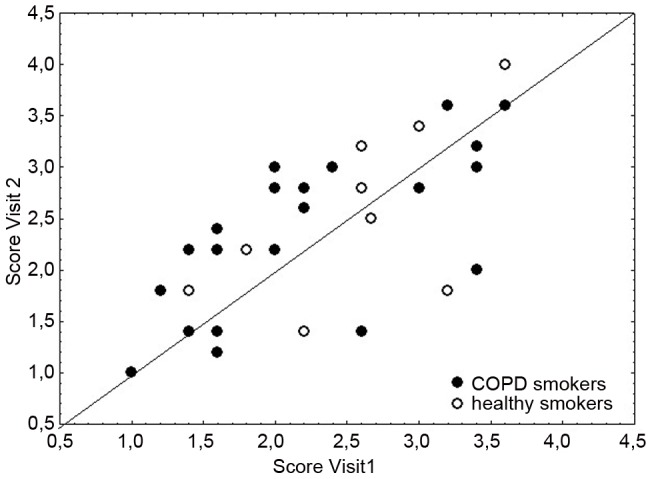
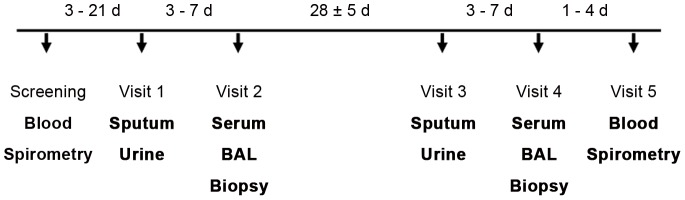
Chronic Obstructive Pulmonary Disease (COPD) is a chronic inflammatory disease, primarily affecting the airways. Stable biomarkers characterizing the inflammatory phenotype of the disease, relevant for disease activity and suited to predict disease progression are needed to monitor the efficacy and safety of drug interventions. We therefore analyzed a large panel of markers in bronchoalveolar lavage, bronchial biopsies, serum and induced sputum of 23 healthy smokers and 24 smoking COPD patients (GOLD II) matched for age and gender. Sample collection was performed twice within a period of 6 weeks. Assays for over 100 different markers were validated for the respective matrices prior to analysis. In our study, we found 51 markers with a sufficient repeatability (intraclass correlation coefficient >0.6), most of these in serum. Differences between groups were observed for markers from all compartments, which extends (von-Willebrand-factor) and confirms (e.g. C-reactive-protein, interleukin-6) previous findings. No correlations between lung and serum markers were observed, including A1AT. Airway inflammation defined by sputum neutrophils showed only a moderate repeatability. This could be improved, when a combination of neutrophils and four sputum fluid phase markers was used to define the inflammatory phenotype.In summary, our study provides comprehensive information on the repeatability and interrelationship of pulmonary and systemic COPD-related markers. These results are relevant for ongoing large clinical trials and future COPD research. While serum markers can discriminate between smokers with and without COPD, they do not seem to sufficiently reflect the disease-associated inflammatory processes within the airways.
Conflict of interest statement
Figures
References
-
- Cazzola M, MacNee W, Martinez FJ, Rabe KF, Franciosi LG, et al. (2008) Outcomes for COPD pharmacological trials: from lung function to biomarkers. Eur Respir J 31: 416–469. - PubMed
-
- Petty TL (2002) COPD in perspective. Chest 121: 116S–120S. - PubMed
-
- Eickhoff P, Valipour A, Kiss D, Schreder M, Cekici L, et al. (2008) Determinants of systemic vascular function in patients with stable chronic obstructive pulmonary disease. Am J Respir Crit Care Med 178: 1211–1218. - PubMed
-
- [Anonymous] (2010) From the Global Strategy for the Diagnosis, Management and Prevention of COPD, Global Initiative for Chronic Obstructive Lung Disease (GOLD) 2010. -Available: http://www.goldcopd.com/. Accessed: September 6th, 2012).
Publication types
MeSH terms
Substances
LinkOut - more resources
Full Text Sources
Medical
Research Materials
