


Can hospital audit teams identify case management problems, analyse their causes, identify and implement improvements? A cross-sectional process evaluation of obstetric near-miss case reviews in Benin
- PMID: 23057707
- PMCID: PMC3561203
- DOI: 10.1186/1471-2393-12-109
Can hospital audit teams identify case management problems, analyse their causes, identify and implement improvements? A cross-sectional process evaluation of obstetric near-miss case reviews in Benin
Abstract
Background: Obstetric near-miss case reviews are being promoted as a quality assurance intervention suitable for hospitals in low income countries. We introduced such reviews in five district, regional and national hospitals in Benin, West Africa. In a cross-sectional study we analysed the extent to which the hospital audit teams were able to identify case management problems (CMPs), analyse their causes, agree on solutions and put these solutions into practice.
Methods: We analysed case summaries, women's interview transcripts and audit minutes produced by the audit teams for 67 meetings concerning one woman with near-miss complications each. We compared the proportion of CMPs identified by an external assessment team to the number found by the audit teams. For the latter, we described the CMP causes identified, solutions proposed and implemented by the audit teams.
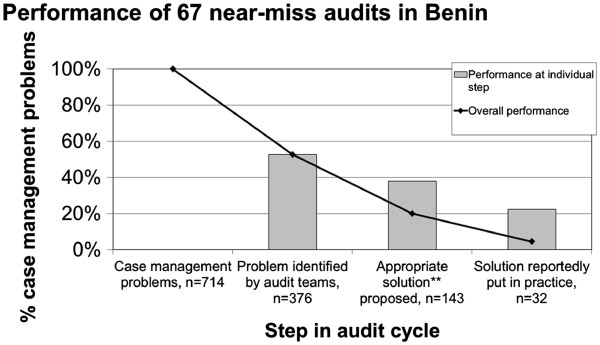
Results: Audit meetings were conducted regularly and were well attended. Audit teams identified half of the 714 CMPs; they were more likely to find managerial ones (71%) than the ones relating to treatment (30%). Most identified CMPs were valid. Almost all causes of CMPs were plausible, but often too superficial to be of great value for directing remedial action. Audit teams suggested solutions, most of them promising ones, for 38% of the CMPs they had identified, but recorded their implementation only for a minority (8.5%).
Conclusions: The importance of following-up and documenting the implementation of solutions should be stressed in future audit interventions. Tools facilitating the follow-up should be made available. Near-miss case reviews hold promise, but their effectiveness to improve the quality of care sustainably and on a large scale still needs to be established.
Figures

References
-
- WHO. Essential obstetric care. http://www.who.int/mediacentre/factsheets/fs245/en/index.html.
-
- Gohou V, Ronsmans C, Kacou L, Yao K, Bohoussou KM, Houphouet B, Bosso P, Diarra-Nama AJ, Bacci A, Filippi V. Responsiveness to life-threatening obstetric emergencies in two hospitals in Abidjan, Côte d'Ivoire. Trop Med Int Health. 2004;9:406–415. doi: 10.1111/j.1365-3156.2004.01204.x. - DOI - PubMed
Publication types
MeSH terms
LinkOut - more resources
Full Text Sources
Medical
