


The impact of peer victimization on later maladjustment: mediating and moderating effects of hostile and self-blaming attributions
- PMID: 23057732
- PMCID: PMC3527635
- DOI: 10.1111/j.1469-7610.2012.02618.x
The impact of peer victimization on later maladjustment: mediating and moderating effects of hostile and self-blaming attributions
Abstract
Background: Evidence indicates that being a victim of bullying or peer aggression has negative short- and long-term consequences. In this study, we investigated the mediating and moderating role of two types of attributional mechanisms (hostile and self-blaming attributions) on children's maladjustment (externalizing and internalizing problems).
Methods: In total, 478 children participated in this longitudinal study from grade 5 to grade 7. Children, parents, and teachers repeatedly completed questionnaires. Peer victimization was assessed through peer reports (T1). Attributions were assessed through self-reports using hypothetical scenarios (T2). Parents and teachers reported on children's maladjustment (T1 and T3).
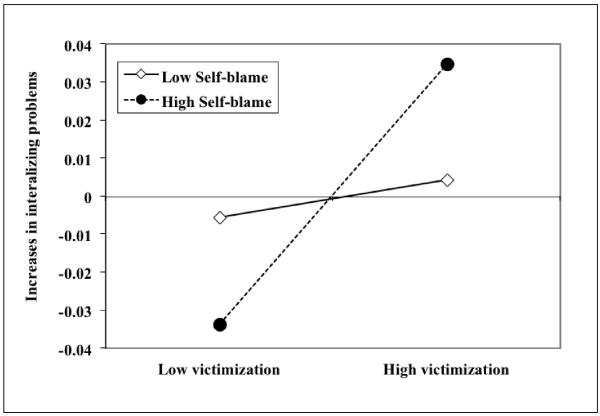
Results: Peer victimization predicted increases in externalizing and internalizing problems. Hostile attributions partially mediated the impact of victimization on increases in externalizing problems. Self-blame was not associated with peer victimization. However, for children with higher levels of self-blaming attributions, peer victimization was linked more strongly with increases in internalizing problems.
Conclusions: Results imply that hostile attributions may operate as a potential mechanism through which negative experiences with peers lead to increases in children's aggressive and delinquent behavior, whereas self-blame exacerbates victimization's effects on internalizing problems.
© 2012 The Authors. Journal of Child Psychology and Psychiatry © 2012 Association for Child and Adolescent Mental Health.
Figures

References
-
- Abramson LY, Alloy LB, Hankin BL, Haeffel GJ, MacCoon DG, Gibb BE, Gotlib IH, Hammen CL. Cognitive vulnerability-stress models of depression in a self-regulatory and psychobiological context. Guilfor; New York: 2002. pp. 268–294.
-
- Abramson LY, Sackheim HA. A paradox in depression: Uncontrollability and self-blame. Psychological Bulletin. 1977;84(5):838. - PubMed
-
- Achenbach TM. Integrative guide for the 1991 CBCL/4-18, YSR, and TRF profiles. University of Vermont, Department of Psychiatry; Burlington, VT: 1991.
-
- Aiken LS, West SG, Reno RR. Multiple regression: Testing and interpreting interactions. Sage Publications, Inc.; 1991.
-
- Alsaker FD. Lessons learned from research in kindergarten. Paper presented at the Biennial Meeting of the European Society for Developmental Psychology (Keynote address); Bergen, Norway. 2011.
Publication types
MeSH terms
Grants and funding
LinkOut - more resources
Full Text Sources
Medical
Research Materials
