. 2012 Oct 11:12:190.
doi: 10.1186/1471-2229-12-190.

Functional analysis and binding affinity of tomato ethylene response factors provide insight on the molecular bases of plant differential responses to ethylene

Affiliations

Functional analysis and binding affinity of tomato ethylene response factors provide insight on the molecular bases of plant differential responses to ethylene

Julien Pirrello et al. BMC Plant Biol. .

Abstract

Background: The phytohormone ethylene is involved in a wide range of developmental processes and in mediating plant responses to biotic and abiotic stresses. Ethylene signalling acts via a linear transduction pathway leading to the activation of Ethylene Response Factor genes (ERF) which represent one of the largest gene families of plant transcription factors. How an apparently simple signalling pathway can account for the complex and widely diverse plant responses to ethylene remains yet an unanswered question. Building on the recent release of the complete tomato genome sequence, the present study aims at gaining better insight on distinctive features among ERF proteins.

Results: A set of 28 cDNA clones encoding ERFs in the tomato (Solanum lycopersicon) were isolated and shown to fall into nine distinct subclasses characterised by specific conserved motifs most of which with unknown function. In addition of being able to regulate the transcriptional activity of GCC-box containing promoters, tomato ERFs are also shown to be active on promoters lacking this canonical ethylene-responsive-element. Moreover, the data reveal that ERF affinity to the GCC-box depends on the nucleotide environment surrounding this cis-acting element. Site-directed mutagenesis revealed that the nature of the flanking nucleotides can either enhance or reduce the binding affinity, thus conferring the binding specificity of various ERFs to target promoters.Based on their expression pattern, ERF genes can be clustered in two main clades given their preferential expression in reproductive or vegetative tissues. The regulation of several tomato ERF genes by both ethylene and auxin, suggests their potential contribution to the convergence mechanism between the signalling pathways of the two hormones.

Conclusions: The data reveal that regions flanking the core GCC-box sequence are part of the discrimination mechanism by which ERFs selectively bind to their target promoters. ERF tissue-specific expression combined to their responsiveness to both ethylene and auxin bring some insight on the complexity and fine regulation mechanisms involving these transcriptional mediators. All together the data support the hypothesis that ERFs are the main component enabling ethylene to regulate a wide range of physiological processes in a highly specific and coordinated manner.


Figures
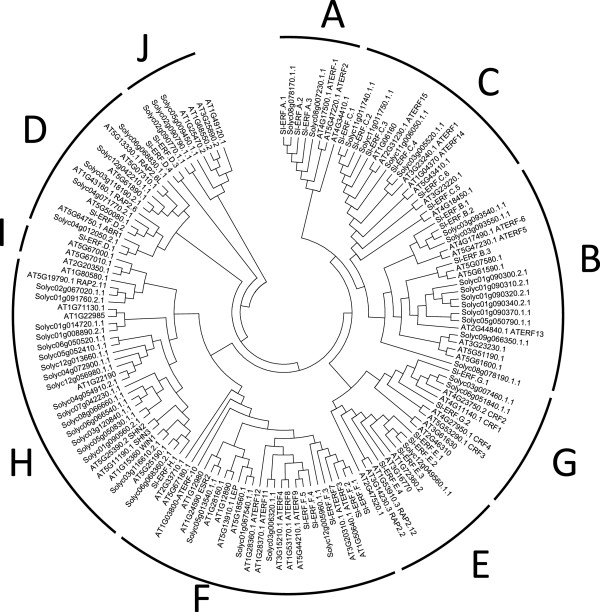
Figure 1
Figure 1
Phylogenetic tree of Arabidopsis and Tomato ERFs. Different subclasses are named by letters (A to J). Tomato genes for which the corresponding cDNA has been successfully isolated and that were subjected to functional analysis in this paper are named using the Sl-ERF nomenclature (Additional file 1) while other tomato ERFs are named using International Tomato Annotation Genome (ITAG 2.3) nomenclature. Phylogenetic trees were constructed with the whole protein sequences using neighbour joining method.
Figure 2
Figure 2
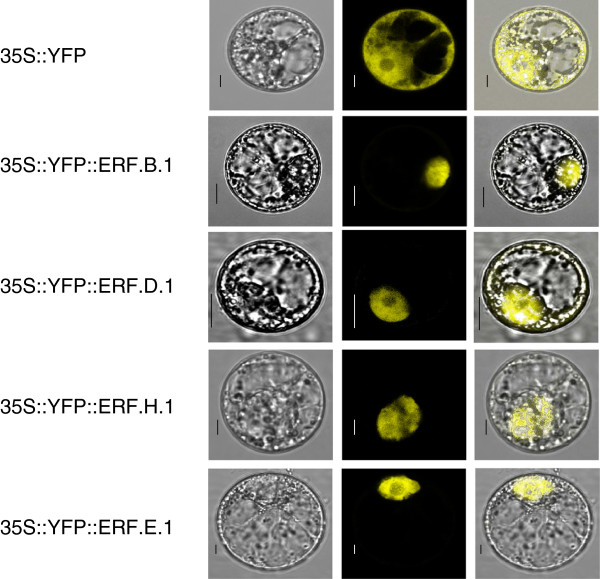
Subcellular localization of Sl-ERFs. ERF.B.1, ERF.D.1, ERF.E.1 and ERF.H.1 proteins were fused to the YFP (Yellow Fluorescent Protein) in the N-terminal region and the chimerical proteins were transiently expressed in BY-2 tobacco protoplasts under the control of the 35S promoter. Subcellular localization was then analyzed by confocal laser scanning microscopy. The merged pictures of the yellow fluorescence channel (middle panels) and the corresponding bright field (left panels) are shown (right panels). Control cells expressing YFP alone are shown in the top panel. The scale bar indicates 10 μm.
Figure 3
Figure 3
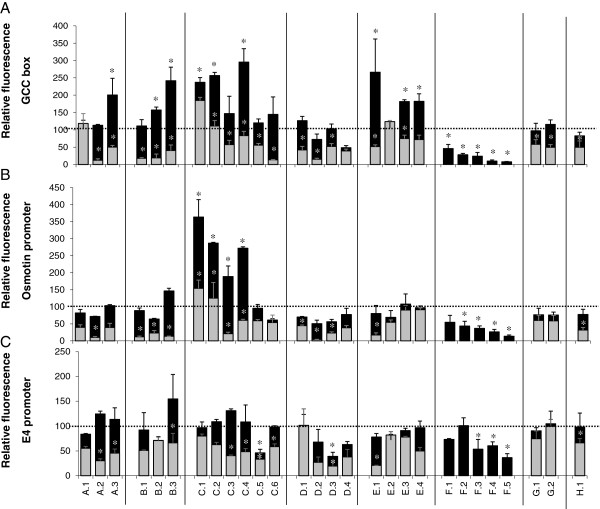
ERF-mediated transcription from native and synthetic promoters. Transient expression in single cell system has been used to assess the transcriptional activity of ERF proteins from different subclasses. The fluorescence of the reporter gene was measured by flow cytometry upon co-transfection with a reporter construct (GCC:: GFP or Sl-Osmotin Promoter:: GFP or Sl-E4promoter:: GFP) and an effector construct (35S::Sl-ERF or 35S::Sl-ERF-SRDX). The basal fluorescence obtained in the assay transfected with the reporter construct and an empty effector construct was taken as reference (100 % relative fluorescence). (A) ERF activity on synthetic promoter containing 4 direct repeats of the GCC-box. (B) ERF activity on osmotin native promoter containing the canonical GCC motif. (C) ERF activity on E4 native promoter lacking the GCC motif. The results are mean of 3 independent biological replicates. Analysis of variance (ANOVA) was performed to determine the effect of the subclass on ERF activity (p<0.05). The Mann–Whitney test indicates significant result (p<0.05). Black and gray Bars indicate relative fluorescence obtained with native or repression version of each ERF, respectively. Bars indicate SE of the mean.
Figure 4
Figure 4
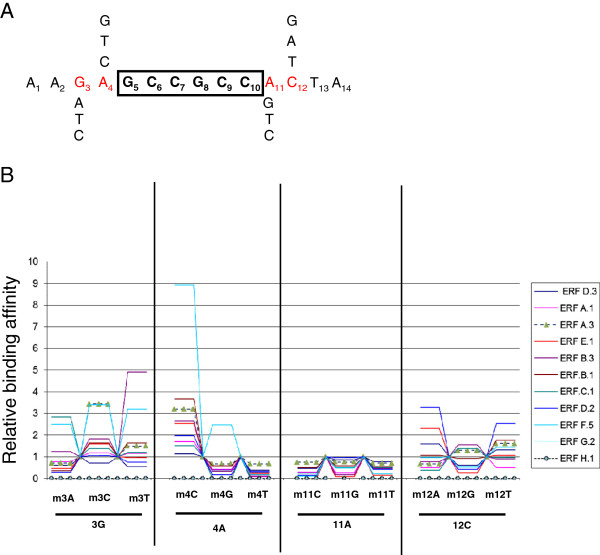
Binding affinity of ERFs to the GCC-box is impacted by the nucleotide composition of the flanking regions. (A) To assess the role of the nucleotide composition of the close environment of the GCC box, nucleotides flanking the chitinase GCC box were mutated. Different mutated GCC boxes were used as probe in gel shift assay to test the binding affinity of ERFs. (B) Binding affinity of ERFs to the mutated probes. Relative affinity is calculated with non mutated Sl-Chitinase (Solyc10g055810.1) as reference. The data are mean of 3 independent replicates. Analysis of variance with the R package reveals that the flanking region of the GCC box is significantly involved in the affinity of the binding (p<0.05).
Figure 5
Figure 5
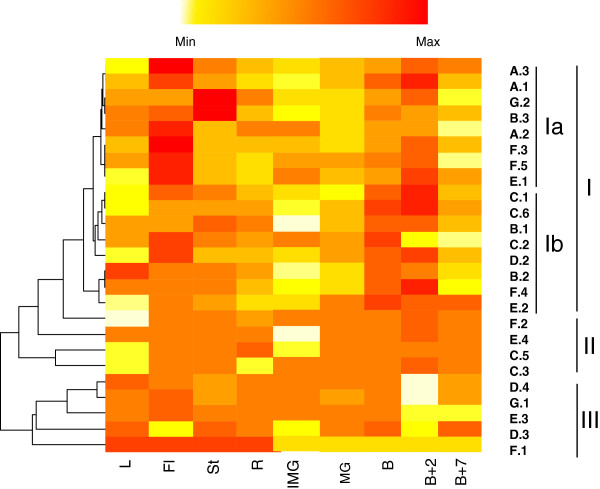
Heatmap representation of the expression of ERF genes in different tomato tissues. The data obtained by quantitative RT-PCR correspond to the levels of ERF transcripts in total RNA samples extracted from Roots (R), Leaves (L), Stem (St), Flower (Fl), Early Immature Green (IMG), Mature Green (MG), Breaker (B), Breaker + 2 days (B+2), Breaker + 7 days (B+7). The data presented correspond to 3 independent biological repetitions. Red and white colours correspond to high and weak expression of the ERF genes, respectively. Heat map was generated using R software.
Figure 6
Figure 6
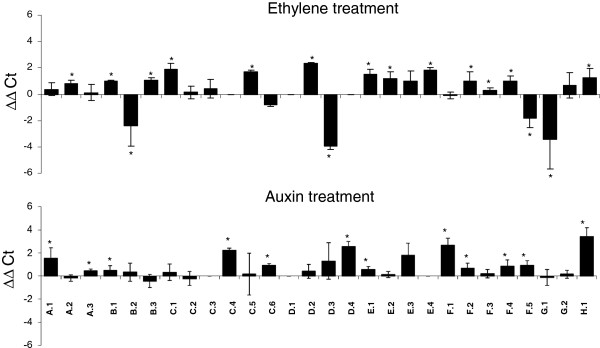
Expression of ERFs in response to ethylene and auxin treatments. Quantitative RT-PCR of ERF transcripts in total RNA samples extracted from 5-days dark growing seedlings treated for 5 hours with ethylene or with IAA for 3 hours. ΔΔCt refers to the fold of difference in ERF expression relative to the untreated seedlings. Stars indicate a statistical significance (p<0.05) using Mann-Withney test.

References

    1. Bleecker AB, Kende H. Ethylene: a gaseous signal molecule in plants. Annu Rev Cell Dev Biol. 2000;16:1–18. - PubMed
    1. Johnson PR, Ecker JR. The ethylene gas signal transduction pathway: a molecular perspective. Annu Rev Genet. 1998;32:227–254. - PubMed
    1. Pirrello J, Jaimes-Miranda F, Sanchez-Ballesta MT, Tournier B, Khalil-Ahmad Q, Regad F, Latché A, Pech JC, Bouzayen M. Sl-ERF2, a tomato ethylene response factor involved in ethylene response and seed germination. Plant Cell Physiol. 2006;47:1195–1205. - PubMed
    1. Benavente LM, Alonso JM. Molecular mechanisms of ethylene signaling in Arabidopsis. Mol Biosyst. 2006;2:165–173. - PubMed
    1. Ohme-Takagi M, Shinshi H. Ethylene-inducible DNA binding proteins that interact with an ethylene-responsive element. Plant Cell. 1995;7:173–182. - PMC - PubMed

Publication types

MeSH terms

LinkOut - more resources