


Blood lead concentration is not altered by high-dose vitamin D supplementation in children and young adults with HIV
- PMID: 23059649
- PMCID: PMC4132882
- DOI: 10.1097/MPG.0b013e3182758c4a
Blood lead concentration is not altered by high-dose vitamin D supplementation in children and young adults with HIV
Abstract
Objectives: Optimal vitamin D status is known to have beneficial health effects and vitamin D supplements are commonly used. It has been suggested that vitamin D supplementation may increase blood lead in children and adults with previous lead exposure. The objective was to determine the safety regarding lead toxicity during 12 weeks of high-dose vitamin D3 supplementation in children and young adults with human immunodeficiency virus (HIV).
Methods: Subjects with HIV (8-24 years) were randomized to vitamin D3 supplementation of 4000 or 7000 IU/day and followed at 6 and 12 weeks for changes in serum 25-hydroxy vitamin D (25D) and whole-blood lead concentration. This was a secondary analysis of a larger study of vitamin D3 supplementation in children and adolescents with HIV.
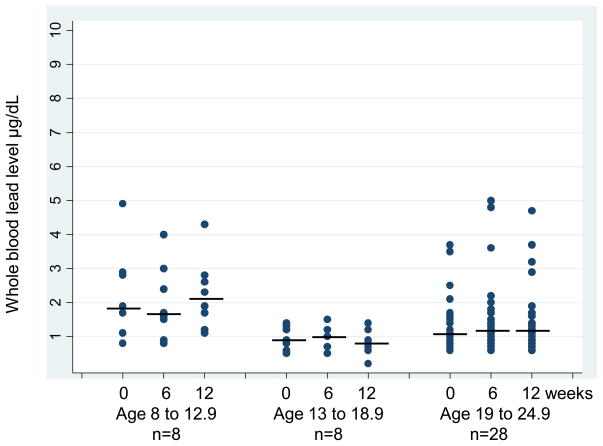
Results: In 44 subjects (75% African American), the baseline mean ± standard deviation serum 25D was 48.3±18.6 nmol/L. Fifty percent of subjects had baseline serum 25D <50.0 nmol/L. Serum 25D increased significantly with D3 supplementation during the 12 weeks. No subject had a whole-blood lead >5.0 μg/dL at baseline or during subsequent visits. Whole-blood lead and 25D were not correlated at baseline, and were negatively correlated after 12 weeks of supplementation (P=0.014). Whole-blood lead did not differ between those receiving 4000 and 7000 IU of vitamin D3.
Conclusions: High-dose vitamin D3 supplementation and the concomitant increased serum 25D did not result in increased whole-blood lead concentration in this sample of children and young adults living in a northeastern urban city.
Trial registration: ClinicalTrials.gov NCT01092338.
Conflict of interest statement
The authors declare they have no or potential competing financial interest.
Figures
References
-
- Jackson RD, LaCroix AZ, Gass M, et al. Calcium plus vitamin D supplementation and the risk of fractures. N Engl J Med. 2006;354(7):669–83. - PubMed
-
- Wintergerst ES, Maggini S, Hornig DH. Contribution of selected vitamins and trace elements to immune function. Ann Nutr Metab. 2007;51(4):301–23. - PubMed
Publication types
MeSH terms
Substances
Associated data
Grants and funding
LinkOut - more resources
Full Text Sources
Other Literature Sources
Medical
