


The par toxin-antitoxin system from Enterococcus faecalis plasmid pAD1 and its chromosomal homologs
- PMID: 23059908
- PMCID: PMC3679275
- DOI: 10.4161/rna.22311
The par toxin-antitoxin system from Enterococcus faecalis plasmid pAD1 and its chromosomal homologs
Abstract
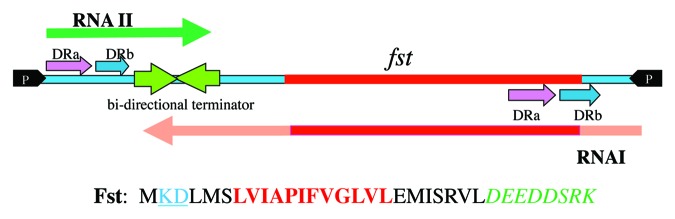
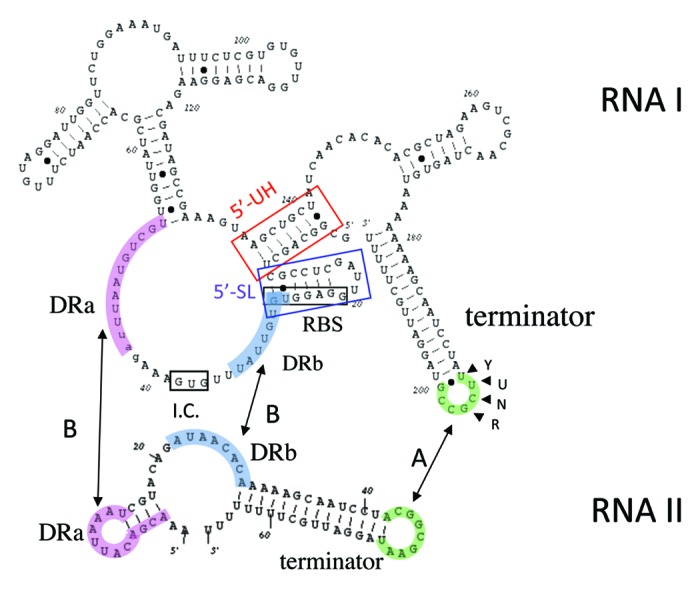
The par post-segregational killing locus present on Enterococcus faecalis plasmid pAD1 was the first Type I toxin-antitoxin system described in Gram-positive bacteria. Translation of the 33 amino acid Fst toxin, encoded on RNA I, is suppressed by a 66 nucleotide regulatory RNA, RNA II. RNA I and RNA II are transcribed convergently and interact at dispersed regions of complementarity, establishing a stable complex that accumulates in plasmid-containing cells. RNA II is slowly removed from the complex, allowing translation of RNA I in plasmid-free segregants. Intramolecular structures are also important for regulating translation of RNA I. The Fst toxin contains a putative transmembrane domain and is believed to exert its function at the bacterial cytoplasmic membrane, although its precise target and mode of action have yet to be determined. Numerous chromosomal homologs of pAD1 par have been identified in Gram-positive bacteria suggesting that this locus may play important roles in cellular function.
Keywords: antisense RNA; peptide toxins; plasmid stability; post-segregational killing; toxin-antitoxin.
Figures
References
Publication types
MeSH terms
Substances
Grants and funding
LinkOut - more resources
Full Text Sources
Miscellaneous
