


Racial/ethnic differences in control of cardiovascular risk factors among type 2 diabetes patients in an insured, ambulatory care population
- PMID: 23062328
- PMCID: PMC3587775
- DOI: 10.1016/j.jdiacomp.2012.08.006
Racial/ethnic differences in control of cardiovascular risk factors among type 2 diabetes patients in an insured, ambulatory care population
Abstract
Aims: This paper examines differences in cardiovascular disease risk factor control among racial/ethnic minorities (Asian Indian, Chinese, Filipino, Japanese, Korean, Vietnamese, Hispanic/Latino, Black/African Americans) with type 2 diabetes compared to Non-Hispanic Whites with type 2 diabetes in an insured, outpatient setting.
Methods: A three-year, cross-sectional sample of 15,826 patients with type 2 diabetes was studied between 2008 and 2010. Goal attainment rates for three cardiovascular disease risk factors (HbA1c, BP, LDL) were estimated. Logistic regression was used to determine the association between patient characteristics and control of risk factors.
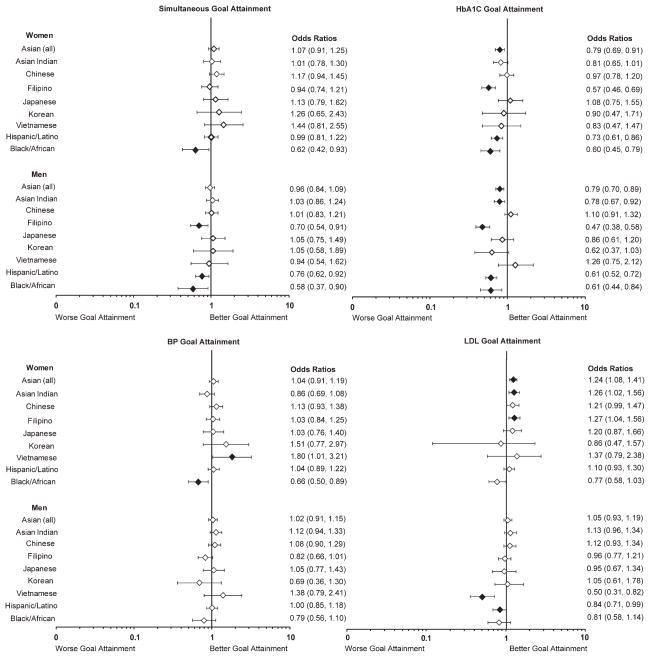
Results: Only one fifth (21.1%) of patients achieved simultaneous goal attainment (HbA1c, BP, LDL). After adjustment for patient characteristics and treatment, Black/African American women and men, and Filipino and Hispanic/Latino men were significantly less likely to simultaneously achieve all three goals, compared to Non-Hispanic Whites. Of the three goals, patients were more likely to achieve HbA1c goals (68.7%) than BP (45.7%) or LDL (58.5%) goals. Racial/ethnic differences were more apparent in risk factors that were under better control (i.e. HbA1c).
Conclusions: Cardiovascular risk factor control in type 2 diabetes is suboptimal, even in an insured population. Special attention may be required for specific racial/ethnic/gender groups.
Copyright © 2013 Elsevier Inc. All rights reserved.
Conflict of interest statement
Conflict of Interest Statement: Nathan Wong receives current research support through UC Irvine from Bristol Myers Squibb in the area of diabetes. The other authors declare that they have no conflict of interest.
Figures
References
-
- Caballero AE. Type 2 diabetes in the Hispanic or Latino population: challenges and opportunities. Current Opinion in Endocrinology, Diabetes, and Obesity. 2007;14:151–157. - PubMed
-
- Centers for Disease Control and Prevention, National Center for Health Statistics. Age-adjusted percentage of civilian, noninstitutionalized population with diagnosed diabetes, by race and sex, United States, 1980–2009. Data from the National Health Interview Survey. 2009 http://www.cdc.gov/diabetes/statistics/prev/national/figraceethsex.htm.
Publication types
MeSH terms
Grants and funding
LinkOut - more resources
Full Text Sources
Other Literature Sources
Medical
