. 2012 Oct 3;103(7):1576-84.
doi: 10.1016/j.bpj.2012.08.037. Epub 2012 Oct 2.

Retention of conformational entropy upon calmodulin binding to target peptides is driven by transient salt bridges

Affiliations

Retention of conformational entropy upon calmodulin binding to target peptides is driven by transient salt bridges

Dayle M A Smith et al. Biophys J. .

Abstract

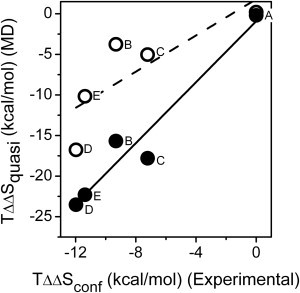
Calmodulin (CaM) is a highly flexible calcium-binding protein that mediates signal transduction through an ability to differentially bind to highly variable binding sequences in target proteins. To identify how binding affects CaM motions, and its relationship to conformational entropy and target peptide sequence, we have employed fully atomistic, explicit solvent molecular dynamics simulations of unbound CaM and CaM bound to five different target peptides. The calculated CaM conformational binding entropies correlate with experimentally derived conformational entropies with a correlation coefficient R(2) of 0.95. Selected side-chain interactions with target peptides restrain interhelical loop motions, acting to tune the conformational entropy of the bound complex via widely distributed CaM motions. In the complex with the most conformational entropy retention (CaM in complex with the neuronal nitric oxide synthase binding sequence), Lys-148 at the C-terminus of CaM forms transient salt bridges alternating between Glu side chains in the N-domain, the central linker, and the binding target. Additional analyses of CaM structures, fluctuations, and CaM-target interactions illuminate the interplay between electrostatic, side chain, and backbone properties in the ability of CaM to recognize and discriminate against targets by tuning its conformational entropy, and suggest a need to consider conformational dynamics in optimizing binding affinities.


Figures

Figure 1
Figure 1
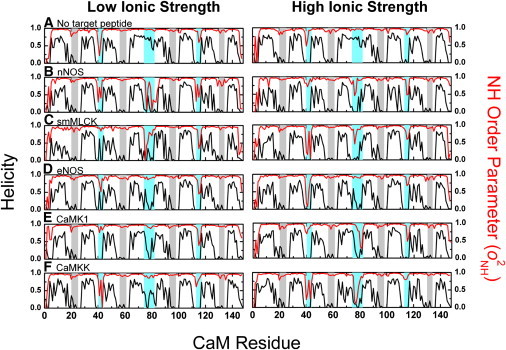
Variable helicity and conformational order in helical linker regions for CaM bound to different target peptides. Time-averaged helical content (black lines, peaks point up) and calculated backbone amide order parameter (ONH2; red lines, peaks point down) for unbound calcium-activated CaM (A) or in association with target peptides (BF). Calcium binding sites (gray) and conformationally sensitive loops (cyan) are highlighted (see Introduction for residue numbers). Graphs are vertically ordered according to calculated quasiharmonic entropies (Table S6).
Figure 2
Figure 2
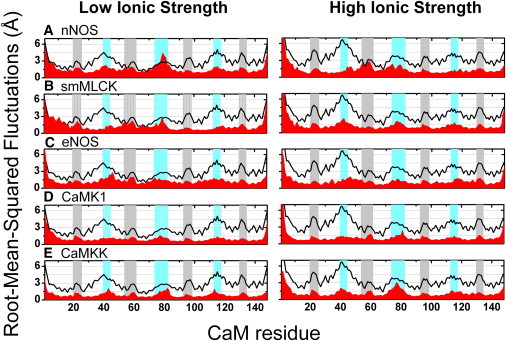
Variable backbone conformational dynamics for peptide target complexes. RMSF for Cα atoms for calcium-activated CaM (black lines) in comparison with indicated complexes between calcium-activated CaM and target peptides (red). Calcium binding sites (gray) and conformationally sensitive loops (cyan) are highlighted. Graphs are vertically ordered according to calculated quasiharmonic entropies (Table S6).
Figure 3
Figure 3
Calculated quasiharmonic conformational entropies from molecular dynamics simulations correlate with experimental conformational entropies. Target-dependent differences in quasiharmonic CaM conformational binding entropy (relative to nNOS-CaM) for backbone atoms (open circles) or all heavy CaM atoms (solid circles) between complexes of calcium-activated CaM bound to different target peptides at high ionic strength (0.15 M KCl). Points are labeled according to peptide targets: (A), neuronal nitric oxide synthase (nNOS; 2o60.pdb); (B), smooth myosin light chain kinase (smMLCK, 1qtx.pdb); (C), epithelial nitric oxide synthase (eNOS; 1niw.pdb); (D), CaM-dependent protein kinase I (CaMK1; 1mxe.pdb); and (E), CaM-dependent protein kinase kinase (CaMKK; 1ckk.pdb). Experimental NMR/isothermal titration calorimetry conformational entropy data were obtained from (5). Lines represent nonlinear least squares fits to the data for backbone atoms (slope = 1.1; R2 = 0.67) and all CaM heavy atoms (slope = 1.9; R2 = 0.95).
Figure 4
Figure 4
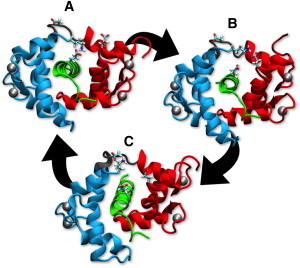
Transient salt bridges enhance conformational entropy. Selected snapshots of nNOS-CaM trajectory (low ionic strength simulation) depicting of CaM Lys-148 transient salt bridges involving Lys-148. Protein residues are shown in ribbons format. Cyan = CaM C-domain (left); Red = CaM N-domain (right); Gray = CaM central linker; Green = nNOS peptide (center). Calcium ions are shown as silver Van der Waals spheres. (A, 13 ns snapshot): salt bridge formed between C-terminal Lys-148 and Glu-12 in target peptide, (B, 29 ns snapshot) salt bridge between Lys-148 and Glu-11 in CaM N-domain, and (C, 39 ns snapshot) salt bridge between Lys-148 and Asp-78 in the CaM central linker.

References

    1. Chin D., Means A.R. Calmodulin: a prototypical calcium sensor. Trends Cell Biol. 2000;10:322–328. - PubMed
    1. Afshar M., Caves L.S.D., Haiech J. Investigating the high affinity and low sequence specificity of calmodulin binding to its targets. J. Mol. Biol. 1994;244:554–571. - PubMed
    1. Grünberg R., Nilges M., Leckner J. Flexibility and conformational entropy in protein-protein binding. Structure. 2006;14:683–693. - PubMed
    1. Brady G.P., Sharp K.A. Entropy in protein folding and in protein-protein interactions. Curr. Opin. Struct. Biol. 1997;7:215–221. - PubMed
    1. Frederick K.K., Marlow M.S., Wand A.J. Conformational entropy in molecular recognition by proteins. Nature. 2007;448:325–329. - PMC - PubMed

Publication types

LinkOut - more resources