


Transcriptomic analysis of postmortem brain identifies dysregulated splicing events in novel candidate genes for schizophrenia
- PMID: 23062752
- PMCID: PMC3502694
- DOI: 10.1016/j.schres.2012.09.015
Transcriptomic analysis of postmortem brain identifies dysregulated splicing events in novel candidate genes for schizophrenia
Abstract
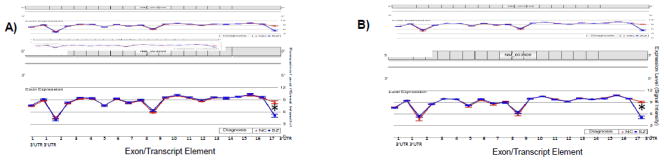
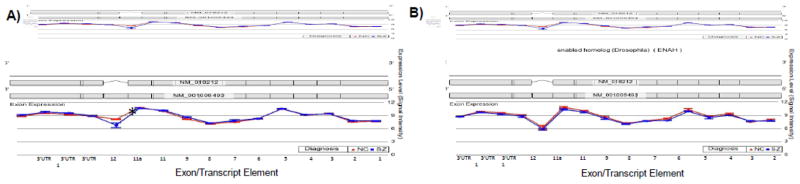
The diverse spatial and temporal expression of alternatively spliced transcript isoforms shapes neurodevelopment and plays a major role in neuronal adaptability. Although alternative splicing is extremely common in the brain, its role in mental illnesses such as schizophrenia has received little attention. To examine this relationship, postmortem brain tissue was obtained from 20 individuals with schizophrenia (SZ) and 20 neuropsychiatrically normal comparison subjects. Gray matter samples were extracted from two brain regions implicated in the disorder: Brodmann Area 10 and caudate. Affymetrix Human Gene 1.0 ST arrays were used on four subjects per group to attain an initial profile of differential expression of transcribed elements within and across brain regions in SZ. Numerous genes of interest with altered mRNA transcripts were identified by microarray through the differential expression of particular exons and 3' untranslated regions (UTRs) between diagnostic groups. Select microarray results--including dysregulation of ENAH exon 11a and CPNE3 3'UTR--were verified by qRTPCR and replicated in the remaining independent sample of 16 SZ patients and 16 normal comparison subjects. These results, if further replicated, clearly illustrate the importance of Identifying transcriptomic variants in expression studies, and implicate novel candidate genes in the disorder.
Copyright © 2012 Elsevier B.V. All rights reserved.
Conflict of interest statement
The authors report no conflicts of interest.
Figures
References
-
- Affymetrix, Inc. Data Sheet: GeneChip® Gene 1.0 ST Array System for Human, Mouse and Rat. 2007.
-
- Dennis G, Jr, Sherman BT, Hosack DA, Yang J, Gao W, Lane HC, Lempicki RA. DAVID: Database for Annotation, Visualization, and Integrated Discovery. Genome Biology. 2003;4(5):3. - PubMed
-
- Dho SE, French MB, Woods SA, McGlade CJ. Characterization of four mammalian numb protein isoforms. Identification of cytoplasmic and membrane-associated variants of the phosphotyrosine binding domain. Journal of Biological Chemistry. 1999;274(46):33097–33104. - PubMed
Publication types
MeSH terms
Substances
Grants and funding
LinkOut - more resources
Full Text Sources
Other Literature Sources
Medical
