. 2012 Nov;18(11):1705-10.
doi: 10.1038/nm.2920. Epub 2012 Oct 14.

The Toll-like receptor 5 ligand flagellin promotes asthma by priming allergic responses to indoor allergens

Affiliations

The Toll-like receptor 5 ligand flagellin promotes asthma by priming allergic responses to indoor allergens

Rhonda H Wilson et al. Nat Med. 2012 Nov.

Abstract

Allergic asthma is a complex disease characterized by eosinophilic pulmonary inflammation, mucus production and reversible airway obstruction. Exposure to indoor allergens is a risk factor for asthma, but this disease is also associated with high household levels of total and particularly Gram-negative bacteria. The ability of bacterial products to act as adjuvants suggests they might promote asthma by priming allergic sensitization to inhaled allergens. In support of this idea, house dust extracts (HDEs) can activate antigen-presenting dendritic cells (DCs) in vitro and promote allergic sensitization to inhaled innocuous proteins in vivo. It is unknown which microbial products provide most of the adjuvant activity in HDEs. A screen for adjuvant activity of microbial products revealed that the bacterial protein flagellin (FLA) stimulated strong allergic airway responses to an innocuous inhaled protein, ovalbumin (OVA). Moreover, Toll-like receptor 5 (TLR5), the mammalian receptor for FLA, was required for priming strong allergic responses to natural indoor allergens present in HDEs. In addition, individuals with asthma have higher serum levels of FLA-specific antibodies as compared to nonasthmatic individuals. Together, these findings suggest that household FLA promotes the development of allergic asthma by TLR5-dependent priming of allergic responses to indoor allergens.


Figures
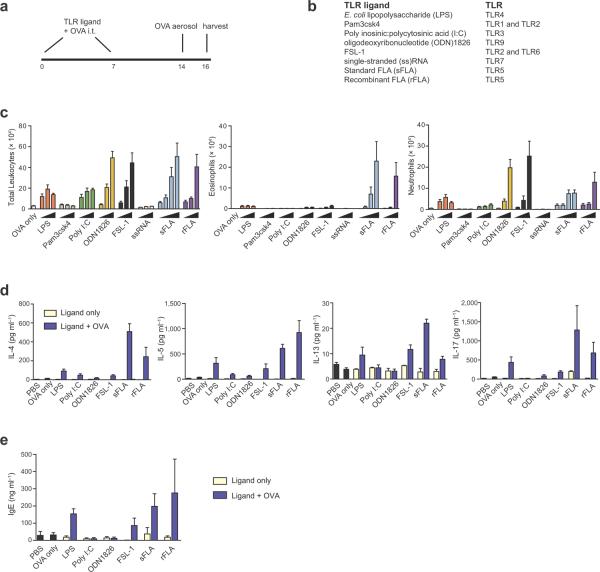
Figure 1
Figure 1
Adjuvant activity of microbial products in the airway. (a) Timeline for sensitizations and challenges. (b) Microbial products used, and the TLRs that mediate signaling responses to each product. (c) Airway inflammation in sensitized mice and challenged mice: Cell number ± s.e.m. in BALF of total leukocytes (left), eosinophils (middle) and neutrophils (right). formula image, increasing amounts (25 ng, 125 ng or 625 ng) of microbial product used during sensitizations; sFLA also includes 1250 ng. n = 5 – 8 mice per group. (d) Pulmonary cytokines: left to right, IL-4, IL-5, IL-13 and IL-17. (e) Total serum IgE. Data are from one of three similar experiments. n = 5 – 8 mice per group. nd, not detected.
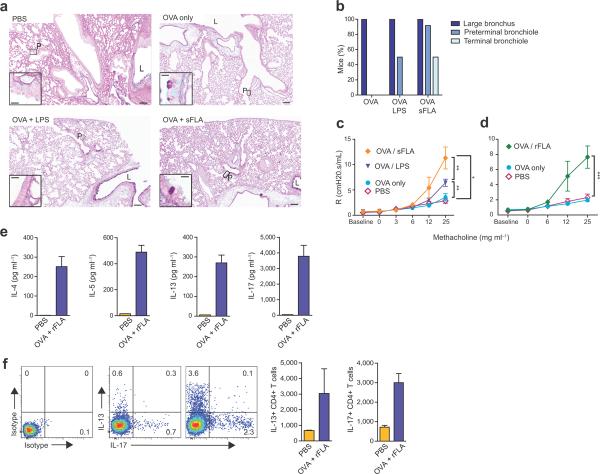
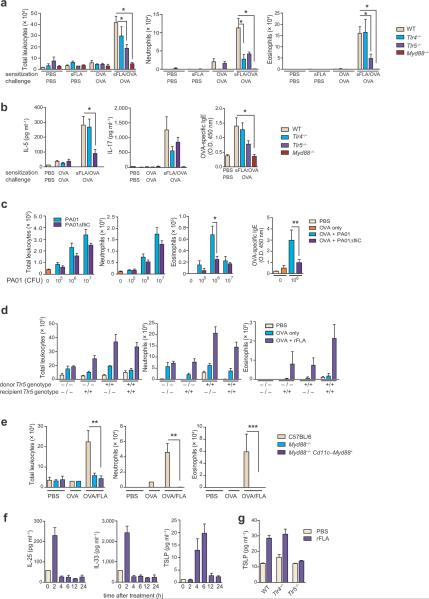
Figure 2
Figure 2
FLA promotes asthma-like responses to OVA. (a). Periodic acid-Schiff / Alcian blue staining of mucus-producing cells in the airway. Representative, low magnification (8×) images are shown (scale bar, 50 microns). Insets (40×) show expanded images of the indicated regions (scale bar, 10 microns). L, large airway; P, preterminal bronchioles. (b) Compiled data of mucus staining. n = 8 – 10 mice per group. (c,d) Mean values ± s.e.m. of airway resistance for intubated mice inhaling air (baseline), or aerosols of PBS containing the indicated concentrations of methacholine. n ≥ 8 mice/group. (e) Cytokine concentrations in cultures of lymph nodes excised from mice sensitized as indicated. IL-4 (left), IL-5 (middle) and IL-17 (right). (f) Intracellular staining for cytokines in pulmonary T cells. Shown are representative flow plots and bar histograms of mean ± s.e.m. numbers of CD4+ cells staining for IL-13 (left) and IL-17 (right).
Figure 3
Figure 3
FLA possesses potent, TLR5-dependent adjuvant activity in the airway. (a) Mean numbers ± s.e.m. of total leukocytes (left), neutrophils (middle) and eosinophils (right) in mice sensitized and challenged as indicated. (b) Concentrations of IL-5 (left) and IL-17 (middle) in BALF, and relative amounts of serum OVA-specific IgE (right) in mice of the indicated genotypes. (c) Left to right, total leukocytes, neutrophils, eosinophils and OVA-specific IgE in mice sensitized to OVA using heat-killed P. aeruginosa as an adjuvant. (d) Total leukocytes (left), neutrophils (middle) and eosinophils (right) in bone marrow chimeric mice generated with WT and Tlr5−/− mice, sensitized as indicated. (e) Total leukocytes (left), neutrophils (middle) and eosinophils in mice expressing a Myd88 transgene in CD11c+ cells only. Experiments were done at least twice with similar results. n = at least 6 mice per group. * P < 0.05. (f) Cytokines in BALF at the indicated time point after rFLA instillation. (g) TSLP concentration in supernatants of FLA-treated primary airway epithelial cells.
Figure 4
Figure 4
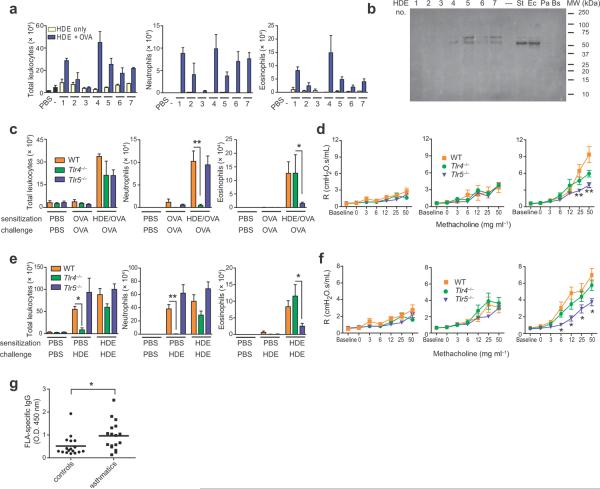
FLA is a primary adjuvant component of common house dust for priming asthma-like responses. (a) Airway inflammation in OVA-challenged mice previously sensitized by instillation of OVA together with the indicated sample of HDE. (b) Western blot of HDEs probed with an anti-S. typhimurium FLA antibody. Also loaded were FLA from S. typhimurium (St) (100 ng), E. coli (Ec) (400 ng), P. aeruginosa (Pa) (400 ng) and B. subtilis (Bs) (400 ng). (c) Airway inflammation and (d) AHR in the indicated strains of OVA-challenged mice previously sensitized to OVA using HDE #7 or given HDE #7 alone. (e) Airway inflammation and (f) AHR in mice given PBS, a single instillation of HDE #7, or two instillations of HDE #7. n = 8 mice per group. Experiments shown were done at least twice, with similar results. * P < 0.05; ** P < 0.01, vs values for WT mice. (g) Relative titers of IgG antibodies to S. typhimurium FLA in asthmatic and non-asthmatic individuals. n = 17 controls, 17 asthmatics. P value by t test.

References

    1. Busse WW, Lemanske RF., Jr. Asthma. N Engl J Med. 2001;344:350–362. - PubMed
    1. Ross MA, et al. Association of asthma symptoms and severity with indoor bioaerosols. Allergy. 2000;55:705–711. - PubMed
    1. Iwasaki A, Medzhitov R. Regulation of adaptive immunity by the innate immune system. Science. 2010;327:291–295. - PMC - PubMed
    1. Ng N, Lam D, Paulus P, Batzer G, Horner AA. House dust extracts have both TH2 adjuvant and tolerogenic activities. J Allergy Clin Immunol. 2006;117:1074–1081. - PubMed
    1. Gewirtz AT, Navas TA, Lyons S, Godowski PJ, Madara JL. Cutting edge: bacterial flagellin activates basolaterally expressed TLR5 to induce epithelial proinflammatory gene expression. J Immunol. 2001;167:1882–1885. - PubMed

Publication types

MeSH terms