. 2012 Mar 1;7(1):13-24.
doi: 10.1080/17452759.2012.673152. Epub 2012 Apr 12.

Continuous Digital Light Processing (cDLP): Highly Accurate Additive Manufacturing of Tissue Engineered Bone Scaffolds

Affiliations

Continuous Digital Light Processing (cDLP): Highly Accurate Additive Manufacturing of Tissue Engineered Bone Scaffolds

David Dean et al. Virtual Phys Prototyp. .

Abstract

Highly accurate rendering of the external and internal geometry of bone tissue engineering scaffolds effects fit at the defect site, loading of internal pore spaces with cells, bioreactor-delivered nutrient and growth factor circulation, and scaffold resorption. It may be necessary to render resorbable polymer scaffolds with 50 μm or less accuracy to achieve these goals. This level of accuracy is available using Continuous Digital Light processing (cDLP) which utilizes a DLP(®) (Texas Instruments, Dallas, TX) chip. One such additive manufacturing device is the envisionTEC (Ferndale, MI) Perfactory(®). To use cDLP we integrate a photo-crosslinkable polymer, a photo-initiator, and a biocompatible dye. The dye attenuates light, thereby limiting the depth of polymerization. In this study we fabricated scaffolds using the well-studied resorbable polymer, poly(propylene fumarate) (PPF), titanium dioxide (TiO(2)) as a dye, Irgacure(®) 819 (BASF [Ciba], Florham Park, NJ) as an initiator, and diethyl fumarate as a solvent to control viscosity.


Figures
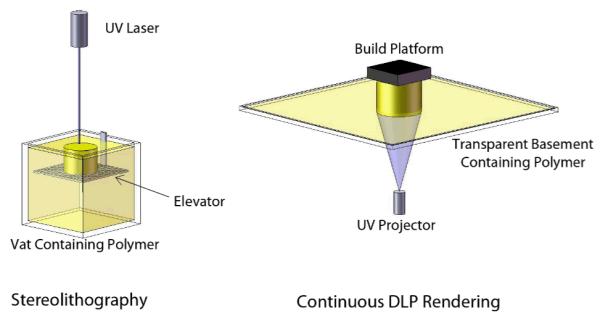
Figure 1
Figure 1
Stereolithography- and cDLP-based systems both rely on photocrosslinking for freeform fabrication. However, the methods differ as illustrated here. Stereolithography typically requires a deep vat of resin. As parts are built, they attach to an elevator which moves downward through the polymer resin as each layer is rendered at the surface by a moving laser. In contrast, cDLP systems render parts by projecting an image through a clear basement plate into a tray containing the resin, curing at the bottom surface rather than the top surface. The parts attach to a build platform which moves upward, away from the basement plate, after each layer is projected.
Figure 2
Figure 2
The basic steps necessary in the calibration of a cDLP system are shown here. The blue arrows indicate a logical calibration order, while the dashed arrow indicates that Steps 5 and 6 may feed back into subsequent iterations of the calibration loop.
Figure 3
Figure 3
The relationship between cure depth (μm) and concentration (wt%) for three biocompatible dyes (amphotericin B, doxycycline hyclate, and rutile titanium dioxide). The data for an effective, but toxic, yellow azo chromium dye is also provided for comparison. Doxycycline hyclate proved ineffective for this application, while amphotericin B and titanium dioxide proved to be promising candidates for further calibration studies (see Figure 6 for a deeper investigation of titanium dioxide). The following parameters were held constant throughout these tests: BAPO concentration = 0.5 wt%; irradiance = 200mW/dm2, exposure time = 300s. Data represents mean ± standard deviation (n=3).
Figure 4
Figure 4
The plate-and-post test scaffold design shown from A) isometric, B) front, and C) top viewpoints. The following dimensions characterize the geometry of this design: plate thickness = 400 μm; distance between plates (or post height) = 800 μm; vertical circular pore diameter = 800 μm; post diameter = 600 μm; overall scaffold diameter = 6 mm; overall scaffold height = 12.4 mm. The height-to-diameter ratio of the scaffold approximately 2:1, which is useful for mechanical compression testing applications. The small size of the test scaffold also lends itself to small animal model testing.
Figure 5
Figure 5
Depth of polymerization (μm) was characterized as a function of titanium dioxide concentration (wt%) for five different combinations of BAPO concentration (wt%) and exposure time (s). From these tests, it was determined that a 2 wt% titanium dioxide concentration with 2 wt% BAPO and a 60 s exposure time would yield an average depth of polymerization equal to 133.3 μm. These settings could therefore be used to build in 50 μm layers with 83.3 μm of overcuring. A 200 mW/dm2 irradiance was used for these tests. Data represents mean ± standard deviation (n=3).
Figure 6
Figure 6
Increasing titanium dioxide concentration led to an increased amount of lateral overcuring. Testing was performed using a 200 mW/dm2 irradiance and a 300 s exposure time. Two levels of BAPO, shown above, were tested for each titanium dioxide concentration. Data shown here represents mean ± standard deviation (n=3).
Figure 7
Figure 7
A curing test sample is shown. The superimposed, red, dashed line encloses the square test pattern which is projected during the test. The material outside of this boundary was not directly exposed, but rather was polymerized due the lateral overcuring caused by scattering.
Figure 8
Figure 8
A photograph of a full plate-and-post scaffold rendered using a 1:1 PPF/DEF ratio with 1.5 wt% BAPO and 0.75 wt% TiO2. A 200 mW/dm2 irradiance and 150s exposure time were used.
Figure 9
Figure 9
Scaffolds rendered using an azo-chromium based dye are illustrated here in several formats. A) Scanning electron microscope (SEM) image of full scaffold (Note fish eye lens artifact); B) SEM zoomed view of Full Scaffold features. Note pixelation of surfaces (in plane); C) Top view of “plate”; D) Oblique view of scaffold features. E) Side view of scaffold features as reconstructed from μCT. E) Oblique view of the μCT data set.

References

    1. Alves CM, Yang Y, Marton D, Carnes DL, Ong JL, Sylvia VL, Dean DD, Reis RL, Agrawal CM. Plasma surface modification of poly(D,L-lactic acid) as a tool to enhance protein adsorption and the attachment of different cell types. J Biomed Mater Res B Appl Biomater. 2008;87(1):59–66. - PubMed
    1. Anderson EJ, Knothe Tate ML. Design of tissue engineering scaffolds as delivery devices for mechanical and mechanically modulated signals. Tissue Eng. 2007;13(10):2525–2538. - PubMed
    1. ASTM F2792–10 . Standard terminology for additive manufacturing technologies. American Society for Testing and Materials; West Conshohocken, PA:
    1. Cheah CM, Chua CK, Leong KF, Cheong CH, Naing MW. An Automatic Algorithm for Generating Complex Polyhedral Scaffolds for Tissue Engineering. Tissue Eng. 2004;10(3-4):595–610. - PubMed
    1. Dean D, Min K-J, Bond A. Computer aided design of large-format prefabricated cranial plates. J Craniofac Surg. 2003;14(6):819–832. - PubMed

LinkOut - more resources