


Rates of visual field progression in clinical glaucoma care
- PMID: 23066646
- PMCID: PMC3798127
- DOI: 10.1111/j.1755-3768.2012.02492.x
Rates of visual field progression in clinical glaucoma care
Abstract
Purpose: To investigate rates of visual field progression and factors associated with progression rate in open-angle glaucoma in clinical glaucoma care.
Methods: We performed a retrospective chart review of all patients with manifest primary open-angle glaucoma (POAG) and pseudoexfoliation glaucoma (PEXG) followed ≥ 5 years with ≥5 SITA Standard fields. Exclusion criteria were minimal. Demographics, intraocular pressure values (IOP), treatment and treatment changes, and visual field (VF) data were recorded. VF progression rates were calculated as slopes of mean deviation (MD) over time.
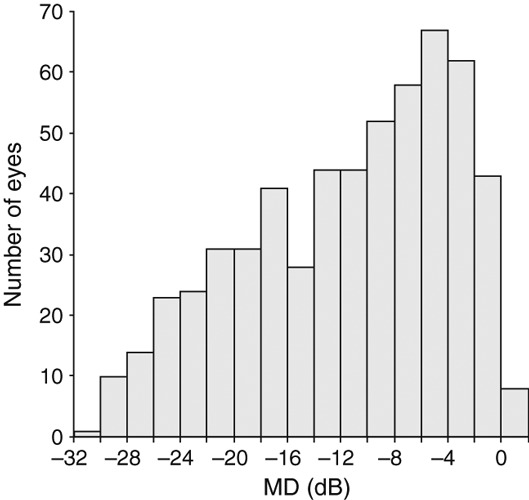
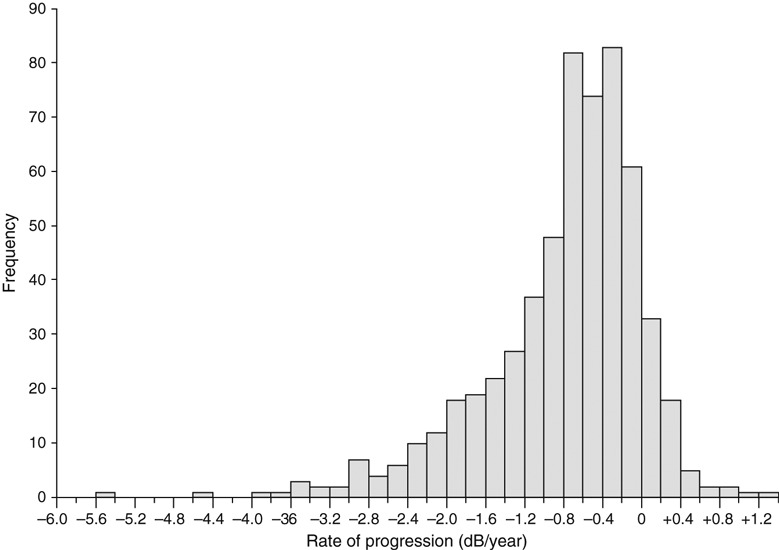
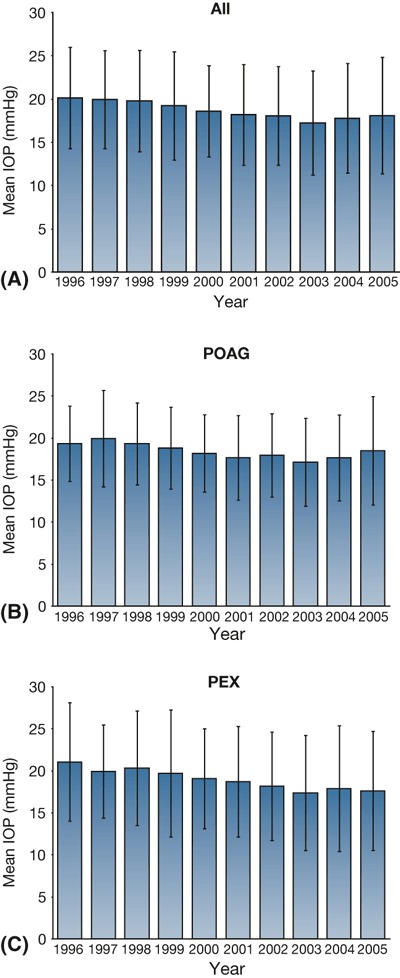
Results: Five hundred and eighty-three patients were eligible. Three hundred and sixty-seven (62%) had POAG and 221 (38%) PEXG. Median MD at study start was -10.0 dB. Mean follow-up time was 7.8 years (SD ± 1.2); mean number of VF tests was 8.9 (SD ± 2.8). Progression rates varied very much among patients with a mean of -0.80 dB/year (SD ± 0.82; median rate, -0.62), and 5.6% of patients progressed at rates worse than -2.5 dB per year A negative slope of MD values was observed in 89% of patients. Mean IOP of all visits decreased over the study period from 20.15 to 18.10 mmHg. Higher age and mean IOP, and more intensive treatment were associated with more rapid progression, while PEXG and IOP variation were not, if treatment intensity was taken into account.
Conclusion: Rates of visual field progression in manifest glaucoma with field loss in ordinary clinical care were highly variable. Progression rates rapid enough to influence quality of life were common.
Keywords: Glaucoma; progression; rate of progression; visual field.
© 2012 The Authors. Acta Ophthalmologica © 2012 Acta Ophthalmologica Scandinavica Foundation.
Figures
References
-
- Ahrlich KD, de Moraes CG, Teng CC, Prata TS, Tello C, Ritch R, Liebmann JM. Visual field progression differences between normal-tension and exfoliative high-tension glaucoma. Invest Ophthalmol Vis Sci. 2010;51:1458–1463. - PubMed
-
- Anderson DR, Drance SM, Schulzer M. Natural history of normal-tension glaucoma. Ophthalmology. 2001;108:247–253. - PubMed
-
- Bengtsson B, Olsson J, Heijl A, Rootzen H. A new generation of algorithms for computerized threshold perimetry, SITA. Acta Ophthalmol Scand. 1997;75:368–375. - PubMed
-
- Bengtsson B, Leske MC, Hyman L, Heijl A. Fluctuation of intraocular pressure and glaucoma progression in the early manifest glaucoma trial. Ophthalmology. 2007;114:205–209. - PubMed
-
- Caprioli J, Coleman AL. Intraocular pressure fluctuation a risk factor for visual field progression at low intraocular pressures in the advanced glaucoma intervention study. Ophthalmology. 2008;115:1123–1129 e1123. - PubMed
Publication types
MeSH terms
LinkOut - more resources
Full Text Sources
Miscellaneous
