


Effort-reward imbalance and work ability: cross-sectional and longitudinal findings from the Second German Sociomedical Panel of Employees
- PMID: 23067110
- PMCID: PMC3505747
- DOI: 10.1186/1471-2458-12-875
Effort-reward imbalance and work ability: cross-sectional and longitudinal findings from the Second German Sociomedical Panel of Employees
Abstract
Background: Although data from longitudinal studies are sparse, effort-reward imbalance (ERI) seems to affect work ability. However, the potential pathway from restricted work ability to ERI must also be considered. Therefore, the aim of our study was to analyse cross-sectional and longitudinal associations between ERI and work ability and vice versa.
Methods: Data come from the Second German Sociomedical Panel of Employees. Logistic regression models were estimated to determine cross-sectional and longitudinal associations. The sample used to predict new cases of poor or moderate work ability was restricted to cases with good or excellent work ability at baseline. The sample used to predict new cases of ERI was restricted to persons without ERI at baseline.
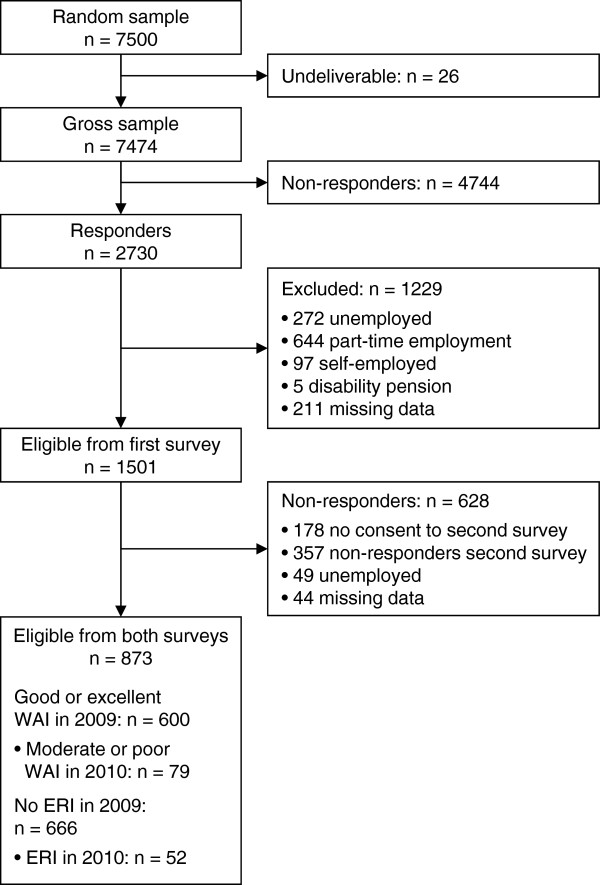
Results: The cross-sectional analysis included 1501 full-time employed persons. The longitudinal analyses considered 600 participants with good or excellent baseline work ability and 666 participants without baseline ERI, respectively. After adjustment for socio-demographic variables, health-related behaviour and factors of the work environment, ERI was cross-sectionally associated with poor or moderate work ability (OR = 1.980; 95% CI: 1.428 to 2.747). Longitudinally, persons with ERI had 2.1 times higher odds of poor or moderate work ability after one year (OR = 2.093; 95% CI: 1.047 to 4.183). Conversely, persons with poor or moderate work ability had 2.6 times higher odds of an ERI after one year (OR = 2.573; 95% CI: 1.314 to 5.041).
Conclusions: Interventions that enable workers to cope with ERI or address indicators of ERI directly could promote the maintenance of work ability. Integration management programmes for persons with poor work ability should also consider their psychosocial demands.
Figures
References
-
- Spiegel JM, Labonte R, Ostry AS. Understanding "globalization" as a determinant of health determinants: a critical perspective. Int J Occup Environ Health. 2004;10(4):360–367. - PubMed
-
- Rama M. Globalization and the labor market. World Bank Res Obs. 2003;18(2):159–186. doi: 10.1093/wbro/lkg010. - DOI
-
- Siegrist J. Adverse health effects of high-effort/low-reward conditions. J Occup Health Psychol. 1996;1(1):27–41. - PubMed
Publication types
MeSH terms
LinkOut - more resources
Full Text Sources
