. 2012 Oct 15;14(5):R218.
doi: 10.1186/ar4057.

Mannose binding lectin: a biomarker of systemic lupus erythematosus disease activity

Mannose binding lectin: a biomarker of systemic lupus erythematosus disease activity

Aditya K Panda et al. Arthritis Res Ther. .

Abstract

Introduction: A role for mannose binding lectin (MBL) in autoimmune diseases has been demonstrated earlier and elevated level of MBL has been shown in systemic lupus erythematosus (SLE) patients. In the current study, we investigated MBL as a potential biomarker for disease activity in SLE.

Methods: In a case control study SLE patients (93 females) and 67 age, sex, ethnicity matched healthy controls were enrolled. Plasma MBL levels were quantified by enzyme linked immunosorbent assay (ELISA). Clinical, serological and other markers of disease activity (C3, C4 and anti-dsDNA) were measured by standard laboratory procedures.

Results: Plasma MBL levels were significantly high in SLE patients compared to healthy controls (P < 0.0001). MBL levels were variable in different clinical categories of SLE. Lower levels were associated with musculoskeletal and cutaneous manifestations (P = 0.002), while higher and intermediate MBL levels were significantly associated with nephritis in combination with other systemic manifestations (P = 0.01 and P = 0.04 respectively). Plasma MBL correlated with systemic lupus erythematosus disease activity index (SLEDAI) (P = 0.0003, r = 0.36), anti-dsDNA (P < 0.0001, r = 0.54), proteinuria (P < 0.0001, r = 0.42) and negatively correlated with C3 (P = 0.007, r = -0.27) and C4 (P = 0.01, r = -0.29).

Conclusions: Plasma MBL is a promising marker in the assessment of SLE disease activity.


Figures
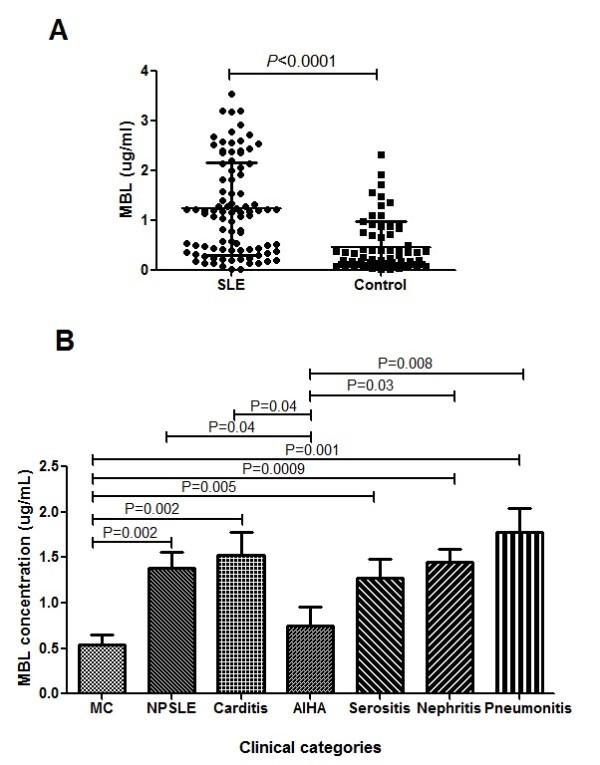
Figure 1
Figure 1
Plasma mannose binding lectin (MBL) levels in systemic lupus erythematosus (SLE) patients and healthy controls (HCs). (A) Plasma samples from HCs (n = 67) and SLE patients (n = 93) were quantified by ELISA according to the manufacturer's instructions. SLE patients displayed significantly higher concentrations of MBL compared to HCs (P < 0.0001). (B) Based on clinical and biochemical parameters, SLE patients were further categorized as musculoskeletal or cutaneous (MC) (n = 16), neuropsychiatric systemic lupus erythematosus (NPSLE) (n = 26), carditis (n = 14), autoimmune hemolytic anemia (AHIA) (n = 10), serositis (n = 18), nephriris (n = 52), pneumonitis (n = 11) and MBL levels were compared among them. Dots represent individual samples; bars show the mean ± SD. The Student's t-test was used to compare MBL concentrations among clinical categories.
Figure 2
Figure 2
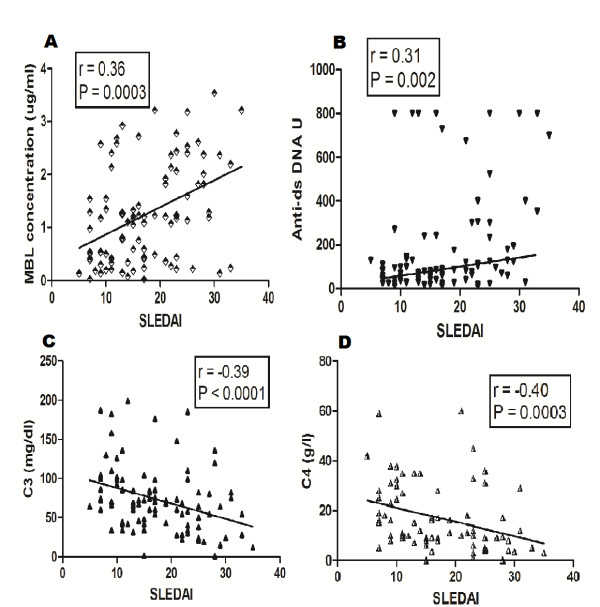
Correlation of SLEDAI scores with plasma levels of mannose binding lectin (MBL), Anti-dsDNA, and complement components C3 and C4. SLEDAI scores correlated positively with plasma MBL (A) and anti-dsDNA levels (B). In contrast, plasma C3 (C) and C4 (D) levels negatively correlated with the SLEDAI. Dots represent individual samples. Correlation analysis was performed using the Spearman correlation coefficient. P < 0.05 was considered significant.
Figure 3
Figure 3
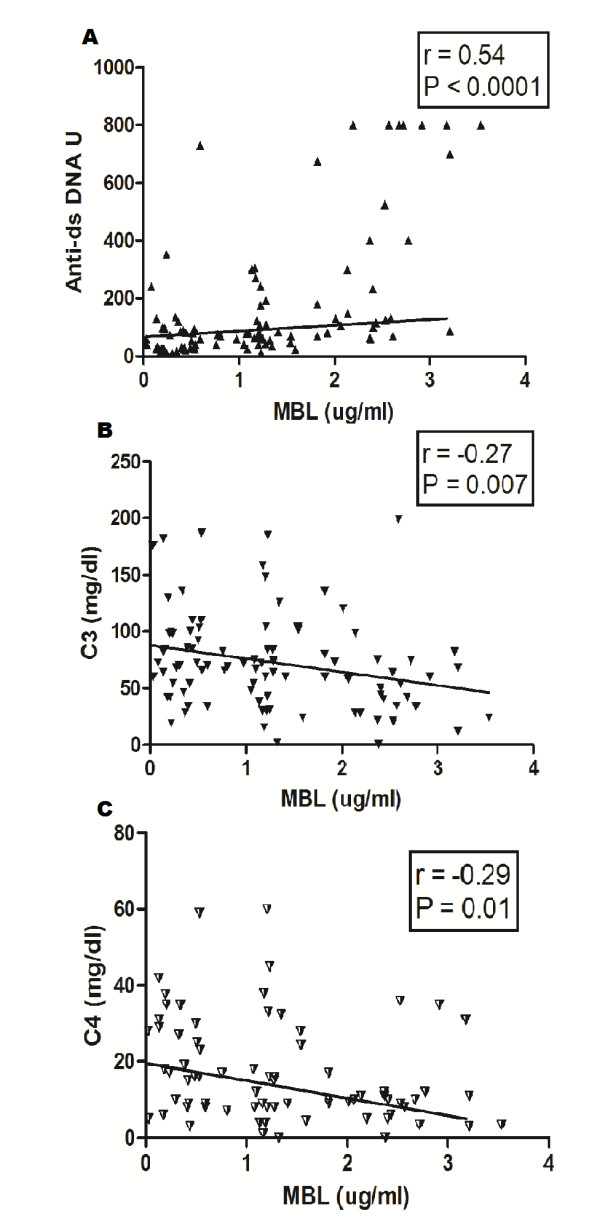
Correlation of plasma mannose binding lectin (MBL) levels with anti-dsDNA, and complement components C3 and C4. Plasma MBL levels correlated positively with anti-dsDNA (A) and negatively with plasma levels of C3 (B) and C4 (C). Dots represent individual samples. Correlation analysis was performed using the Spearman correlation coefficient. P < 0.05 was considered significant.
Figure 4
Figure 4
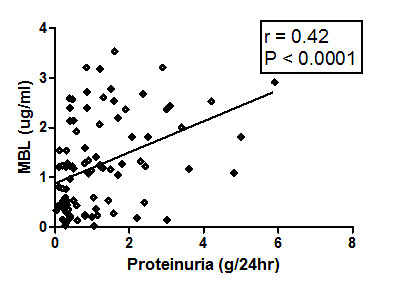
Correlation of plasma mannose binding lectin (MBL) levels with proteinuria in female systemic lupus erythematosus (SLE) patients. SLE patients (n = 93) were analyzed for association between MBL and proteinurea. Plasma MBL levels of SLE patients correlated positively with proteinurea. Dots represent individual samples. Correlation analysis was performed using the Spearman correlation coefficient. P < 0.05 was considered significant.

References

    1. Danchenko N, Satia JA, Anthony MS. Epidemiology of systemic lupus erythematosus: a comparison of worldwide disease burden. Lupus. 2006;15:308–318. doi: 10.1191/0961203306lu2305xx. - DOI - PubMed
    1. Shoenfeld Y, Zandman-Goddard G, Stojanovich L, Cutolo M, Amital H, Levy Y, Abu-Shakra M, Barzilai O, Berkun Y, Blank M, de Carvalho JF, Doria A, Gilburd B, Katz U, Krause I, Langevitz P, Orbach H, Pordeus V, Ram M, Toubi E, Sherer Y. The mosaic of autoimmunity: hormonal and environmental factors involved in autoimmune diseases-2008. Isr Med Assoc J. 2008;10:8–12. - PubMed
    1. Malaviya AN, Singh RR, Singh YN, Kapoor SK, Kumar A. Prevalence of systemic lupus erythematosus in India. Lupus. 1993;2:115–118. doi: 10.1177/096120339300200209. - DOI - PubMed
    1. Chandrasekaran AN, Radhakrishna B. Rheumatoid arthritis and connective tissue disorders: India and South-East Asia. Baillieres Clin Rheumatol. 1995;9:45–57. doi: 10.1016/S0950-3579(05)80142-6. - DOI - PubMed
    1. Malaviya AN, Chandrasekaran AN, Kumar A, Shamar PN. Systemic lupus erythematosus in India. Lupus. 1997;6:690–700. doi: 10.1177/096120339700600903. - DOI - PubMed

Publication types