


Review
doi: 10.1212/WNL.0b013e31826e9b1d.
Presymptomatic studies in ALS: rationale, challenges, and approach
Affiliations
- PMID: 23071166
- PMCID: PMC3468777
- DOI: 10.1212/WNL.0b013e31826e9b1d
Item in Clipboard
Review
Presymptomatic studies in ALS: rationale, challenges, and approach
Neurology.
.
No abstract available
Figures
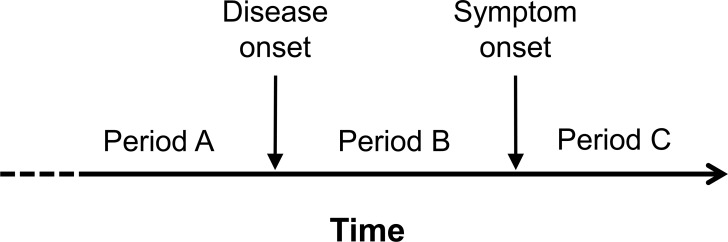
During period A, prior to the onset of disease, environmental exposures might act, alone or in conjunction with other factors, either to cause disease or to modify the risk and timing of disease onset. During period B, between the onset of disease and the appearance of symptoms, environmental exposures might modify the course of the disease process, hastening or slowing the rate of progression and the latency to onset of symptoms, for example. Environmental exposures during this period cannot, by definition, cause disease since they postdate the onset of disease. Presymptomatic studies in amyotrophic lateral sclerosis (e.g., Pre-fALS study) offer an opportunity to delineate the distinction between periods A and B. During period C, after symptom onset, environmental exposures might also modify the course of disease, either for better or for worse.
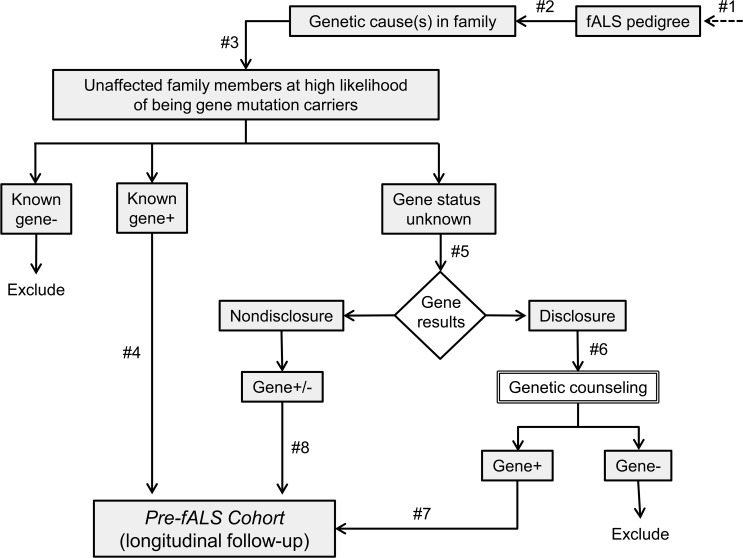
Family members known not to carry the mutated gene (“known gene−”) are excluded. Presymptomatic individuals known to carry the mutated gene (“known gene+”) are directly enrolled in longitudinal follow-up. Other presymptomatic individuals with a high likelihood of having inherited the mutated gene are offered genetic testing. Those who elect to learn the results of genetic testing (“disclosure”) are offered genetic counseling, and only gene carriers (“gene+”) are enrolled in longitudinal follow-up. For those who elect not to learn the results of genetic testing (“nondisclosure”), both carriers and noncarriers of mutated gene (“gene +/−”) are enrolled in the Pre-symptomatic Familial ALS (Pre-fALS) cohort. fALS = familial amyotrophic lateral sclerosis.
References
-
- Ross GW, Petrovitch H, Abbott RD, et al. Association of olfactory dysfunction with risk for future Parkinson's disease. Ann Neurol 2008; 63: 167– 173 . - PubMed
-
- Schenck CH, Bundlie SR, Mahowald MW. Delayed emergence of a parkinsonian disorder in 38% of 29 older men initially diagnosed with idiopathic rapid eye movement sleep behaviour disorder. Neurology 1996; 46: 388– 393 . - PubMed
Publication types
MeSH terms
LinkOut - more resources
Full Text Sources
Other Literature Sources
Medical
Miscellaneous
