


Effects of school-wide positive behavioral interventions and supports on child behavior problems
- PMID: 23071207
- PMCID: PMC3483890
- DOI: 10.1542/peds.2012-0243
Effects of school-wide positive behavioral interventions and supports on child behavior problems
Abstract
Objective: School-Wide Positive Behavioral Interventions and Supports (SWPBIS) is a universal prevention strategy currently implemented in >16,000 schools across the United States. SWPBIS intends to reduce students' behavior problems by altering staff behaviors and developing systems and supports to meet children's behavioral needs. The current study reports intervention effects on child behaviors and adjustment from an effectiveness trial of SWPBIS.
Methods: The sample of 12,344 elementary school children was 52.9% male, 45.1% African American, and 46.1% Caucasian. Approximately 49% received free or reduced-priced meals, and 12.9% received special education services at baseline. The trial used a group randomized controlled effectiveness design implemented in 37 elementary schools. Multilevel analyses were conducted on teachers' ratings of children's behavior problems, concentration problems, social-emotional functioning, prosocial behavior, office discipline referrals, and suspensions at 5 time points over the course of 4 school years.
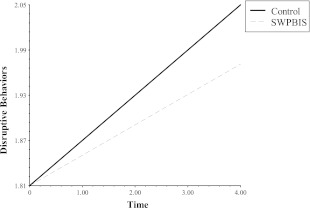
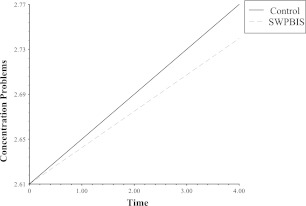
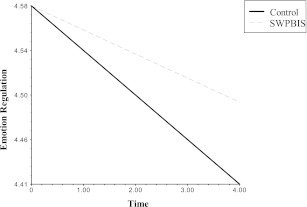
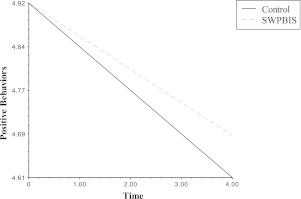
Results: The multilevel results indicated significant effects of SWPBIS on children's behavior problems, concentration problems, social-emotional functioning, and prosocial behavior. Children in SWPBIS schools also were 33% less likely to receive an office discipline referral than those in the comparison schools. The effects tended to be strongest among children who were first exposed to SWPBIS in kindergarten.
Conclusions: These findings provide support for the hypothesized reduction in behavior problems and improvements in prosocial behavior and effective emotion regulation after training in SWPBIS. The SWPBIS framework appears to be a promising approach for reducing problems and promoting adjustment among elementary school children.
Trial registration: ClinicalTrials.gov NCT01583127.
Figures
Comment in
-
School-wide positive behavioural intervention and support programme reduces behaviour problems in elementary school children.Evid Based Ment Health. 2013 May;16(2):49. doi: 10.1136/eb-2012-101174. Epub 2013 Feb 20. Evid Based Ment Health. 2013. PMID: 23426958 No abstract available.
-
A school-based behavioral intervention program demonstrates improvement in individual student behavior.J Pediatr. 2013 Mar;162(3):652-3. doi: 10.1016/j.jpeds.2012.12.062. J Pediatr. 2013. PMID: 23438923 No abstract available.
References
-
- Moffitt TE. Life-course-persistent versus adolescence-limited antisocial behavior. In: Cicchetti D, Cohen DJ, eds. Developmental Psychopathology. Hoboken, NJ: John Wiley & Sons; 2006:570–598
-
- Schaeffer CM, Petras H, Ialongo N, Poduska J, Kellam S. Modeling growth in boys’ aggressive behavior across elementary school: links to later criminal involvement, conduct disorder, and antisocial personality disorder. Dev Psychol. 2003;39(6):1020–1035 - PubMed
-
- Sugai G, Horner RR. Introduction to the special series on positive behavior support in schools. J Emot Behav Disord. 2002;10(3):130–135
-
- Sugai G, Horner RR. A promising approach for expanding and sustaining School-Wide Positive Behavior Support. School Psych Rev. 2006;35(2):245–259
-
- Lewis T, Sugai G. Effective behavior support: a systems approach to proactive schoolwide management. Focus Exceptional Child. 1999;31(6):1–24
Publication types
MeSH terms
Associated data
Grants and funding
LinkOut - more resources
Full Text Sources
Medical
