


Methods in comparative effectiveness research
- PMID: 23071240
- PMCID: PMC3504326
- DOI: 10.1200/JCO.2012.42.2659
Methods in comparative effectiveness research
Abstract
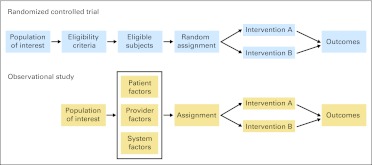
Comparative effectiveness research (CER) seeks to assist consumers, clinicians, purchasers, and policy makers to make informed decisions to improve health care at both the individual and population levels. CER includes evidence generation and evidence synthesis. Randomized controlled trials are central to CER because of the lack of selection bias, with the recent development of adaptive and pragmatic trials increasing their relevance to real-world decision making. Observational studies comprise a growing proportion of CER because of their efficiency, generalizability to clinical practice, and ability to examine differences in effectiveness across patient subgroups. Concerns about selection bias in observational studies can be mitigated by measuring potential confounders and analytic approaches, including multivariable regression, propensity score analysis, and instrumental variable analysis. Evidence synthesis methods include systematic reviews and decision models. Systematic reviews are a major component of evidence-based medicine and can be adapted to CER by broadening the types of studies included and examining the full range of benefits and harms of alternative interventions. Decision models are particularly suited to CER, because they make quantitative estimates of expected outcomes based on data from a range of sources. These estimates can be tailored to patient characteristics and can include economic outcomes to assess cost effectiveness. The choice of method for CER is driven by the relative weight placed on concerns about selection bias and generalizability, as well as pragmatic concerns related to data availability and timing. Value of information methods can identify priority areas for investigation and inform research methods.
Conflict of interest statement
Author's disclosures of potential conflicts of interest and author contributions are found at the end of this article.
Figures
References
-
- Committee on Comparative Effectiveness Research Prioritization, Institute of Medicine: Washington, DC: The National Academies Press; 2009. Summary: Initial National Priorities for Comparative Effectiveness Research; p. 29.
-
- Berwick DM, Nolan TW, Whittington J. The triple aim: Care, health, and cost. Health Aff (Millwood) 2008;27:759–769. - PubMed
-
- Brook RH. Can the Patient-Centered Outcomes Research Institute become relevant to controlling medical costs and improving value? JAMA. 2011;306:2020–2021. - PubMed
-
- Federal Coordinating Council: Report to the President and the Congress on Comparative Effectiveness Research. http://www.hhs.gov/recovery/programs/cer/execsummary.html.
-
- Sox HC, Goodman SN. The methods of comparative effectiveness research. Annu Rev Public Health. 2012;33:425–445. - PubMed
Publication types
MeSH terms
Grants and funding
LinkOut - more resources
Full Text Sources
