. 2012 Nov 6;109(45):18361-6.
doi: 10.1073/pnas.1210393109. Epub 2012 Oct 15.

Evolution of lanthipeptide synthetases

Affiliations

Evolution of lanthipeptide synthetases

Qi Zhang et al. Proc Natl Acad Sci U S A. .

Abstract

Lanthionine-containing peptides (lanthipeptides) are a family of ribosomally synthesized and posttranslationally modified peptides containing (methyl)lanthionine residues. Here we present a phylogenomic study of the four currently known classes of lanthipeptide synthetases (LanB and LanC for class I, LanM for class II, LanKC for class III, and LanL for class IV). Although they possess very similar cyclase domains, class II-IV synthetases have evolved independently, and LanB and LanC enzymes appear to not always have coevolved. LanM enzymes from various phyla that have three cysteines ligated to a zinc ion (as opposed to the more common Cys-Cys-His ligand set) cluster together. Most importantly, the phylogenomic data suggest that for some scaffolds, the ring topology of the final lanthipeptides may be determined in part by the sequence of the precursor peptides and not just by the biosynthetic enzymes. This notion was supported by studies with two chimeric peptides, suggesting that the nisin and prochlorosin biosynthetic enzymes can produce the correct ring topologies of epilancin 15X and lacticin 481, respectively. These results highlight the potential of lanthipeptide synthetases for bioengineering and combinatorial biosynthesis. Our study also demonstrates unexplored areas of sequence space that may be fruitful for genome mining.


Conflict of interest statement

The authors declare no conflict of interest.

Figures
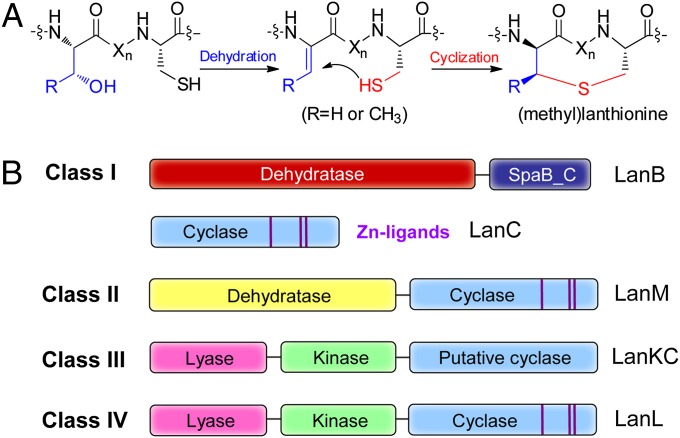
Fig. 1.
Fig. 1.
Biosynthesis of lanthipeptides, showing the mechanism of (methyl)lanthionine formation (A), and the four classes of synthetases (B). Xn represents a peptide linker. The conserved zinc-binding motifs are highlighted by the purple lines in the cyclase domains. SpaB_C is an in silico defined domain currently found as a stand-alone protein for thiopeptide biosynthesis and as the C-terminal domain of LanB enzymes. The N-terminal domain of LanB enzymes is made up of two subdomains according to the Conserved Domain Database (26).
Fig. 2.
Fig. 2.
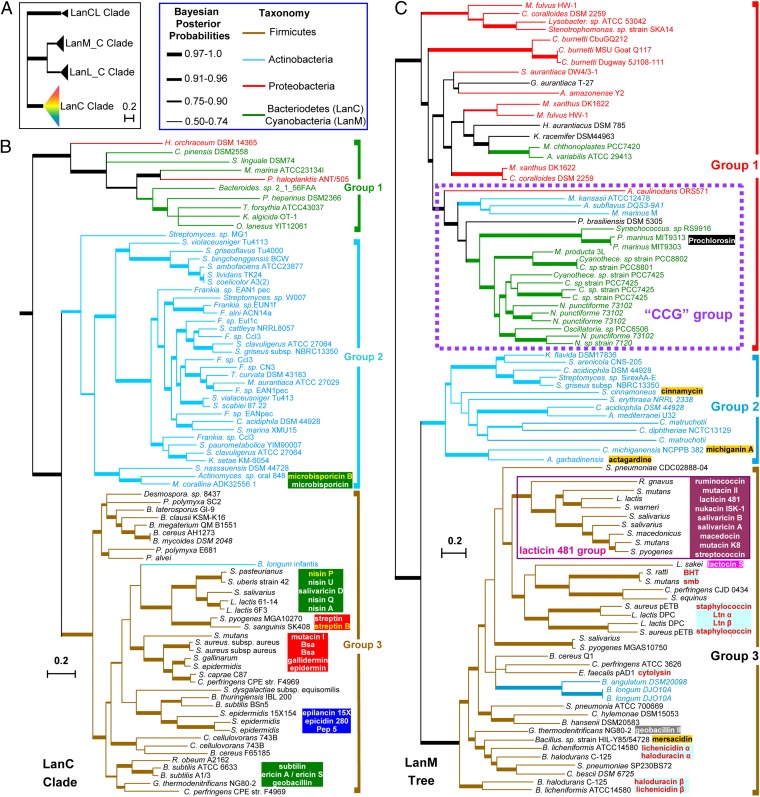
Bayesian MCMC phylogeny of LanC and LanM enzymes. (A) Tree of LanC and LanC-like enzymes. LanM_C and LanL_C represent the C-terminal cyclase domains of LanM and LanL, respectively. (B) The LanC clade of A. (C) Phylogenetic tree of LanM enzymes. As no suitable outgroup protein can be found (LanLs cannot serve as outgroup, because their N-terminal domains are not homologous to those of LanMs), the trees were rooted by using all members of a sister clade as the outgroup, an approach previously suggested as optimal in such instances (44). Bayesian inferences of posterior probabilities are indicated by line width. Lanthipeptides in each tree are shown by different colored boxes according to structural types. Two-component lantibiotics are in red font, and lanthipeptides proposed in this study are in yellow font.
Fig. 3.
Fig. 3.
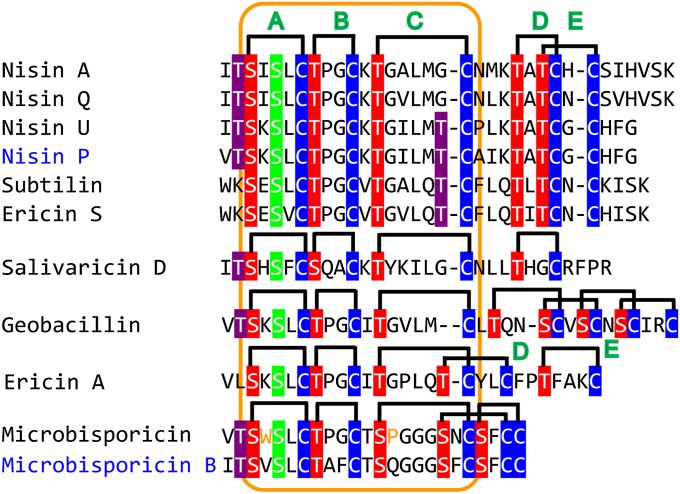
Comparative analysis of the nisin-like peptides. A–E denote different rings. The conserved N termini are highlighted by the orange box. Ser and Thr that are involved in ring formation are shown by red highlighted font. Ser and Thr that are dehydrated but not involved in ring formation are shown in green and purple highlighted font. New compounds proposed in this study are shown in blue font.
Fig. 4.
Fig. 4.
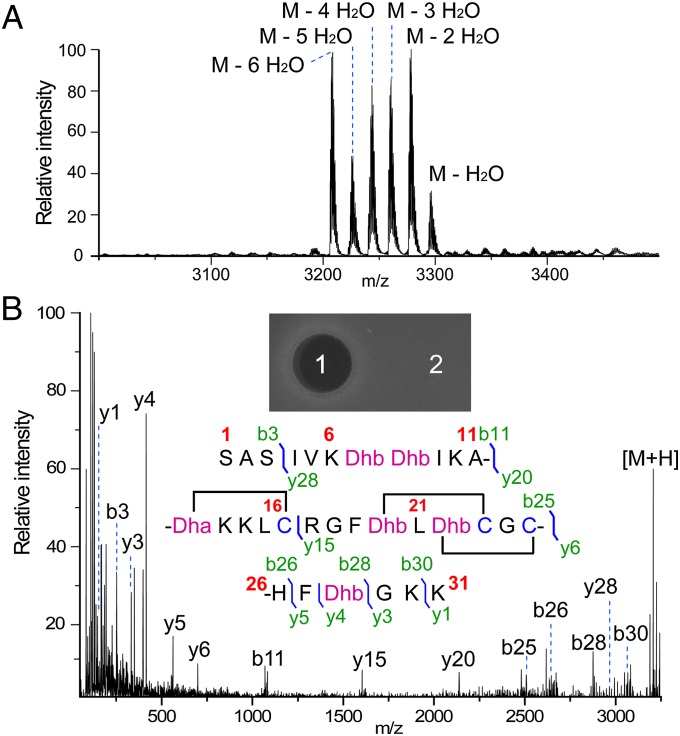
Generation of a bioactive epilancin 15X analog with the nisin biosynthetic enzymes. (A) MALDI-MS analysis of NisA-ElxA modified in E. coli by NisB and NisC and treated with GluC protease. (B) ESI-MS/MS analysis of the sixfold dehydrated peptide. The proposed structure, the MS/MS fragmentation pattern, and the in vitro bioassay against S. carnosus are shown. Spots 1 and 2 on the bioassay plate are assay and negative control.
Fig. 5.
Fig. 5.
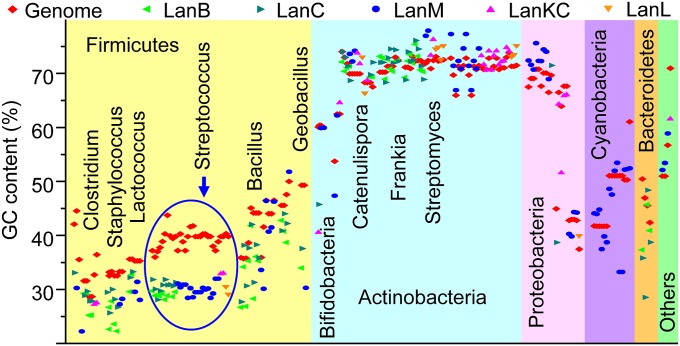
Base composition analysis of the lanthipeptide synthetase genes and the associated genomes. Genome sequences are from the same species as the synthetase genes but the subspecies are different in some cases.

References

    1. Fischbach MA, Walsh CT. Assembly-line enzymology for polyketide and nonribosomal peptide antibiotics: Logic, machinery, and mechanisms. Chem Rev. 2006;106(8):3468–3496. - PubMed
    1. Strieker M, Tanović A, Marahiel MA. Nonribosomal peptide synthetases: Structures and dynamics. Curr Opin Struct Biol. 2010;20(2):234–240. - PubMed
    1. Oman TJ, van der Donk WA. Follow the leader: The use of leader peptides to guide natural product biosynthesis. Nat Chem Biol. 2010;6(1):9–18. - PMC - PubMed
    1. Velásquez JE, van der Donk WA. Genome mining for ribosomally synthesized natural products. Curr Opin Chem Biol. 2011;15(1):11–21. - PMC - PubMed
    1. McIntosh JA, Donia MS, Schmidt EW. Ribosomal peptide natural products: Bridging the ribosomal and nonribosomal worlds. Nat Prod Rep. 2009;26(4):537–559. - PMC - PubMed

Publication types

LinkOut - more resources