. 2012;8(10):e1003016.
doi: 10.1371/journal.pgen.1003016. Epub 2012 Oct 11.

Mismatch repair balances leading and lagging strand DNA replication fidelity

Affiliations

Mismatch repair balances leading and lagging strand DNA replication fidelity

Scott A Lujan et al. PLoS Genet. 2012.

Abstract

The two DNA strands of the nuclear genome are replicated asymmetrically using three DNA polymerases, α, δ, and ε. Current evidence suggests that DNA polymerase ε (Pol ε) is the primary leading strand replicase, whereas Pols α and δ primarily perform lagging strand replication. The fact that these polymerases differ in fidelity and error specificity is interesting in light of the fact that the stability of the nuclear genome depends in part on the ability of mismatch repair (MMR) to correct different mismatches generated in different contexts during replication. Here we provide the first comparison, to our knowledge, of the efficiency of MMR of leading and lagging strand replication errors. We first use the strand-biased ribonucleotide incorporation propensity of a Pol ε mutator variant to confirm that Pol ε is the primary leading strand replicase in Saccharomyces cerevisiae. We then use polymerase-specific error signatures to show that MMR efficiency in vivo strongly depends on the polymerase, the mismatch composition, and the location of the mismatch. An extreme case of variation by location is a T-T mismatch that is refractory to MMR. This mismatch is flanked by an AT-rich triplet repeat sequence that, when interrupted, restores MMR to > 95% efficiency. Thus this natural DNA sequence suppresses MMR, placing a nearby base pair at high risk of mutation due to leading strand replication infidelity. We find that, overall, MMR most efficiently corrects the most potentially deleterious errors (indels) and then the most common substitution mismatches. In combination with earlier studies, the results suggest that significant differences exist in the generation and repair of Pol α, δ, and ε replication errors, but in a generally complementary manner that results in high-fidelity replication of both DNA strands of the yeast nuclear genome.


Conflict of interest statement

The authors have declared that no competing interests exist.

Figures
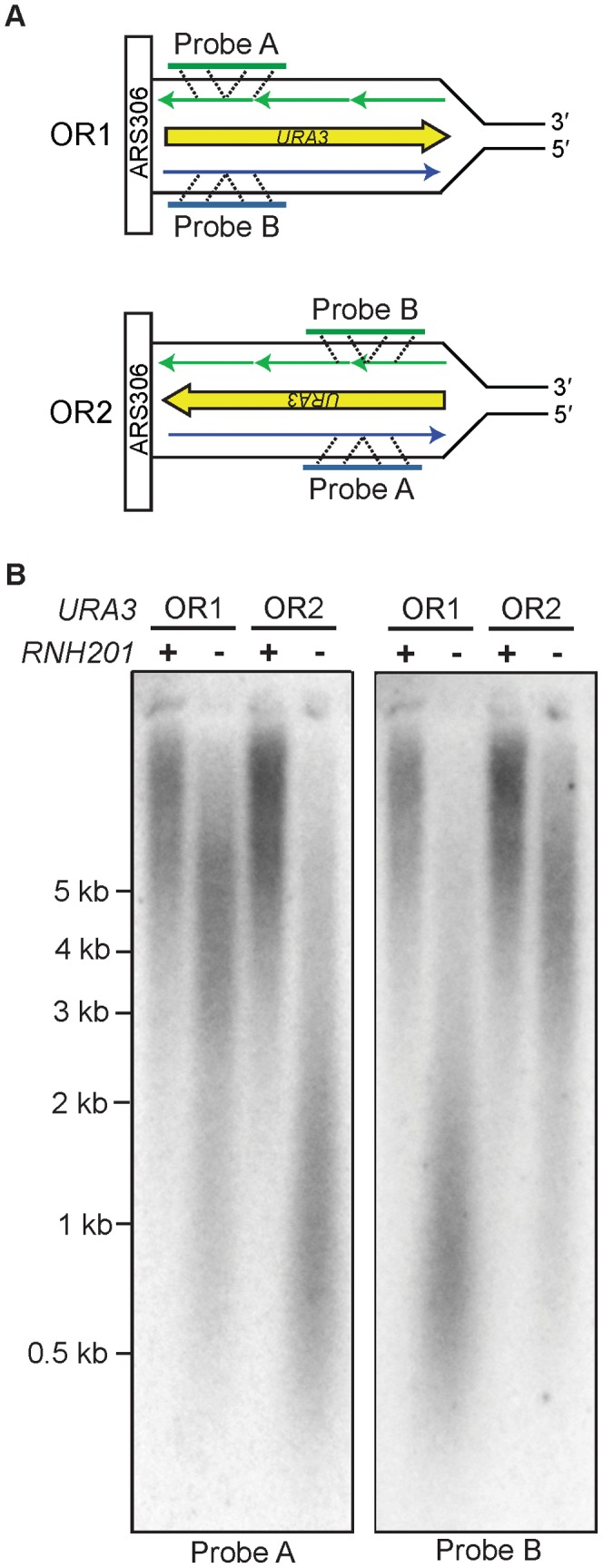
Figure 1
Figure 1. Strand-specific incorporation of rNMPs into genomic DNA.
A. The orientation of the URA3 reporter with respect to coding sequence is indicated as orientation 1 (OR1) or orientation 2 (OR2). DNA template strands are in black, the nascent leading strand is in blue and the nascent lagging strand is in green. B. Detection of alkali-sensitive sites in yeast genomic DNA reveals a strand bias for incorporation of ribonucleotides. Following alkaline hydrolysis and alkaline agarose-electrophoresis, the DNA was transferred to a nylon membrane and processed for Southern analysis. The indicated region of the URA3 reporter gene was examined using strand-specific radiolabeled probes that anneal to either the nascent leading or nascent lagging strand. The sizes of DNA markers are indicated on the left. All strains harbor the pol2-M644G mutator allele. Increased DNA mobility is indicative of alkali-sensitivity due to the presence of ribonucleotides in the nascent DNA strand.
Figure 2
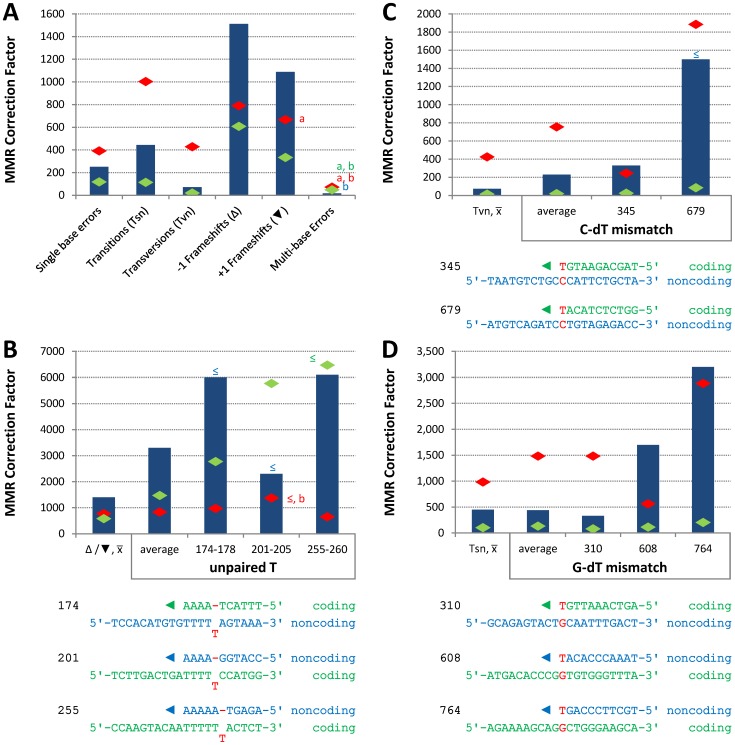
Figure 2. Correction factors for various mismatches made by each mutator polymerases.
Mismatch repair correction factors for errors created by M644G Pol ε (blue columns), L868M Pol α (red diamonds), and L612M Pol δ (green diamonds) . All correction factors are significant (p≤0.05) unless otherwise noted. (A) Correction factors for six classes of mutations across all URA3 sequence positions. URA3-orientations 1 and 2 correction factors are averaged (geometric mean). Mutation class abbreviations are shown in parentheses. In panels B, C and D, for specific mutations, the inferred mismatch and the surrounding sequence context are shown below the chart. Mutation positions are shown to the left. The nascent (above) and template (below) strands are shown to the right. Triangles indicate synthesis direction. The coding strand is green, the non-coding strand is blue, and mismatched bases are red. (B) Correction factors for unpaired T bases at specific URA3 positions, as compared to averages and general frameshift mutations. (C) Correction factors for C-dT mismatches at specific URA3 positions, as compared to averages and general transversion mutations. Only positions 345 and 679 had sufficient observations to allow significant calculations for all three polymerases. (D) Correction factors for G-dT mismatches at specific URA3 positions, as compared to averages and general transition mutations. URA3 positions 310, 608, and 764 had sufficient observations. x– Average of relevant sequence positions and both URA3 orientations. Upper bound, estimated by increasing msh2Δ observation count from 0 to 1 for purposes of correction factor calculations. a Calculated from only one URA3 orientation due to insufficient observations in the other. b p>0.05.
Figure 3
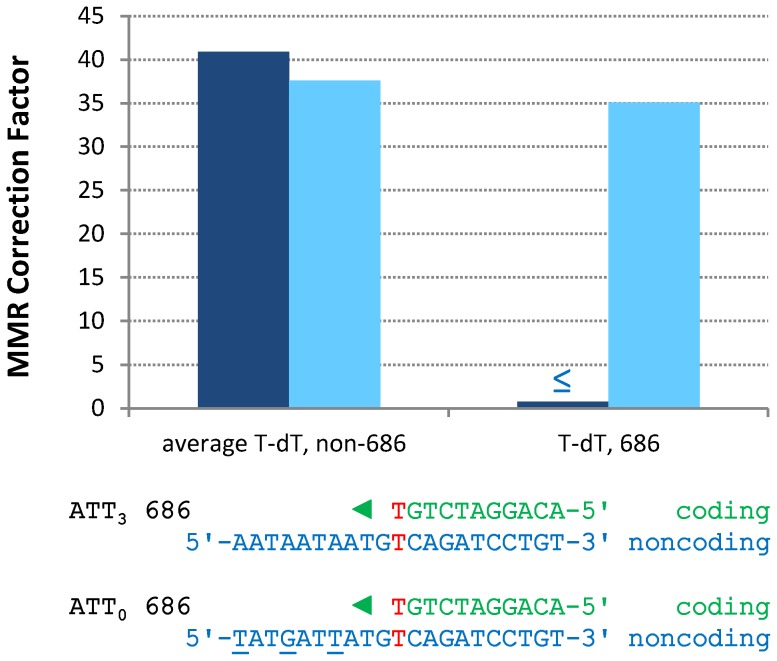
Figure 3. Restoration of T-dT repair at position 686 by removing a flanking triplet repeat.
Mismatch repair correction factors for errors created by M644G Pol ε in ATT3 (dark blue columns) and ATT0 (light blue columns) URA3 sequences. The T-dT mismatch at position 686 and the surrounding sequence context are shown below the chart: nascent strand above; template strand below. Triangles indicate the direction of synthesis. The three silent mutations made to convert ATT3 into ATT0 URA3 are underlined. Note that the polymerase active site encounters the triplet repeat in the ATT3 template strand after making the T-dT mismatch at position 686. Upper bound, estimated by increasing msh2Δ observation count from 0 to 1 for purposes of correction factor calculations.

References

    1. Kunkel TA (2004) DNA replication fidelity. J Biol Chem 279: 16895–16898. - PubMed
    1. Nick McElhinny SA, Gordenin DA, Stith CM, Burgers PM, Kunkel TA (2008) Division of labor at the eukaryotic replication fork. Mol Cell 30: 137–144. - PMC - PubMed
    1. Kunkel TA, Erie DA (2005) DNA mismatch repair. Annu Rev Biochem 74: 681–710. - PubMed
    1. Iyer RR, Pluciennik A, Burdett V, Modrich PL (2006) DNA mismatch repair: functions and mechanisms. Chem Rev 106: 302–323. - PubMed
    1. Hsieh P, Yamane K (2008) DNA mismatch repair: molecular mechanism, cancer, and ageing. Mech Ageing Dev 129: 391–407. - PMC - PubMed

Publication types

Substances