


Reproducibility, performance, and clinical utility of a genetic risk prediction model for prostate cancer in Japanese
- PMID: 23071574
- PMCID: PMC3468627
- DOI: 10.1371/journal.pone.0046454
Reproducibility, performance, and clinical utility of a genetic risk prediction model for prostate cancer in Japanese
Abstract
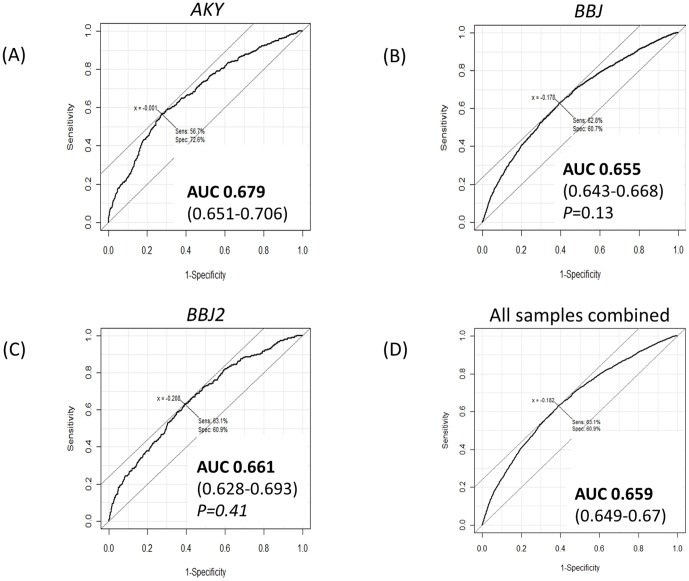
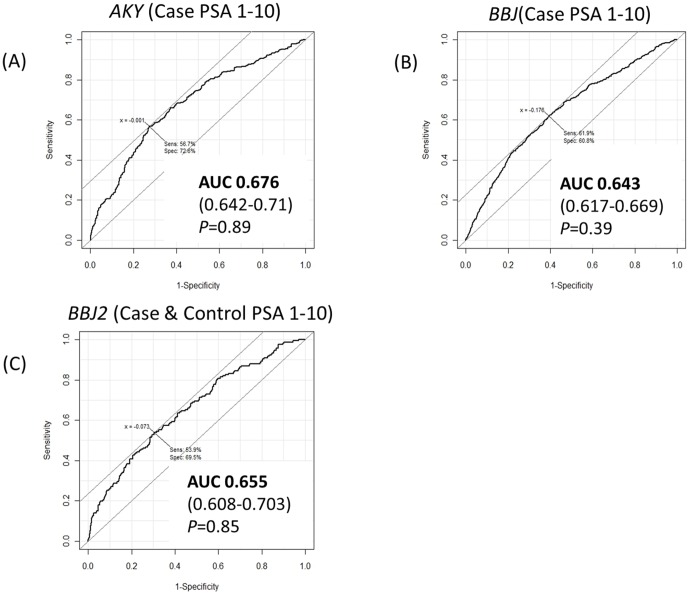
Prostate specific antigen (PSA) is widely used as a diagnostic biomarker for prostate cancer (PC). However, due to its low predictive performance, many patients without PC suffer from the harms of unnecessary prostate needle biopsies. The present study aims to evaluate the reproducibility and performance of a genetic risk prediction model in Japanese and estimate its utility as a diagnostic biomarker in a clinical scenario. We created a logistic regression model incorporating 16 SNPs that were significantly associated with PC in a genome-wide association study of Japanese population using 689 cases and 749 male controls. The model was validated by two independent sets of Japanese samples comprising 3,294 cases and 6,281 male controls. The areas under curve (AUC) of the model were 0.679, 0.655, and 0.661 for the samples used to create the model and those used for validation. The AUCs were not significantly altered in samples with PSA 1-10 ng/ml. 24.2% and 9.7% of the patients had odds ratio <0.5 (low risk) or >2 (high risk) in the model. Assuming the overall positive rate of prostate needle biopsies to be 20%, the positive biopsy rates were 10.7% and 42.4% for the low and high genetic risk groups respectively. Our genetic risk prediction model for PC was highly reproducible, and its predictive performance was not influenced by PSA. The model could have a potential to affect clinical decision when it is applied to patients with gray-zone PSA, which should be confirmed in future clinical studies.
Conflict of interest statement
Figures
References
-
- Grönberg H (2003) Prostate cancer epidemiology. Lancet 361: 859–864. - PubMed
-
- Matsuda T, Saika K (2009) Comparison of time trends in prostate cancer incidence (1973–2002) in Asia, from cancer incidence in five continents, Vols IV–IX. Jpn J Clin Oncol 39: 468–469. - PubMed
-
- Bostwick DG, Burke HB, Djakiew D, Euling S, Ho SM, et al. (2004) Human prostate cancer risk factors. Cancer 101: 2371–2490. - PubMed
-
- Pienta KJ, Esper PS (1993) Risk factors for prostate cancer. Ann Intern Med 118: 793–803. - PubMed
-
- Loeb S, Catalona WJ (2007) Prostate-specific antigen in clinical practice. Cancer Lett 249: 30–39. - PubMed
Publication types
MeSH terms
Substances
Grants and funding
LinkOut - more resources
Full Text Sources
Medical
Research Materials
Miscellaneous
