


Testosterone administration reduces lying in men
- PMID: 23071635
- PMCID: PMC3468628
- DOI: 10.1371/journal.pone.0046774
Testosterone administration reduces lying in men
Abstract
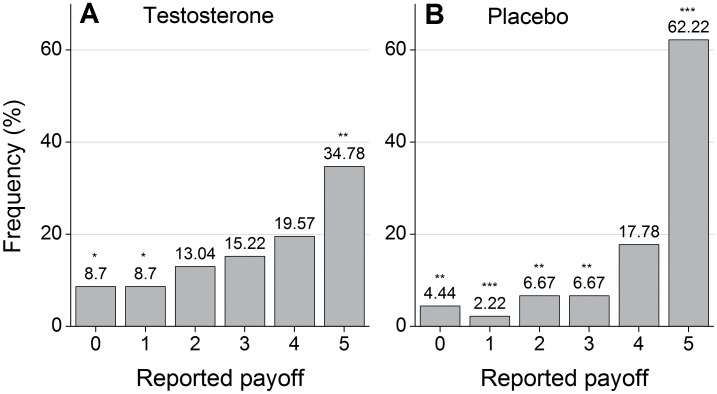
Lying is a pervasive phenomenon with important social and economic implications. However, despite substantial interest in the prevalence and determinants of lying, little is known about its biological foundations. Here we study a potential hormonal influence, focusing on the steroid hormone testosterone, which has been shown to play an important role in social behavior. In a double-blind placebo-controlled study, 91 healthy men (24.32±2.73 years) received a transdermal administration of 50 mg of testosterone (n=46) or a placebo (n=45). Subsequently, subjects participated in a simple task, in which their payoff depended on the self-reported outcome of a die-roll. Subjects could increase their payoff by lying without fear of being caught. Our results show that testosterone administration substantially decreases lying in men. Self-serving lying occurred in both groups, however, reported payoffs were significantly lower in the testosterone group (p<0.01). Our results contribute to the recent debate on the effect of testosterone on prosocial behavior and its underlying channels.
Conflict of interest statement
Figures
References
-
- Bok S (1978) Lying: Moral choice in public and private life. New York: Vintage Books. 326 p.
-
- DePaulo BM, Kashy DA, Kirkendol SE, Wyer MM, Epstein JA (1996) Lying in everyday life. J Pers Soc Psychol 70: 979–995. - PubMed
-
- Vrij A (2001) Detecting lies and deceit: The psychology of lying and the implications for professional practice. Hoboken: John Wiley & Sons. 254 p.
-
- Archer J (2006) Testosterone and human aggression: an evaluation of the challenge hypothesis. Neurosci Biobehav Rev 30: 319–345. - PubMed
-
- Carre J M, McCormick C, Hariri A (2011) The social neuroendocrinology of human aggression. Psychoneuroendocrino 36 935–944. - PubMed
Publication types
MeSH terms
Substances
LinkOut - more resources
Full Text Sources
Other Literature Sources
Molecular Biology Databases
