. 2012;7(10):e46821.
doi: 10.1371/journal.pone.0046821. Epub 2012 Oct 8.

Evolutionary history of contagious bovine pleuropneumonia using next generation sequencing of Mycoplasma mycoides Subsp. mycoides "Small Colony"

Affiliations

Evolutionary history of contagious bovine pleuropneumonia using next generation sequencing of Mycoplasma mycoides Subsp. mycoides "Small Colony"

Virginie Dupuy et al. PLoS One. 2012.

Abstract

Mycoplasma mycoides subsp. mycoides "Small Colony" (MmmSC) is responsible for contagious bovine pleuropneumonia (CBPP) in bovidae, a notifiable disease to the World Organization for Animal Health (OIE). Although its origin is not documented, the disease was known in Europe in 1773. It reached nearly world-wide distribution in the 19(th) century through the cattle trade and was eradicated from most continents by stamping-out policies. During the 20(th) century it persisted in Africa, and it reappeared sporadically in Southern Europe. Yet, classical epidemiology studies failed to explain the re-occurrence of the disease in Europe in the 1990s. The objectives of this study were to obtain a precise phylogeny of this pathogen, reconstruct its evolutionary history, estimate the date of its emergence, and determine the origin of the most recent European outbreaks. A large-scale genomic approach based on next-generation sequencing technologies was applied to construct a robust phylogeny of this extremely monomorphic pathogen by using 20 representative strains of various geographical origins. Sixty two polymorphic genes of the MmmSC core genome were selected, representing 83601 bp in total and resulting in 139 SNPs within the 20 strains. A robust phylogeny was obtained that identified a lineage specific to European strains; African strains were scattered in various branches. Bayesian analysis allowed dating the most recent common ancestor for MmmSC around 1700. The strains circulating in Sub-Saharan Africa today, however, were shown to descend from a strain that existed around 1810. MmmSC emerged recently, about 300 years ago, and was most probably exported from Europe to other continents, including Africa, during the 19(th) century. Its diversity is now greater in Africa, where CBPP is enzootic, than in Europe, where outbreaks occurred sporadically until 1999 and where CBPP may now be considered eradicated unless MmmSC remains undetected.


Conflict of interest statement

Competing Interests: The authors have declared that no competing interests exist.

Figures

Figure 1
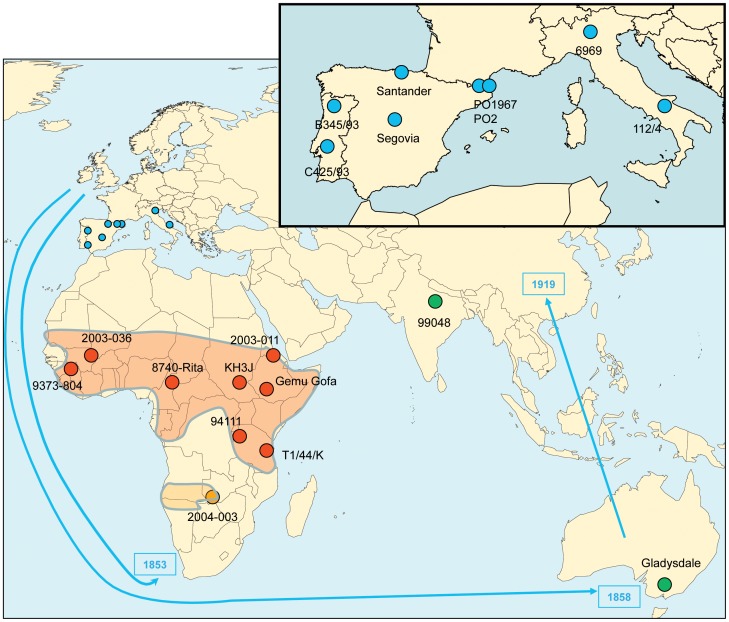
Figure 1. Geographical distribution and diversity of the M. mycoides subsp. mycoides “Small Colony” (MmmSC) strains studied.
Twenty MmmSC strains were included in this study. Two strains were chosen from each European country that was infected in the 20th century (blue dots). Eight strains from Sub-Saharan Africa were selected to reflect the widest geographical diversity in this region (red dots). One strain was chosen to represent the southern part of the African continent (orange dot). In addition, one strain from Australia and one from India were also included (green dots). The reference strain, PG1T, is not represented as its origin is not known. The arrows indicate the routes of contagious bovine pleuropneumonia (CBPP) expansion during the 19th century as inferred from historical documents. The dates of introduction are indicated at the tip of the arrows. The red and orange shaded areas in Africa represent the most probable zones where CBPP is now enzootic.
Figure 2
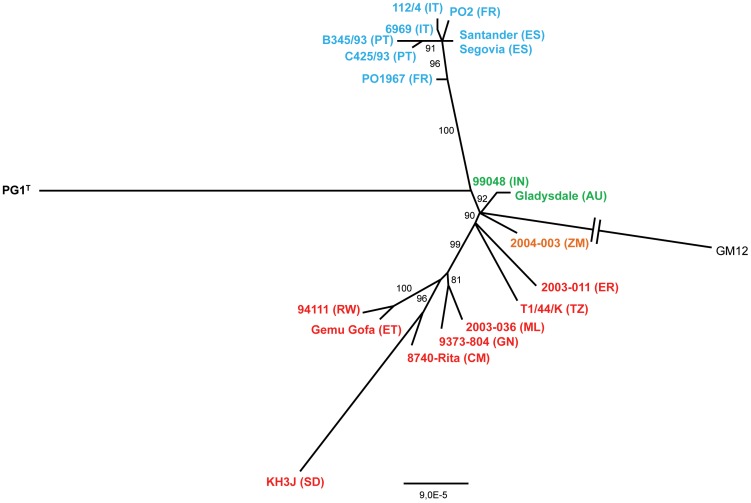
Figure 2. Phylogeny of Mycoplasma mycoides subsp. mycoides “Small Colony” (MmmSC) inferred by the maximum likelihood method.
The maximum likelihood tree was reconstructed using PhyML (GTR with invariable sites) based on the alignment of 62 concatenated core genes of MmmSC. Bootstrap values >80% are shown. Strain names are colored according to the sampling location (see Figure 1). Country codes are indicated in brackets. The branch corresponding to the outgroup (GM12) was shortened, as indicated by two parallel bars. The scale indicates the number of substitutions per site. Abbreviations: AU = Australia; CM = Cameroon; ES = Spain; ER = Eritrea; ET = Ethiopia; FR = France; GN = Guinea; IN = India; IT = Italy; ML = Mali; PT = Portugal; RW = Rwanda; SD = Sudan; TZ = Tanzania; ZM = Zambia.
Figure 3
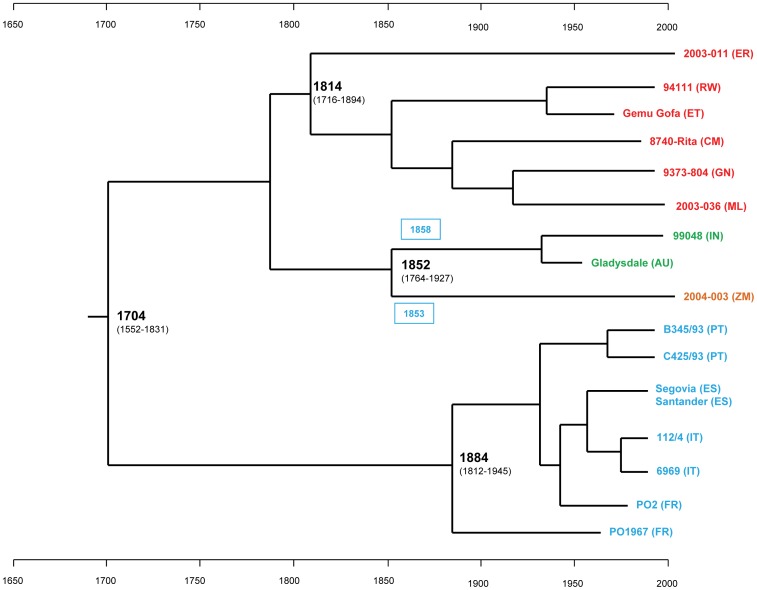
Figure 3. Bayesian inference of Mycoplasma mycoides subsp. mycoides “Small Colony” evolutionary history.
The maximum credibility tree resulted from BEAST analysis with the concatenated sequence of 62 core genes and using a strict molecular clock and a GTR+I substitution model. Branches are scaled by time according to the scales displayed at the bottom and top of the figure. Strain names are colored according to the sampling location (see Figure 1). Country codes are indicated in brackets (for abbreviations refer to Figure 2). The dates at the nodes refer to the most recent common ancestor (MRCA) estimated by BEAST for all strains deriving from these nodes. The 95% Highest Posterior Densities (HPD) values are displayed in brackets. The node leading to the Australasian and South African strains was used as a control of estimation accuracy. The model dates their MRCA around 1850. This agrees with the dates of CBPP introduction in Australia (1858) and Southern Africa (1853), indicated in blue boxes. According to this model, the MRCA for all the tested strains emerged around 1700 and the MRCA for all the Sub-Saharan strains around 1810.

References

    1. Peires JB (1989) The dead will arise. Johanesburgh: Ravan. 348 p.
    1. Roeder PL (2011) Rinderpest: The end of cattle plague. Prev Vet Med 102: 98–106. - PubMed
    1. Provost A, Perreau P, Breard A, Le Goff C, Martel JL, et al. (1987) Contagious bovine pleuropneumonia. Rev Sci Tech 6: 625–679. - PubMed
    1. Estienne C (1564) L'agriculture et maison rustique. Paris: Du Puis, Jaques. 336 p.
    1. Scheuchzer JJ (1732) Fliegender Zungen-Krebs, eine Vieh-Seuche, welche anno 1732. die Eydgenössische Lande ergriffen. Zürich: Heidegger. 60 p.

Publication types

MeSH terms