


GABAergic control of critical developmental periods for anxiety- and depression-related behavior in mice
- PMID: 23071808
- PMCID: PMC3469546
- DOI: 10.1371/journal.pone.0047441
GABAergic control of critical developmental periods for anxiety- and depression-related behavior in mice
Abstract
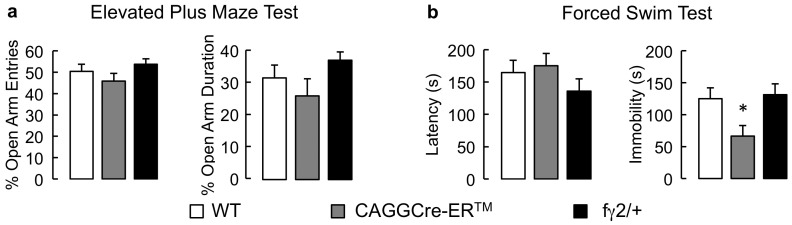
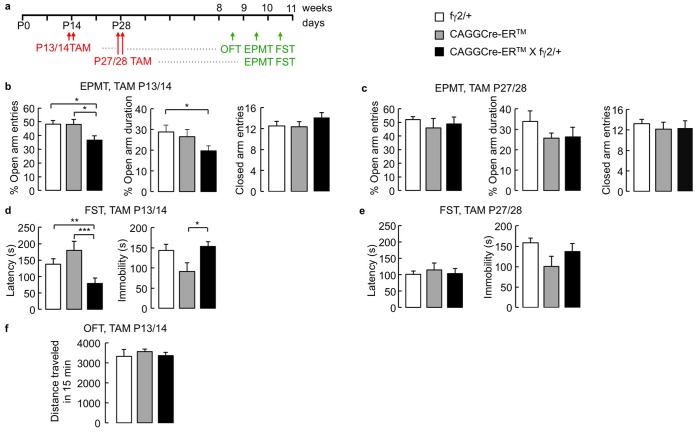
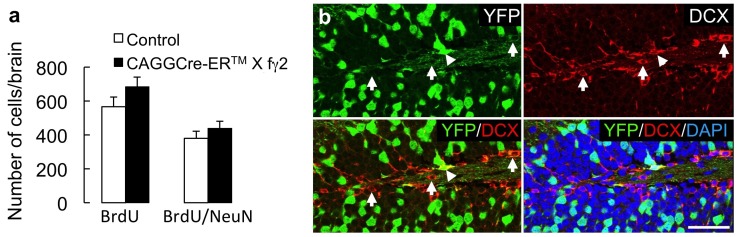
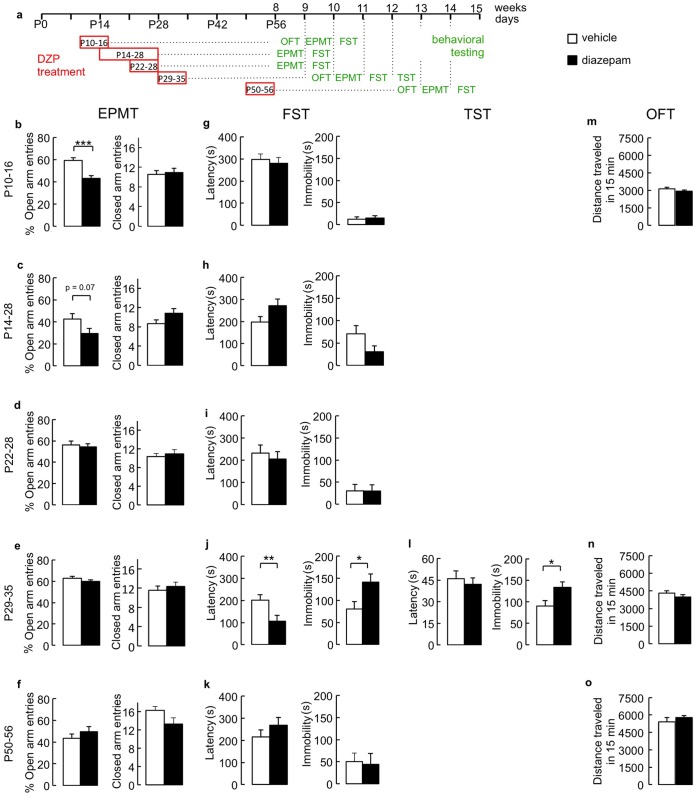
Vulnerability for anxiety and depressive disorders is thought to have origins in early life and is increasingly recognized to involve deficits in GABAergic neurotransmission. Mice that were rendered heterozygous for the γ2 subunit gene of GABA(A) receptors (GABA(A)Rs) show behavioral, cognitive, neuroendocrine and pharmacologic features expected of a mouse model of melancholic anxious depression, including reduced survival of adult-born hippocampal neurons. Here we embarked on elucidating the developmental substrate underlying this phenotype, focusing on the Elevated Plus Maze and Forced Swim Test as relevant behavioral paradigms. In a first series of experiments using hemizygous tamoxifen-induced genetic inactivation of a floxed γ2 genomic locus we show that reducing the gene dosage at postnatal days (P)13/14 but not P27/28 results in altered behavior in both of these tests in adulthood, reminiscent of the anxious-depressive phenotype previously described for global heterozygous mice. However, in contrast to global heterozygous mice, the behavioral changes induced by γ2 subunit knockdown at P13/14 occurred without changes in adult hippocampal neurogenesis, indicating that altered neurogenesis is not an absolute prerequisite for anxiety- and depression-related behavior in this model. In a separate series of experiments using a pharmacological approach, acute but transient potentiation of GABA(A)Rs with diazepam uncovered distinct developmental vulnerabilities for altered behavior in the Elevated Plus Maze and Forced Swim Test, respectively. Specifically, diazepam given during P10-16 but not during later weeks resulted in increased anxiety-like behavior in adulthood, while diazepam administered during P29-35 but not earlier nor later resulted in increased immobility behavior in adulthood. We conclude that anxiety-like behavior in the Elevated Plus Maze and behavioral despair-like immobility in the Forced Swim Test are controlled by separate postnatal critical periods characterized by distinct developmental sensitivity to manipulation of GABAergic transmission via γ2 subunit-containing GABA(A)Rs.
Conflict of interest statement
Figures
Similar articles
-
GABAergic control of adult hippocampal neurogenesis in relation to behavior indicative of trait anxiety and depression states.J Neurosci. 2007 Apr 4;27(14):3845-54. doi: 10.1523/JNEUROSCI.3609-06.2007. J Neurosci. 2007. PMID: 17409249 Free PMC article.
-
gamma-Aminobutyric acid-type A receptor deficits cause hypothalamic-pituitary-adrenal axis hyperactivity and antidepressant drug sensitivity reminiscent of melancholic forms of depression.Biol Psychiatry. 2010 Sep 15;68(6):512-20. doi: 10.1016/j.biopsych.2010.04.024. Epub 2010 Jul 1. Biol Psychiatry. 2010. PMID: 20579975 Free PMC article.
-
Defects in dendrite and spine maturation and synaptogenesis associated with an anxious-depressive-like phenotype of GABAA receptor-deficient mice.Neuropharmacology. 2015 Jan;88:171-9. doi: 10.1016/j.neuropharm.2014.07.019. Epub 2014 Aug 5. Neuropharmacology. 2015. PMID: 25107590 Free PMC article.
-
GABA homeostasis contributes to the developmental programming of anxiety-related behavior.Brain Res. 2008 May 19;1210:189-99. doi: 10.1016/j.brainres.2008.03.006. Epub 2008 Mar 18. Brain Res. 2008. PMID: 18407251
-
Animal models of anxiety disorders in rats and mice: some conceptual issues.Dialogues Clin Neurosci. 2011;13(4):495-506. doi: 10.31887/DCNS.2011.13.4/tsteimer. Dialogues Clin Neurosci. 2011. PMID: 22275854 Free PMC article. Review.
Cited by
-
Neural mechanisms underlying GABAergic regulation of adult hippocampal neurogenesis.Cell Tissue Res. 2018 Jan;371(1):33-46. doi: 10.1007/s00441-017-2668-y. Epub 2017 Sep 25. Cell Tissue Res. 2018. PMID: 28948349 Free PMC article. Review.
-
Reversal of a Treatment-Resistant, Depression-Related Brain State with the Kv7 Channel Opener Retigabine.Neuroscience. 2019 May 15;406:109-125. doi: 10.1016/j.neuroscience.2019.03.003. Epub 2019 Mar 8. Neuroscience. 2019. PMID: 30858110 Free PMC article.
-
Upregulated GABA Inhibitory Function in ADHD Children with Child Behavior Checklist-Dysregulation Profile: 123I-Iomazenil SPECT Study.Front Psychiatry. 2015 Jun 2;6:84. doi: 10.3389/fpsyt.2015.00084. eCollection 2015. Front Psychiatry. 2015. PMID: 26082729 Free PMC article.
-
The Epigenome in Neurodevelopmental Disorders.Front Neurosci. 2021 Nov 3;15:776809. doi: 10.3389/fnins.2021.776809. eCollection 2021. Front Neurosci. 2021. PMID: 34803599 Free PMC article. Review.
-
Modulation of anxiety and fear via distinct intrahippocampal circuits.Elife. 2016 Mar 14;5:e14120. doi: 10.7554/eLife.14120. Elife. 2016. PMID: 26971710 Free PMC article.
References
-
- Murphy JM, Horton NJ, Laird NM, Monson RR, Sobol AM, et al. (2004) Anxiety and depression: a 40-year perspective on relationships regarding prevalence, distribution, and comorbidity. Acta Psychiatr Scand 109: 355–375. - PubMed
-
- Gamez W, Watson D, Doebbeling BN (2007) Abnormal personality and the mood and anxiety disorders: Implications for structural models of anxiety and depression. J Anxiety Disord 21: 526–539. - PubMed
-
- Pritchett DB, Sontheimer H, Shivers BD, Ymer S, Kettenmann H, et al. (1989) Importance of a novel GABAA receptor subunit for benzodiazepine pharmacology. Nature 338: 582–585. - PubMed
Publication types
MeSH terms
Substances
Grants and funding
LinkOut - more resources
Full Text Sources
Medical
Molecular Biology Databases
