. 2012 Oct;19(5):423-33.
doi: 10.1093/dnares/dss023.

Efficient detection, quantification and enrichment of subtle allelic alterations

Affiliations

Efficient detection, quantification and enrichment of subtle allelic alterations

Jianbin Chen et al. DNA Res. 2012 Oct.

Abstract

Gene targeting (GT) can introduce subtle alterations into a particular locus and represents a powerful tool for genome editing. Engineered zinc finger nucleases (ZFNs) are effective for generating minor allelic alterations. Efficient detection of such minor alterations remains one of the challenges in ZFN-mediated GT experiments. Here, we report the establishment of procedures allowing for efficient detection, quantification and enrichment of such subtle alterations. In a biallelic model, polyacrylamide gel electrophoresis (PAGE) is capable of detecting rare allelic variations in the form of DNA heteroduplexes at a high efficiency of ~0.4% compared with ~6.3% by the traditional T7 endonuclease I-digestion and agarose gel electrophoresis. In a multiple allelic model, PAGE could discriminate different alleles bearing addition or deletion of 1-18 bp as distinct bands that were easily quantifiable by densitometry. Furthermore, PAGE enables enrichment for rare alleles. We show for the first time that direct endogenous GT is possible in medaka by ZFN RNA injection, whereas PAGE allows for detection and cloning of ZFN-targeted alleles in adults arising from ZFN-injected medaka embryos. Therefore, PAGE is effective for detection, quantification and enrichment of multiple fine allelic differences and thus offers a versatile tool for screening targeted subtle gene alterations.


Figures

Figure 1.
Figure 1.
Heteroduplex production and detection by TAGE and PAGE. (A) Flowchart showing heteroduplex production by PCR and heteroduplex detection by PAGE and TAGE. (B and C) Biallelic heteroduplex model assay. Plasmids containing a WT allele (WT1) and a mutant allele with an 18-bp deletion (D18) were mixed with indicated dilution factor for PCR. (B) TAGE detection. D18 with a dilution factor of 16 can be detected. (C) PAGE detection. D18 with a dilution factor of 256 can be detected. Size markers in base pairs are indicated to the left. Arrowheads denote a double band. Asterisks depict heteroduplexes. Hm, homoduplex; Ht, heteroduplex; PAGE, polyacrylamide gel electrophoresis; T7, T7 endonuclease I; TAGE, T7-digestion and agarose gel electrophoresis. This figure appears in colour in the online version of DNA Research.
Figure 2.
Figure 2.
PAGE detection of multiple alleles. (A) Partial sequences of five different alleles of the medaka gsdf gene. Additions are shown as a loop. Deletions are depicted by gaps. Bold letters indicate the cleavage site of ZFN. (B) PAGE profiles of different mixtures of the alleles. Mix ratios of the alleles are indicated above lanes. Dashed lines delineate the same heteroduplexes cross lanes. Asterisks highlight heteroduplexes. (C) Correlation between the number of alleles and total number of different PCR products which may show different bands on PAGE. Colour background depicts the positive correlation between the concentrations of each DNA strands and the corresponding band intensities. Capital letters, upper strands; small capital case letters, lower strands; underlining, homoduplexes; Hm, homoduplex; Ht, heteroduplex. This figure appears in colour in the online version of DNA Research.
Figure 3.
Figure 3.
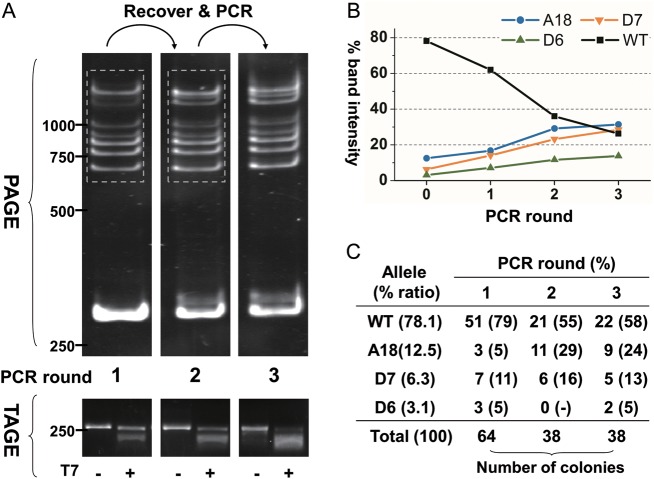
PAGE detection, enrichment and quantification of multiple alleles. (A) PAGE and TAGE profiles of multiple alleles after successive rounds of PCR following gel recovery (dash frame). DNA mixture containing four alleles shown in lane 12 of Fig. 2B was used as template with mix ratios indicated in (C). (B) Relative intensity of different bands of each round. Round ‘0’ represent the initial percentages of each allele. (C) The number of clones and percentages of each allele from PCR products of each round. This figure appears in colour in the online version of DNA Research.
Figure 4.
Figure 4.
Detection of ZFN-mediated allelic alterations in medaka. Medaka embryos were microinjected with RNAs for a pair of ZFNs that targeted the first exon of gsdf locus, and were allowed to develop into adult animals. Genomic DNA was extracted from fin clips of eight randomly sampled adults and was subjected to PCR and PAGE detection of targeted allelic alterations. (A) PAGE profiles of PCR products, unambiguously showing the presence of heteroduplex DNA (asterisks) in two out of eight fish. (B) TAGE profile of PCR products, showing a faint band of heteroduplex DNA (asterisks) within smears in the same two fish.

References

    1. Capecchi M.R. Gene targeting in mice: functional analysis of the mammalian genome for the twenty-first century. Nat. Rev. Genet. 2005;6:507–12. - PubMed
    1. Wang R.H., Sengupta K., Li C., et al. Impaired DNA damage response, genome instability, and tumorigenesis in SIRT1 mutant mice. Cancer Cell. 2008;14:312–23. - PMC - PubMed
    1. Collins F.S., Rossant J., Wurst W. A mouse for all reasons. Cell. 2007;128:9–13. - PubMed
    1. Tong C., Li P., Wu N.L., Yan Y., Ying Q.-L. Production of p53 gene knockout rats by homologous recombination in embryonic stem cells. Nature. 2010;467:211–3. - PMC - PubMed
    1. Clark K.J., Voytas D.F., Ekker S.C. A TALE of two nucleases: gene targeting for the masses? Zebrafish. 2011;8:147–9. - PMC - PubMed

Publication types