. 2012 Oct 17;4(156):156ra139.
doi: 10.1126/scitranslmed.3004334.

A preclinical evaluation of Minnelide as a therapeutic agent against pancreatic cancer

Affiliations

A preclinical evaluation of Minnelide as a therapeutic agent against pancreatic cancer

Rohit Chugh et al. Sci Transl Med. .

Abstract

Pancreatic cancer is one of the most lethal human malignancies with an all-stage 5-year survival frequency of <5%, which highlights the urgent need for more effective therapeutic strategies. We have previously shown that triptolide, a diterpenoid, is effective against pancreatic cancer cells in vitro as well as in vivo. However, triptolide is poorly soluble in water, limiting its clinical use. We therefore synthesized a water-soluble analog of triptolide, named Minnelide. The efficacy of Minnelide was tested both in vitro and in multiple independent yet complementary in vivo models of pancreatic cancer: an orthotopic model of pancreatic cancer using human pancreatic cancer cell lines in athymic nude mice, a xenograft model where human pancreatic tumors were transplanted into severe combined immunodeficient mice, and a spontaneous pancreatic cancer mouse model (KRas(G12D); Trp53(R172H); Pdx-1Cre). In these multiple complementary models of pancreatic cancer, Minnelide was highly effective in reducing pancreatic tumor growth and spread, and improving survival. Together, our results suggest that Minnelide shows promise as a potent chemotherapeutic agent against pancreatic cancer, and support the evaluation of Minnelide in clinical trials against this deadly disease.


Conflict of interest statement

Competing interests: University of Minnesota has filed a patent for Minnelide, which has been licensed to Minneamrita Therapeutics LLC. Inventors on this patent include G.I.G., S.P.P., R.C., S.M.V., and A.K.S. S.M.V. and A.K.S. have financial interests in this company. The other authors declare that they have no competing interests. Minnelide synthesis has been filed under patent WO/2010/129918.

Figures

Fig 1
Fig 1
Minnelide is synthesized from its parent compound, triptolide. Schematic of the synthesis of Minnelide from triptolide. (A) DMSO, Ac2O, AcOH, 5 days, 52%. (B) Dibenzylphosphate, 4-Å molecular sieves, N-iodosuccinimide, dichloromethane, tetrahydrofuran, 5 hours, 80%. (C) (i) H2, Pd/C, room temperature, 3 hours; (ii) NaCO3, 90%; purity of Minnelide >95% (by HPLC).
Fig 2
Fig 2
Minnelide hydrolyses and decreases cell viability in pancreatic cancer cell lines. (A) In vitro enzymatic hydrolysis of Minnelide was performed with alkaline phosphatase in glycine buffer. The half-life of Minnelide under these conditions was 2 min. Left, degradation of Minnelide; right, generation of the parent compound, triptolide. (B) Pancreatic cancer cells (MIA PaCa-2, Panc-1, S2-013, and S2-VP10) were seeded in 96-well plates 24 hours before being exposed to either the inactive (without alkaline phosphatase) or the active (with alkaline phosphatase) form of Minnelide at the concentrations indicated. Cell viability was measured 48 hours after treatment and compared with untreated cells (control). Triptolide (200 nM) was used as a positive control. Statistical significance of results was calculated with the Student’s t test. Columns, mean; bars, SE (n = 4; *P < 0.05).
Fig 3
Fig 3
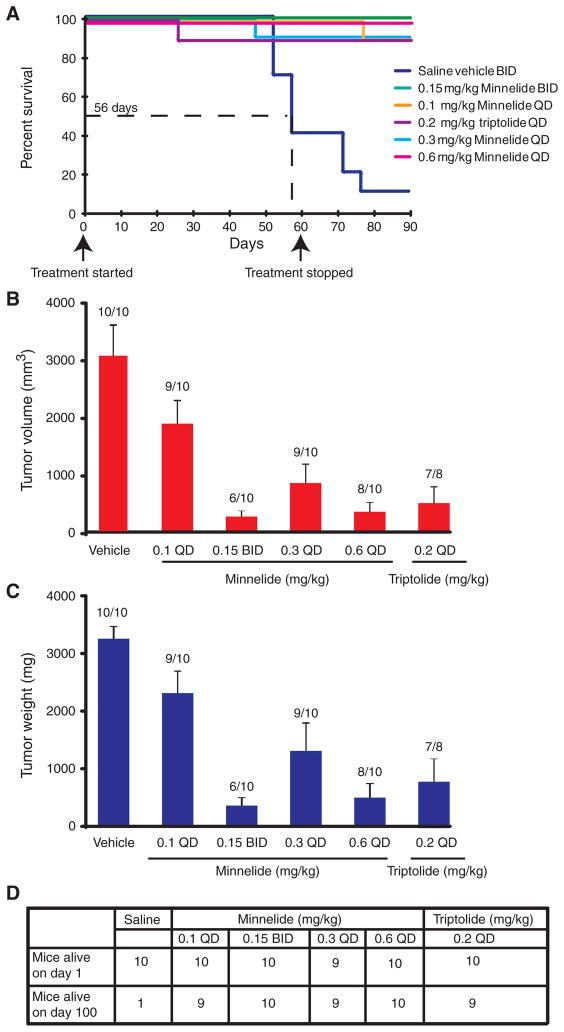
Minnelide decreases pancreatic tumor growth in vivo and increases survival. MIA PaCa-2 cells (1 × 10⁶) were injected into the tail of the pancreas of athymic Ncr nu/nu mice. (A) Kaplan-Meier analysis of animals injected with either triptolide (0.2 mg/kg), Minnelide (0.1 to 0.6 mg/kg QD or 0.15 mg/kg BID), or saline daily for 60 days; experiment was terminated on day 90. Treatment was started on day 12 after surgery. (B and C) Analysis of tumor volume (B) or tumor weight (C) from animals in (A). Numbers above columns represent number of animals that developed tumors over the number of animals studied. Columns, mean; bars, SE. (D) Table represents animals alive at start of treatment and end of experiment in each group indicated.
Fig 4
Fig 4
Minnelide decreases metastatic spread and pancreatic tumor growth. S2-013 cells (1 × 10⁶) were injected into the tail of the pancreas of athymic Ncr nu/nu mice on day 1. On day 7 after surgery, mice were randomized, and each group of 10 mice was intraperitoneally injected with Minnelide (0.42 mg/kg) or saline daily for 28 consecutive days. (A) Pictorial representation of control and Minnelide-treated mice. All mice in the control group, but none in the Minnelide-treated group, displayed ascites, metastasis, and jaundice. (B and C) Graphs showing significantly reduced pancreatic tumor volume (B) and weight (C) in the Minnelide-treated group compared with the vehicle-treated group. *P < 0.05. (D) Table showing the macroscopic analysis of metastasis in the control and Minnelide-treated groups.
Fig 5
Fig 5
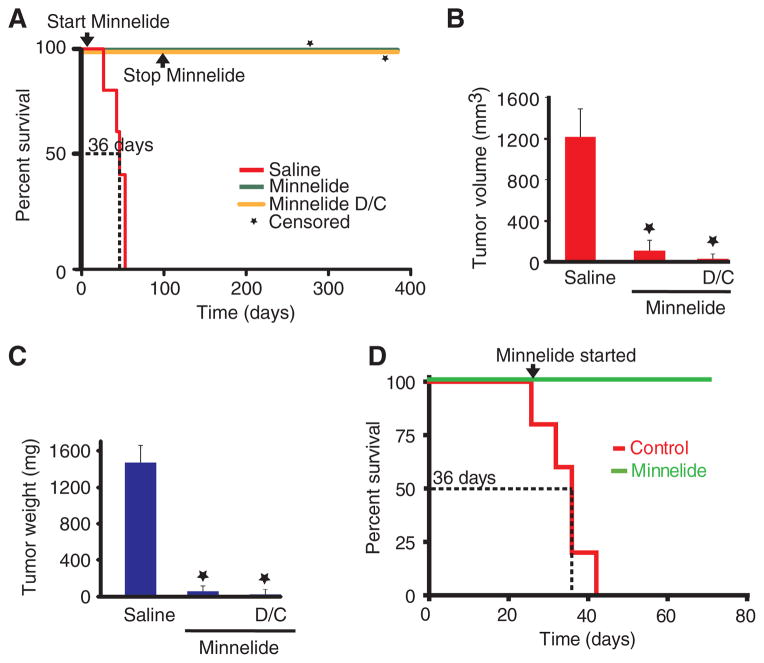
Minnelide increases percent overall survival in an orthotopic xenograft mouse model. AsPC-1 cells (2 × 10⁵) were injected into the tail of the pancreas of athymic Ncr nu/nu mice on day 1. Asterisk, censored because deaths were unrelated to pancreatic cancer. (A) On day 7 after surgery, mice were randomized and each group of 10 mice was intraperitoneally injected with Minnelide (0.42 mg/kg) or saline daily for 100 consecutive days. Saline-treated mice were euthanized when moribund. On day 100, the Minnelide-treated cohort (n = 10) was divided into two groups. One group (n = 5) continued to receive Minnelide (0.42 mg/kg), whereas treatment was terminated in the second group (n = 5; D/C; Stop Minnelide). Kaplan-Meier curve of the saline- or Minnelide-treated mice. Saline-treated mice had a mean survival of 36 days. All the animals in the Minnelide-treated group were alive at day 385 when the experiment was terminated. Survival lines are superimposed. (B and C) Graphs showing the average tumor volume (B) or tumor weight (C) of saline- or Minnelide-treated mice. (D) AsPC-1 cells (2 × 10⁵) were injected into the tail of the pancreas of athymic Ncr nu/nu mice on day 1, and treatment with Minnelide (0.42 mg/kg) or saline was started after the death of the first animal on day 28. Animals in the saline group were sacrificed when moribund, and the experiment was terminated on day 75. Kaplan-Meier curve of the saline- or Minnelide-treated mice shows an increase in survival of Minnelide-treated animals. The median survival of saline-injected animals was 36 days.
Fig 6
Fig 6
Minnelide increases percent overall survival in a human xenograft model. A de-identified patient pancreatic tumor was implanted into SCID animals. (A) Minnelide treatment (0.42 mg/kg) was started when tumor size was either 300 mm3 (Minnelide) or 1000 mm3 (Minnelide). In the 300 mm3 group, treatment was terminated on day 55 (Minnelide stop). In the 1000 mm3 group, treatment was continued until the termination of the experiment on day 120. (B) Kaplan-Meier analysis of animals in (A). Asterisk, censored because deaths were unrelated to tumor burden. Saline-treated mice were euthanized when tumor size reached the limit of animal care guidelines, as described in Materials and Methods. (C) Tumor weight from experiment in (A). (D) Pictorial representation of animals in (A). (E) Representative H&E-stained sections from a saline-treated tumor (n = 5) and a Minnelide-treated tumor (n = 11; ×10 magnification on an Aperio ScanScope scanner). (F) Minnelide treatment (0.21 or 0.42 mg/kg) was started when tumor size was 1000 mm3 (day 1). Experiment was terminated on day 90. Skin was resected to assess small subcutaneous tumors. (G) Kaplan-Meier survival analysis of animals in (F). Asterisk, censored because deaths were unrelated to tumor burden. Animals in the saline group were euthanized when tumor size reached the limit of animal care guidelines. (H) Tumor weight from experiment in (F). (I) Pictorial representation of animals in (F). (J) Representative H&E-stained sections from a saline-treated tumor (n = 5) and Minnelide-treated tumors [0.21 mg/kg (n = 8) or 0.42 mg/kg (n = 5)] (×10 magnification on an Aperio ScanScope scanner).
Fig 7
Fig 7
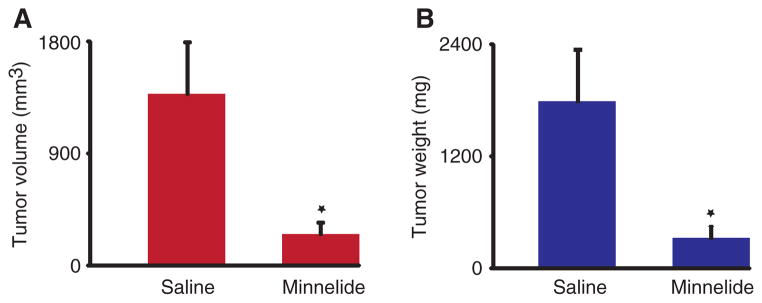
Minnelide decreases tumor burden in a spontaneous pancreatic cancer mouse model. KRasG12D; Trp53R172H; Pdx-1Cre animals were genotyped and randomly assigned to either the saline or the Minnelide treatment group (0.3 mg/kg) at 4 to 6 weeks of age. Saline animals were sacrificed when moribund. (A and B) Tumor volume (A) and weight (B) of animals in either group.
Fig 8
Fig 8
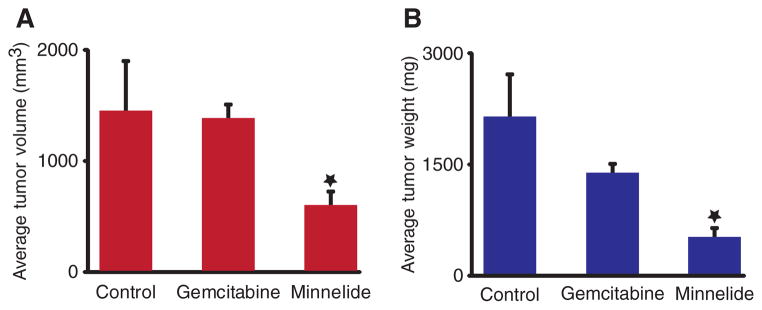
Comparison of Minnelide and gemcitabine in an orthotopic pancreatic cancer mouse model. MIA PaCa-2 cells (1 × 10⁶) were injected into the tail of the pancreas of athymic Ncr nu/nu mice. On day 12, animals were injected with Minnelide (0.28 mg/kg QD), gemcitabine (100 mg/kg BIW), or saline daily for 60 days, and experiment was terminated on day 90. (A and B) Graphs show significantly reduced (A) pancreatic tumor weight and (B) volume in Minnelide-treated mice compared with controls, whereas there is statistically no difference between gemcitabine-treated mice and controls. Columns, mean; bars, SE. *P < 0.05.

References

    1. Jemal A, Siegel R, Xu J, Ward E. Cancer statistics, 2010. CA Cancer J Clin. 2010;60:277–300. - PubMed
    1. Warshaw AL, Gu ZY, Wittenberg J, Waltman AC. Preoperative staging and assessment of resectability of pancreatic cancer. Arch Surg. 1990;125:230–233. - PubMed
    1. Burris H, Storniolo AM. Assessing clinical benefit in the treatment of pancreas cancer: Gemcitabine compared to 5-fluorouracil. Eur J Cancer. 1997;33(Suppl 1):S18–S22. - PubMed
    1. Moore MJ, Goldstein D, Hamm J, Figer A, Hecht JR, Gallinger S, Au HJ, Murawa P, Walde D, Wolff RA, Campos D, Lim R, Ding K, Clark G, Voskoglou-Nomikos T, Ptasynski M, Parulekar W. National Cancer Institute of Canada Clinical Trials Group, Erlotinib plus gemcitabine compared with gemcitabine alone in patients with advanced pancreatic cancer: A phase III trial of the National Cancer Institute of Canada Clinical Trials Group. J Clin Oncol. 2007;25:1960–1966. - PubMed
    1. Phillips PA, Dudeja V, McCarroll JA, Borja-Cacho D, Dawra RK, Grizzle WE, Vickers SM, Saluja AK. Triptolide induces pancreatic cancer cell death via inhibition of heat shock protein 70. Cancer Res. 2007;67:9407–9416. - PubMed

Publication types