


Combined gene dosage requirement for SWI/SNF catalytic subunits during early mammalian development
- PMID: 23076393
- PMCID: PMC3562406
- DOI: 10.1007/s00335-012-9433-z
Combined gene dosage requirement for SWI/SNF catalytic subunits during early mammalian development
Abstract
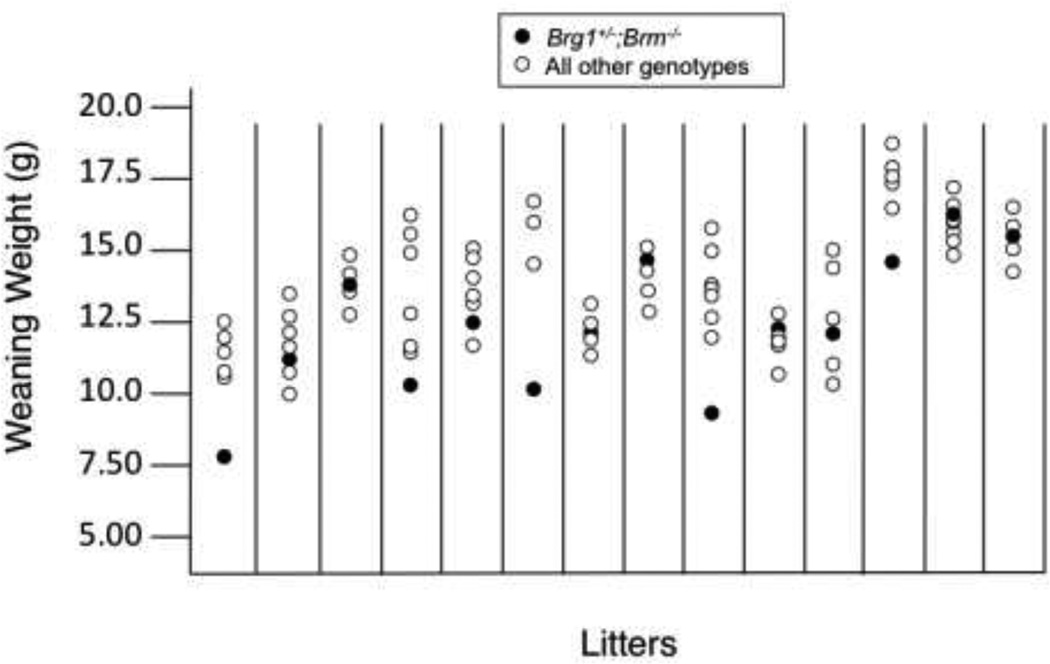
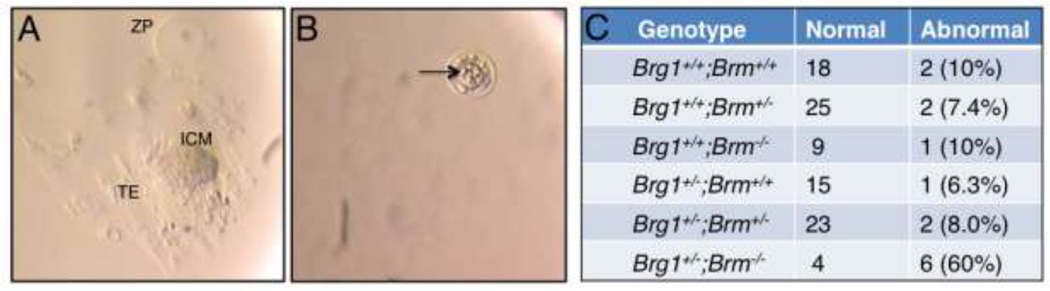
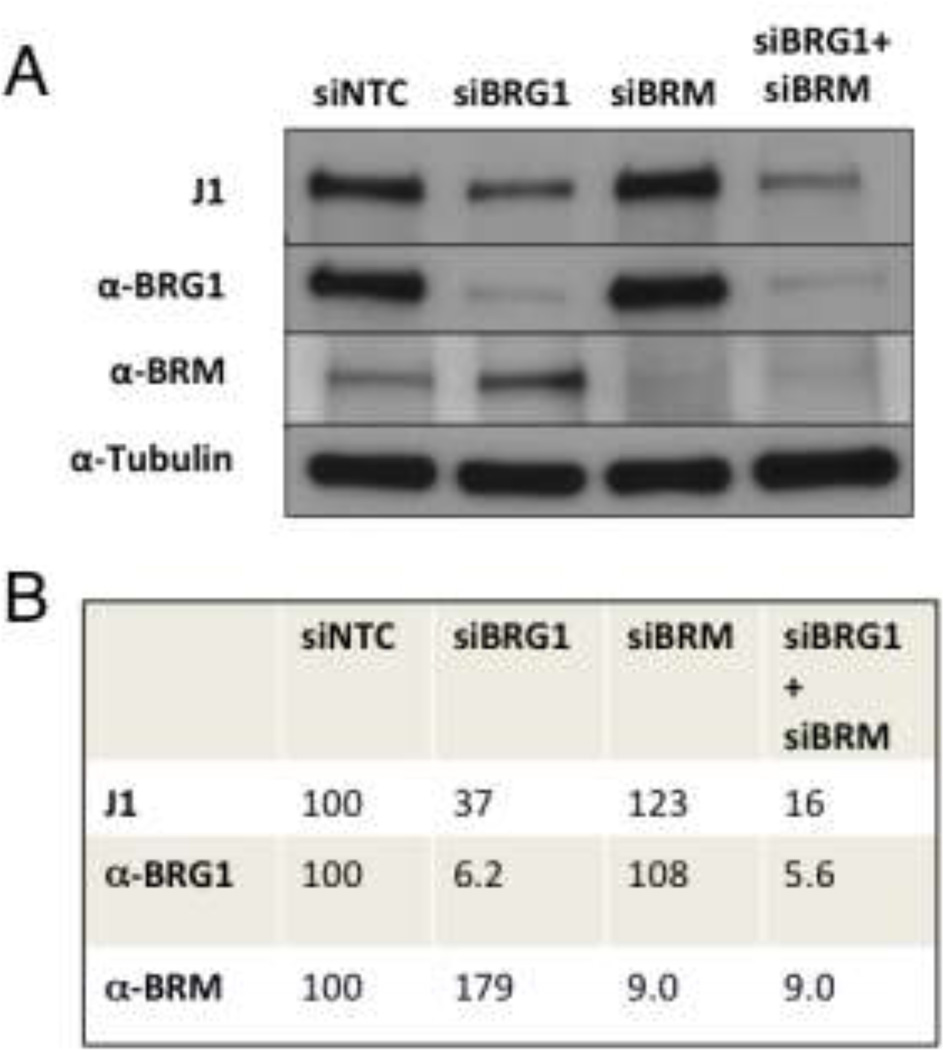
Mammalian SWI/SNF complexes utilize either BRG1 or BRM as alternative catalytic subunits with DNA-dependent ATPase activity to remodel chromatin. Although the two proteins are 75 % identical, broadly expressed, and have similar biochemical activities in vitro, BRG1 is essential for mouse embryonic development, while BRM is dispensable. To investigate whether BRG1 and BRM have overlapping functions during mouse embryogenesis, we performed double-heterozygous intercrosses using constitutive null mutations previously created by gene targeting. The progeny of these crosses had a distribution of genotypes that was significantly skewed relative to their combined gene dosage. This was most pronounced at the top and bottom of the gene dosage hierarchy, with a 1.5-fold overrepresentation of Brg1 (+/+) ;Brm (+/+) mice and a corresponding 1.6-fold underrepresentation of Brg1 (+/-) ;Brm (-/-) mice. To account for the underrepresentation of Brg1 (+/-) ;Brm (-/-) mice, timed matings and blastocyst outgrowth assays demonstrated that ~50 % of these embryos failed to develop beyond the peri-implantation stage. These results challenge the idea that BRG1 is the exclusive catalytic subunit of SWI/SNF complexes in ES cells and suggest that BRM also interacts with the pluripotency transcription factors to facilitate self-renewal of the inner cell mass. In contrast to implantation, the Brm genotype did not influence an exencephaly phenotype that arises because of Brg1 haploinsufficiency during neural tube closure and that results in peri-natal lethality. Taken together, these results support the idea that BRG1 and BRM have overlapping functions for certain developmental processes but not others during embryogenesis.
Conflict of interest statement
The authors declare no conflicts of interest.
Figures
References
-
- Bruneau BG. Chromatin remodeling in heart development. Current Opinion in Genetics & Development. 2010;20:505–511. - PubMed
-
- Bultman S, Gebuhr T, Yee D, La Mantia C, Nicholson J, Gilliam A, et al. A Brg1 null mutation in the mouse reveals functional differences among mammalian SWI/SNF complexes. Molecular Cell. 2000;6:1287–1295. - PubMed
-
- Bultman SJ, Herschkowitz JI, Godfrey V, Gebuhr TC, Yaniv M, Perou CM, et al. Characterization of mammary tumors from Brg1 heterozygous mice. Oncogene. 2008;27:460–468. - PubMed
Publication types
MeSH terms
Substances
Grants and funding
LinkOut - more resources
Full Text Sources
Molecular Biology Databases
Miscellaneous
