


Cephalic version by postural management for breech presentation
- PMID: 23076882
- PMCID: PMC7052740
- DOI: 10.1002/14651858.CD000051.pub2
Cephalic version by postural management for breech presentation
Abstract
Background: Babies with breech presentation (bottom first) are at increased risk of complications during birth, and are often delivered by caesarean section. The chance of breech presentation persisting at the time of delivery, and the risk of caesarean section, can be reduced by external cephalic version (ECV - turning the baby by manual manipulation through the mother's abdomen). It is also possible that maternal posture may influence fetal position. Many postural techniques have been used to promote cephalic version.
Objectives: The objective of this review was to assess the effects of postural management of breech presentation on measures of pregnancy outcome. We evaluated procedures in which the mother rests with her pelvis elevated. These include the knee-chest position, and a supine position with the pelvis elevated with a wedge-shaped cushion.
Search methods: We searched the Cochrane Pregnancy and Childbirth Group's Trials Register (22 August 2012).
Selection criteria: Randomised and quasi-randomised trials comparing postural management with pelvic elevation for breech presentation, with a control group.
Data collection and analysis: One or both review authors assessed eligibility and trial quality.
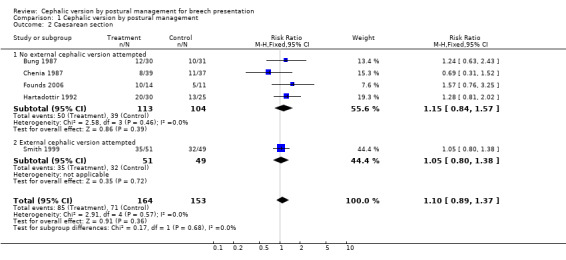
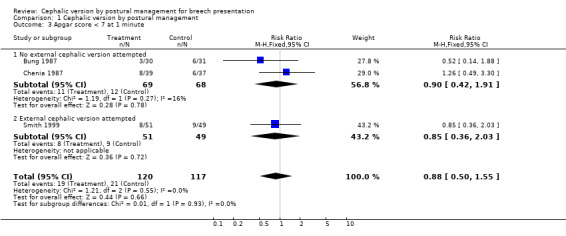
Main results: We have included six studies involving a total of 417 women. The rates for non-cephalic births, Cesarean section and Apgar scores below 7 at one minute, regardless of whether ECV was attempted or not, were similar between the intervention and control groups (risk ratio (RR) 0.98; 95% confidence interval (CI) 0.84 to 1.15; RR 1.10; 95% CI 0.89 to 1.37; RR 0.88; 95% CI 0.50 to 1.55).
Authors' conclusions: There is insufficient evidence from well-controlled trials to support the use of postural management for breech presentation. The numbers of women studied to date remain relatively small. Further research is needed.
Conflict of interest statement
None known.
Figures

Update of
-
Cephalic version by postural management for breech presentation.Cochrane Database Syst Rev. 2000;(3):CD000051. doi: 10.1002/14651858.CD000051. Cochrane Database Syst Rev. 2000. Update in: Cochrane Database Syst Rev. 2012 Oct 17;10:CD000051. doi: 10.1002/14651858.CD000051.pub2. PMID: 10908458 Updated.
References
References to studies included in this review
Bung 1987 {published data only}
-
- Bung P, Huch R, Huch A. Is Indian version a successful method of lowering the frequency of breech presentations?. Geburtshilfe und Frauenheilkunde 1987;47:202‐5. - PubMed
Chenia 1987 {published data only}
-
- Chenia F, Crowther CA. Does advice to assume the knee‐chest position reduce the incidence of breech presentation at delivery? A randomized clinical trial. Birth 1987;14:75‐8. - PubMed
Founds 2006 {published data only}
Hartadottir 1992 {published data only}
-
- Hartadottir H, Thornton JG. A randomised trial of the knee/chest position to encourage spontaneous version of breech pregnancies. Proceedings of 26th British Congress of Obstetrics and Gynaecology; 1992; Manchester, UK, 1992:356. Manchester, 1992:356.
Obwegeser 1999 {published data only}
-
- Obwegeser R, Hohlagschwandtner M, Auerbach L, Schneider B. Management of breech presentation by Indian version ‐ a prospective, randomized trial [Erhohung der Rate von Spontanwendungen bei Beckenendlagen durch die Indische Brucke? Eine prospective, randomisierte Studie]. Zeitschrift fur Geburtshilfe und Neonatologie 1999;203:161‐5. - PubMed
Smith 1999 {published data only}
-
- Smith C, Crowther C, Wilkinson C, Pridmore B, Robinson J. Knee‐chest postural management for breech at term: a randomized controlled trial. Birth 1999;26:71‐5. - PubMed
-
- Smith C, Wilkinson C, Crowther C. Knee chest postural management for breech at term: a randomised controlled trial. 2nd Annual Congress of the Perinatal Society of Australia & New Zealand; 1998 March 30‐April 4; Alice Springs, Australia 1998:143.
References to studies excluded from this review
Bullough 1987 {published data only}
-
- Bullough CHW. A comparison of methods of achieving version in late pregnancy. Personal communication 1987.
Cardini 1998 {published data only}
-
- Cardini F, Weixin H. Moxibustion for correction of breech presentation: a randomized controlled trial. JAMA 1998;280(18):1580‐4. - PubMed
Van Drooge 1984 {published data only}
-
- Drooge PH, Huisjes HJ. Hyperextension treatment in breech presentation [Hyperextensiebehandeling bij stuitligging]. Nederlands Tijdschrift roor Geneeskunde 1984;128:1088‐90. - PubMed
Additional references
Clarke 2000
-
- Clarke M, Oxman AD, editors. Cochrane Reviewers' Handbook 4.1 [updated June 2000]. In: Review Manager (RevMan) [Computer program]. Version 4.1. Oxford, England: The Cochrane Collaboration, 2000.
Egger 1997
Elkins 1982
-
- Elkins VH. External cephalic version. In: Enkin M, Chalmers I editor(s). Effectiveness and Satisfaction in Antenatal Care. London: Cambridge University Press, 1982:216.
Harbord 2006
-
- Harbord RM, Egger M, Sterne JA. A modified test for small‐study effects in meta‐analyses of controlled trials with binary endpoints. Statistics in Medicine 2006;25:3443‐57. - PubMed
Higgins 2009
-
- Higgins JPT, Green S, editors. Cochrane Handbook for Systematic Reviews of Interventions Version 5.0.2 [updated September 2009]. The Cochrane Collaboration, 2009. Available from www.cochrane‐handbook.org.
Hofmeyr 1989
-
- Hofmeyr GJ. Breech presentation and abnormal lie in late pregnancy. In: Chalmers I, Enkin MW, Keirse MJNC editor(s). Effective Care in Pregnancy and Childbirth. Oxford: Oxford University Press, 1989:653‐65.
Hofmeyr 1996
Hofmeyr 2003
RevMan 2000 [Computer program]
-
- The Cochrane Collaboration. Review Manager (RevMan). Version 4.1 for Windows. Oxford, England: The Cochrane Collaboration, 2000.
RevMan 2008 [Computer program]
-
- The Nordic Cochrane Centre, The Cochrane Collaboration. Review Manager (RevMan). Version 5.0. Copenhagen: The Nordic Cochrane Centre, The Cochrane Collaboration, 2008.
References to other published versions of this review
Hofmeyr 1995
-
- Hofmeyr GJ. Cephalic version by postural management. [revised 05 October 1993]. In: Enkin MW, Keirse MJNC, Renfrew MJ, Neilson JP, Crowther C (eds.) Pregnancy and Childbirth Module. In: The Cochrane Pregnancy and Childbirth Database [database on disk and CDROM]. The Cochrane Collaboration; Issue 2, Oxford: Update Software; 1995.
Publication types
MeSH terms
LinkOut - more resources
Full Text Sources
