


Neurologic disorders incidence in HIV+ vs HIV- men: Multicenter AIDS Cohort Study, 1996-2011
- PMID: 23077015
- PMCID: PMC3525315
- DOI: 10.1212/WNL.0b013e318271f7b8
Neurologic disorders incidence in HIV+ vs HIV- men: Multicenter AIDS Cohort Study, 1996-2011
Abstract
Objective: To study the incidence and pattern of neurologic disorders in a large cohort of HIV-positive men, compared with HIV-negative men, in the era of highly active antiretroviral therapy (HAART).
Methods: The Multicenter AIDS Cohort Study is a prospective study of men who have sex with men enrolled in 4 cities in the United States. We compared HIV-positive vs HIV-negative men for incidence and category of neurologic diagnoses in the HAART era (July 1, 1996, to last known follow-up or death, on or before July 1, 2011).
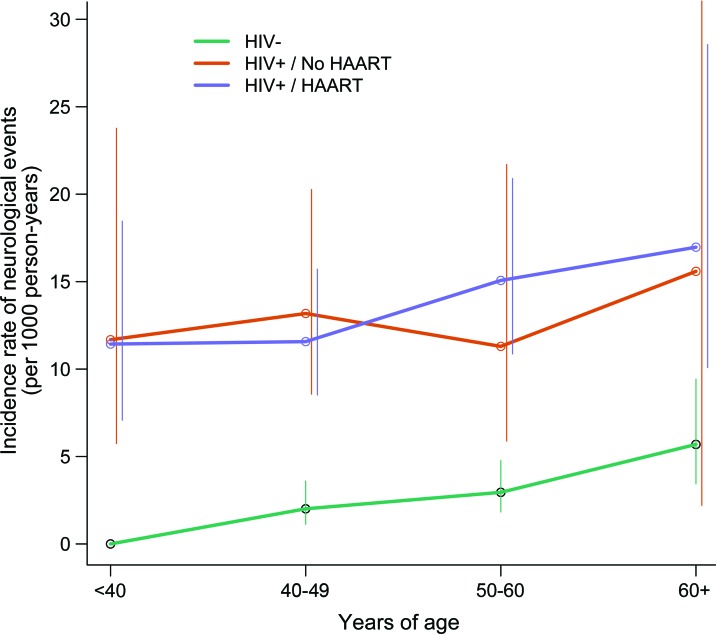
Results: There were 3,945 participants alive during the HAART era (2,083 HIV negative, 1,776 HIV positive, and 86 who became infected with HIV during the study period) including 3,427 who were older than 40 years of age. Median age at first neurologic diagnosis among all participants alive in the HAART era was lower in HAART-treated HIV-positive vs HIV-negative men (48 vs 57 years of age, p < 0.001). Incidence of neurologic diagnoses was higher in HAART-treated HIV-positive vs HIV-negative men (younger than 40 years: 11.4 vs 0 diagnoses per 1,000 person-years [p < 0.001]; 40-49 years: 11.6 vs 2.0 [p < 0.001]; 50-60 years: 15.1 vs 3.0 [p < 0.001]; older than 60 years: 17.0 vs 5.7 [p < 0.01]). Excess neurologic disease was found in the categories of nervous system infections (p < 0.001), dementia (p < 0.001), seizures/epilepsy (p < 0.01), and peripheral nervous system disorders (p < 0.001), but not stroke (p = 0.60).
Conclusions: HIV-positive men receiving HAART have a higher burden of neurologic disease than HIV-negative men and develop neurologic disease at younger ages.
Figures
References
-
- UNAIDS UNAIDS report on the global AIDS epidemic 2010. Available at: http://www.unaids.org/en/dataanalysis/ Accessed April 28, 2012
-
- Mills EJ, Bakanda C, Birungi J, et al. Life expectancy of persons receiving combination antiretroviral therapy in low-income countries: a cohort analysis from Uganda. Ann Intern Med 2011;155:209–216 - PubMed
-
- Bacellar H, Munoz A, Miller EN, et al. Temporal trends in the incidence of HIV-1-related neurologic diseases: Multicenter AIDS Cohort Study, 1985–1992. Neurology 1994;44:1892–1900 - PubMed
-
- Sacktor N, Lyles RH, Skolasky R, et al. HIV-associated neurologic disease incidence changes: Multicenter AIDS Cohort Study, 1990–1998. Neurology 2001;56:257–260 - PubMed
Publication types
MeSH terms
Grants and funding
LinkOut - more resources
Full Text Sources
Molecular Biology Databases
