. 2013 Jan;87(1):384-94.
doi: 10.1128/JVI.01633-12. Epub 2012 Oct 17.

Investigation of influenza virus polymerase activity in pig cells

Affiliations

Investigation of influenza virus polymerase activity in pig cells

Olivier Moncorgé et al. J Virol. 2013 Jan.

Abstract

Reassortant influenza viruses with combinations of avian, human, and/or swine genomic segments have been detected frequently in pigs. As a consequence, pigs have been accused of being a "mixing vessel" for influenza viruses. This implies that pig cells support transcription and replication of avian influenza viruses, in contrast to human cells, in which most avian influenza virus polymerases display limited activity. Although influenza virus polymerase activity has been studied in human and avian cells for many years by use of a minigenome assay, similar investigations in pig cells have not been reported. We developed the first minigenome assay for pig cells and compared the activities of polymerases of avian or human influenza virus origin in pig, human, and avian cells. We also investigated in pig cells the consequences of some known mammalian host range determinants that enhance influenza virus polymerase activity in human cells, such as PB2 mutations E627K, D701N, G590S/Q591R, and T271A. The two typical avian influenza virus polymerases used in this study were poorly active in pig cells, similar to what is seen in human cells, and mutations that adapt the avian influenza virus polymerase for human cells also increased activity in pig cells. In contrast, a different pattern was observed in avian cells. Finally, highly pathogenic avian influenza virus H5N1 polymerase activity was tested because this subtype has been reported to replicate only poorly in pigs. H5N1 polymerase was active in swine cells, suggesting that other barriers restrict these viruses from becoming endemic in pigs.


Figures
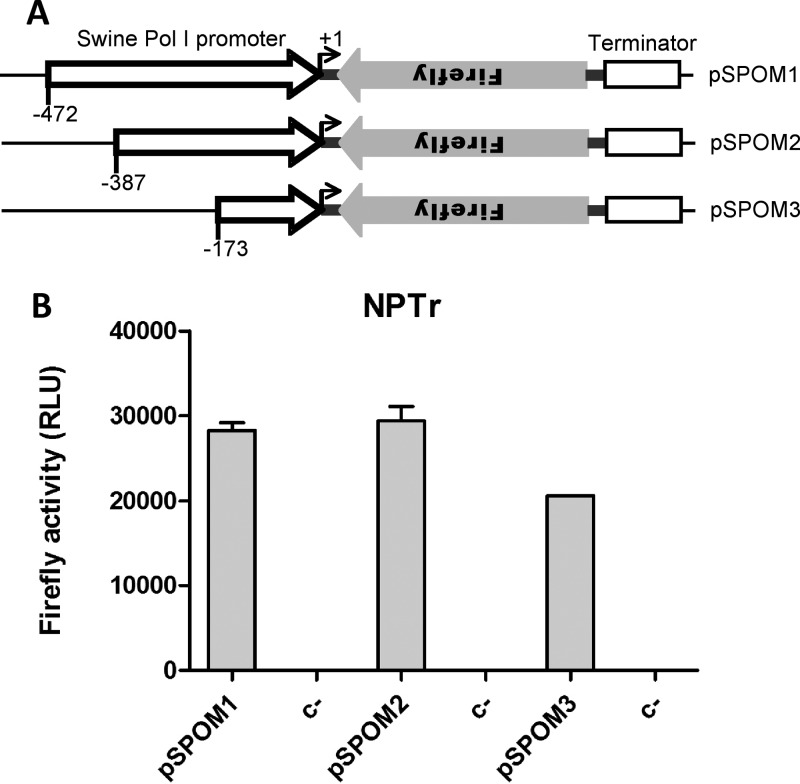
Fig 1
Fig 1
Generation of influenza virus polymerase assay for use with swine cells. (A) The swine RNA polymerase I promoter sequence was cloned into an influenza A virus minigenome reporter plasmid. Three different constructs with different 5′ boundaries were made (position −472, −387, or −173 to +1). The mouse RNA polymerase I terminator sequence is indicated by a white box. The dark gray boxes correspond to the influenza A virus NS segment noncoding sequences that flank the firefly luciferase open reading frame in reverse orientation (light gray). (B) NPTr cells were transfected with four plasmids, encoding PB1, PB2, PA, and NP proteins derived from influenza virus A/England/195/09 (Eng195), together with a plasmid that directs expression of the virus-like firefly luciferase reporter RNA minigenome under the control of the swine RNA polymerase I promoter (pSPOM1-Firefly, pSPOM2-Firefly, or pSPOM3-Firefly). Control cells were transfected with the reporter RNA minigenome alone (C−). At 20 h posttransfection, cells were lysed and firefly luciferase activity measured. Results are shown as raw data. Similar results were obtained with swine NSK cells (data not shown). RLU, relative light units.
Fig 2
Fig 2
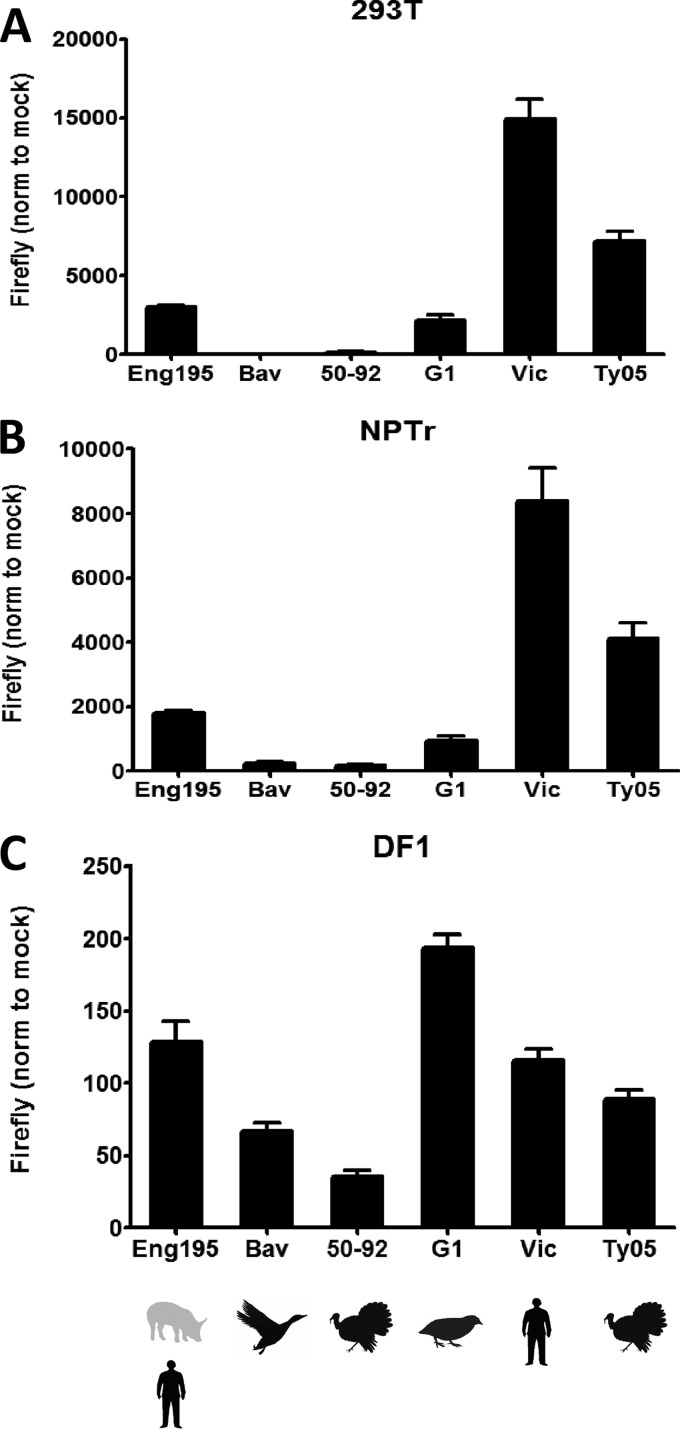
Activities of a panel of avian and human influenza virus polymerases in human, swine, and avian cells. Plasmids encoding PB1, PB2, PA, and NP proteins derived from influenza viruses A/England/195/09 (Eng195), A/Duck/Bavaria/1/77 (Bav), A/Turkey/England/50-92/91 (50-92), A/Quail/Hong Kong/G1/97 (G1), A/Victoria/3/75 (Vic), and A/Turkey/Turkey/1/2005 (Ty05) were transfected into human 293T (A), swine NPTr (B), and avian DF-1 (C) cells, together with a species-specific firefly luciferase minigenome reporter plasmid. At 20 h posttransfection, cells were lysed and firefly luciferase activity measured. Data were normalized to those for cells transfected with reporter plasmid alone. Results shown are the averages with standard deviations for three independent experiments.
Fig 3
Fig 3
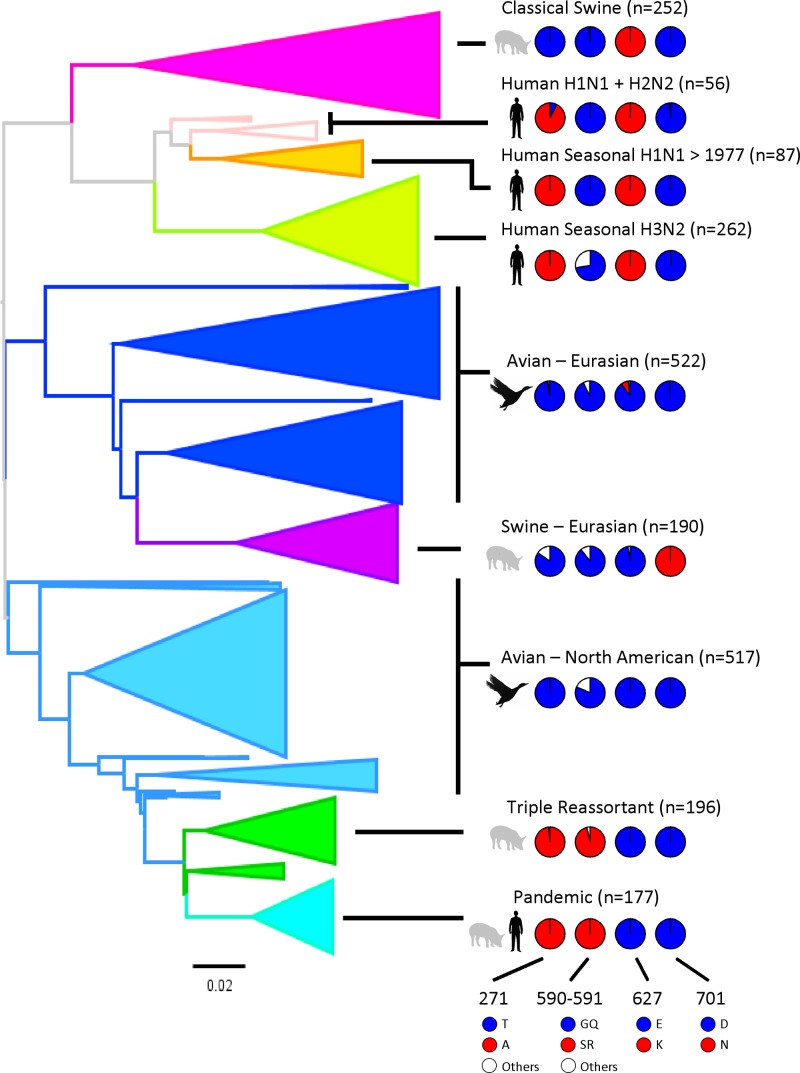
Polymorphism frequencies at positions 271, 590-591, 627, and 701 in PB2, according to virus lineage. On the left is the neighbor-joining tree for PB2, with collapsed tips and branches colored by major lineage. A total of 2,259 PB2 sequences were analyzed (see Materials and Methods). Also shown are pie charts for each lineage, depicting the PB2 polymorphisms (across all hosts) at amino acids 271, 590-591, 627, and 701. The avian-like amino acids are colored blue, and the main alternative is colored red. Other amino acids are colored white. Details of the percentages of the different amino acids found at each PB2 site can be found in Table S2 in the supplemental material.
Fig 4
Fig 4
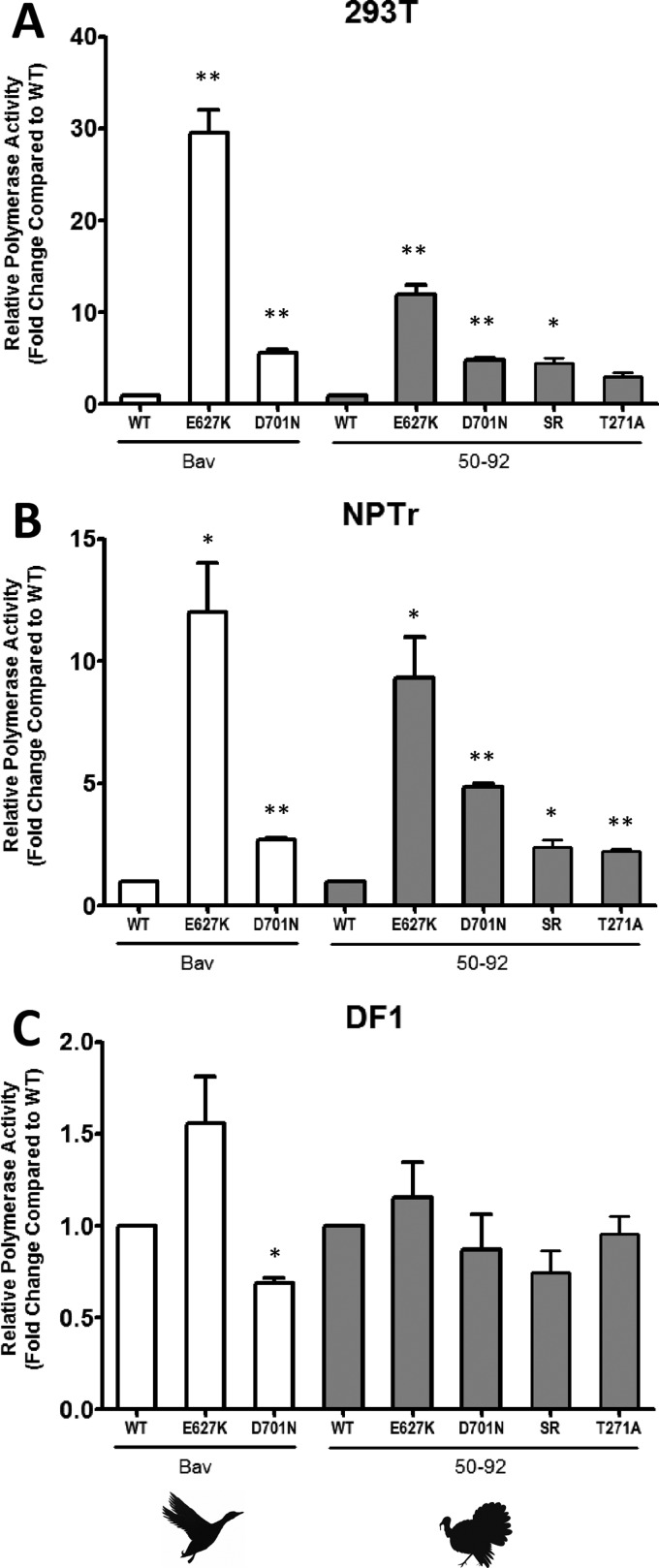
Polymerase activities of Bav and 50-92 complexes containing PB2 mutants. Human 293T (A), swine NPTr (B), or avian DF-1 (C) cells were transfected with plasmids expressing A/Duck/Bavaria/1/77 (Bav) or A/Turkey/England/50-92/91 (50-92) NP, PB1, PA, and WT or mutant PB2, together with a species-specific firefly luciferase minigenome reporter plasmid. At 20 h posttransfection, cells were lysed and firefly luciferase activity was measured. Data were normalized to the activity of the WT polymerase. Results shown are the averages with standard deviations for three independent experiments. The statistical significance of the difference between each mutant and the respective wild-type polymerase was assessed by unpaired Student's t test (*, P < 0.05; **, P < 0.01).
Fig 5
Fig 5
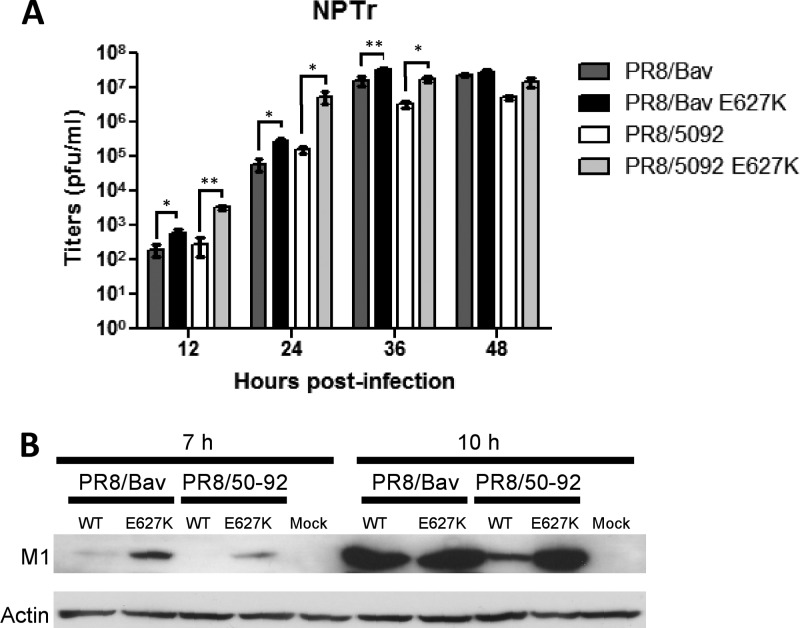
Viral replication in pig cells. (A) Multistep growth of viruses in swine cells. NPTr cells were infected with the indicated viruses at an MOI of 0.001. Culture supernatants were harvested at the indicated times, and virus titers were determined on MDCK cells. Student's t test with the Bonferroni correction was performed to determine the P values (*, P < 0.05; **, P < 0.01). (B) Viral protein synthesis in infected NPTr cells. Cells were infected with the indicated viruses at an MOI of 3 and then incubated at 37°C. Infected cells were harvested and lysed at the indicated time points and then analyzed by Western blotting using a monoclonal antibody against influenza A virus M1. Anti-actin antibody was used as a loading control. The data shown are results of two independent experiments.

References

    1. Alexander DJ. 2000. A review of avian influenza in different bird species. Vet. Microbiol. 74:3–13 - PubMed
    1. Fouchier RA, Munster V, Wallensten A, Bestebroer TM, Herfst S, Smith D, Rimmelzwaan GF, Olsen B, Osterhaus AD. 2005. Characterization of a novel influenza A virus hemagglutinin subtype (H16) obtained from black-headed gulls. J. Virol. 79:2814–2822 - PMC - PubMed
    1. Webster RG, Bean WJ, Gorman OT, Chambers TM, Kawaoka Y. 1992. Evolution and ecology of influenza A viruses. Microbiol. Rev. 56:152–179 - PMC - PubMed
    1. Kilbourne ED. 2006. Influenza pandemics of the 20th century. Emerg. Infect. Dis. 12:9–14 - PMC - PubMed
    1. Kawaoka Y, Krauss S, Webster RG. 1989. Avian-to-human transmission of the PB1 gene of influenza A viruses in the 1957 and 1968 pandemics. J. Virol. 63:4603–4608 - PMC - PubMed

Publication types

Substances