


The antitumor efficiency of combined electrochemotherapy and single dose irradiation on a breast cancer tumor model
- PMID: 23077461
- PMCID: PMC3472947
- DOI: 10.2478/v10019-012-0035-x
The antitumor efficiency of combined electrochemotherapy and single dose irradiation on a breast cancer tumor model
Abstract
Background: The aim of this study was to investigate the antitumor effectiveness of electrochemotherapy with cisplatin combined with suboptimal radiotherapy doses. Tumor radiosensitization was evaluated on large invasive ductal carcinoma tumors in Balb/C mice.
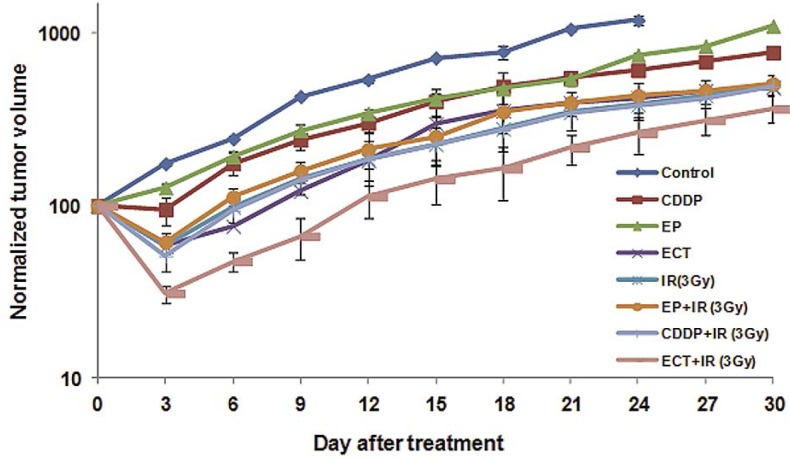
Materials and methods: Tumors of an average volume of 630 mm(3) were treated with cisplatin, electric pulses, radiotherapy, electrochemotherapy, alone as well as in appropriate combinations. Tumors were irradiated with Cobalt-60 γ-rays at doses 3 Gy and 5 Gy in combination with electrochemotherapy using cisplatin. Controls included each of the treatments alone as well as the combination of the radiotherapy with electric pulses alone or with cisplatin alone. Antitumor effectiveness was evaluated by tumor growth delay, tumor-doubling time, inhibition ratio and the objective response rates.
Results: As anticipated, electrochemotherapy was more effective than the treatment with cisplatin alone or the application of the electric pulses alone. When treatments were combined with tumor irradiation at either 3 or 5 Gy, the combination with electrochemotherapy was more effective: at 5 Gy, 2 animals out of 8 were in complete remission 100 days later. In general the higher 5 Gy dose of γ-radiation was more effective than the lower one of 3 Gy.
Conclusions: The results of our study demonstrate that irradiation doses, 3 Gy or 5 Gy, increase the antitumor effectiveness of electrochemotherapy with cisplatin on invasive ductal carcinoma tumors. Good antitumor results were achieved in experimental tumors with a size comparable to clinical lesions, demonstrating that this three-modality combined treatment is useful for the treatment of large lesions even at sub-optimal radiotherapy doses.
Keywords: cisplatin; electroporation; invasive ductal carcinoma; irradiation; multimodalities.
Figures


References
LinkOut - more resources
Full Text Sources
Research Materials
