


Determining Mycobacterium tuberculosis infection among BCG-immunised Ugandan children by T-SPOT.TB and tuberculin skin testing
- PMID: 23077594
- PMCID: PMC3471887
- DOI: 10.1371/journal.pone.0047340
Determining Mycobacterium tuberculosis infection among BCG-immunised Ugandan children by T-SPOT.TB and tuberculin skin testing
Abstract
Background: Children with latent tuberculosis infection (LTBI) represent a huge reservoir for future disease. We wished to determine Mycobacterium tuberculosis (M.tb) infection prevalence among BCG-immunised five-year-old children in Entebbe, Uganda, but there are limited data on the performance of immunoassays for diagnosis of tuberculosis infection in children in endemic settings. We therefore evaluated agreement between a commercial interferon gamma release assay (T-SPOT.TB) and the tuberculin skin test (TST; 2 units RT-23 tuberculin; positive defined as diameter ≥10 mm), along with the reproducibility of T-SPOT.TB on short-term follow-up, in this population.
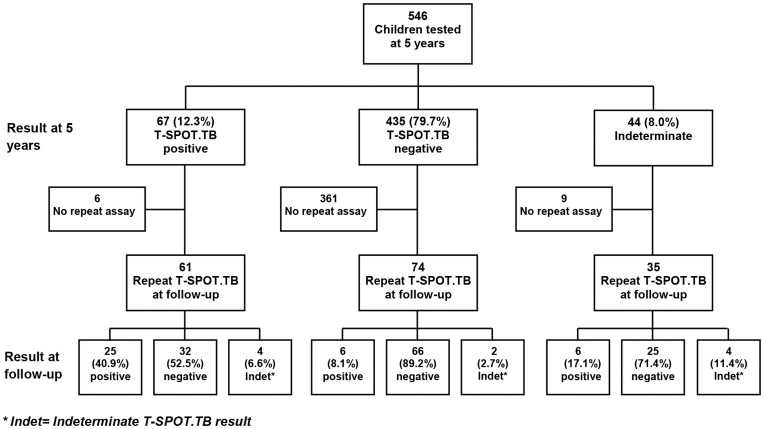
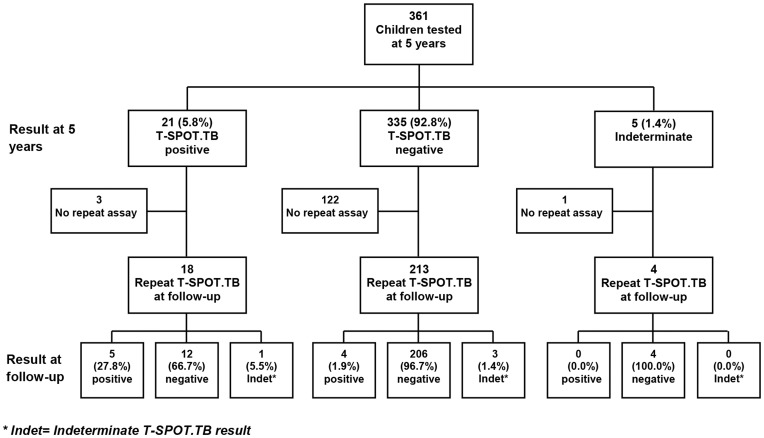
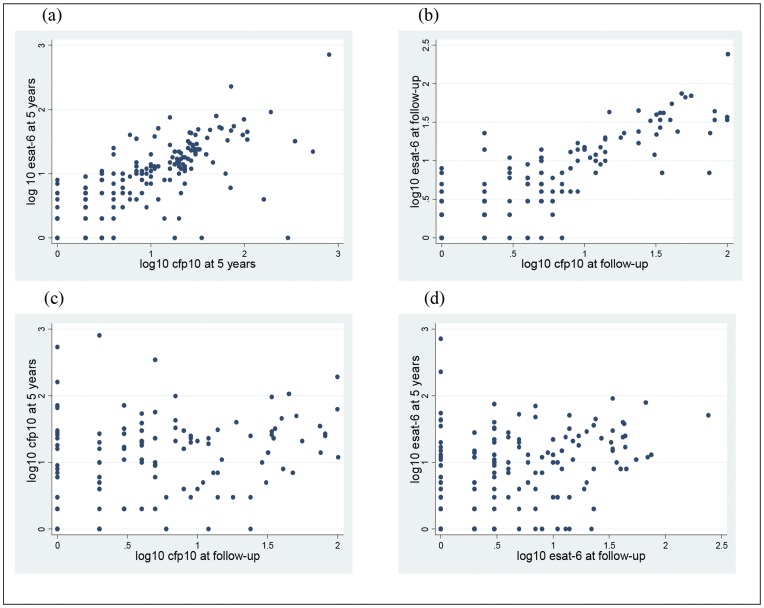
Methodology/principal findings: We recruited 907 children of which 56 were household contacts of TB patients. They were tested with T-SPOT.TB at age five years and then re-examined with T-SPOT.TB (n = 405) and TST (n = 319) approximately three weeks later. The principal outcome measures were T-SPOT.TB and TST positivity. At five years, 88 (9.7%) children tested positive by T-SPOT.TB. More than half of those that were T-SPOT.TB positive at five years were negative at follow-up, whereas 96% of baseline negatives were consistently negative. We observed somewhat better agreement between initial and follow-up T-SPOT.TB results among household TB contacts (κ = 0.77) than among non-contacts (κ = 0.39). Agreement between T-SPOT.TB and TST was weak (κ = 0.28 and κ = 0.40 for T-SPOT.TB at 5 years and follow-up, respectively). Of 28 children who were positive on both T-SPOT.TB tests, 14 (50%) had a negative TST. Analysis of spot counts showed high levels of instability in responses between baseline and follow-up, indicating variability in circulating numbers of T cells specific for certain M.tb antigens.
Conclusions/significance: We found that T-SPOT.TB positives are unstable over a three-week follow-up interval, and that TST compares poorly with T-SPOT.TB, making the categorisation of children as TB-infected or TB-uninfected difficult. Existing tools for the diagnosis of TB infection are unsatisfactory in determining infection among children in this setting.
Conflict of interest statement
Figures
References
-
- WHO (2011) Global tuberculosis control: WHO report 2011. Geneva: WHO.
-
- Cruz AT, Geltemeyer AM, Starke JR, Flores JA, Graviss EA, et al. (2011) Comparing the tuberculin skin test and T-SPOT.TB blood test in children. Pediatrics 127: e31–38. - PubMed
-
- Lucas M, Nicol P, McKinnon E, Whidborne R, Lucas A, et al. (2010) A prospective large-scale study of methods for the detection of latent Mycobacterium tuberculosis infection in refugee children. Thorax 65: 442–448. - PubMed
Publication types
MeSH terms
Substances
Grants and funding
LinkOut - more resources
Full Text Sources
Medical
