


Association of anemia with worsened activities of daily living and health-related quality of life scores derived from the Minimum Data Set in long-term care residents
- PMID: 23083314
- PMCID: PMC3541079
- DOI: 10.1186/1477-7525-10-129
Association of anemia with worsened activities of daily living and health-related quality of life scores derived from the Minimum Data Set in long-term care residents
Abstract
Background: Among long-term care (LTC) residents, we explored the association between anemia status and hemoglobin (Hb) level with Activities of Daily Living (ADL) functioning and health-related quality of life (HRQOL).
Methods: Data were derived from the AnalytiCare database, containing laboratory and Minimum Data Set (MDS) reports for 27 LTC facilities in Colorado. Study timeframe was 1/1/07-9/15/08. Patients were selected based on: residence in LTC >90 days, Hb and serum creatinine value within 90 days of the earliest non-admission (index) MDS. From the index MDS, the method of 1) Carpenter et al. [BMC Geriatrics 6:7(2006)] was used to derive a summary measure of ADL performance (the MDS-ADL score) and 2) Wodchis et al. [IJTAHC 19:3(2003)] was used to assign HRQOL scores (MDS items were mapped to the Health Utilities Index Mark 2 (HUI2) scoring function to create the MDS-HSI score). Anemia was defined as Hb <12 g/dL females and <13 g/dL males. Adjusted linear regression was used to evaluate the independent association of anemia and hemoglobin level on MDS-ADL and MDS-HSI scores.
Results: 838 residents met all inclusion criteria; 46% of residents were anemic. Mean (SD) MDS-ADL score was 14.9 (7.5) [0-28 scale, where higher score indicates worse functioning]. In the adjusted model, anemia was associated with a significantly worse MDS-ADL score (+1.62 points, P=.001). Residents with Hb levels 10 to <11 g/dL had significantly worse ADL score (+2.06 points, P=.005) than the >13 g/dL reference. The mean MDS-HSI score was 0.431 (0.169) [range, where 0=dead to 1=perfect health]. Compared with non-anemic residents, in this adjusted model, residents with anemia had significantly worse MDS-HSI scores (-0.034 points, P=.005). Residents with hemoglobin levels <10 g/dL had significantly worse MDS-HSI scores (-0.058 points, P=.016) than the >13 g/dL reference.
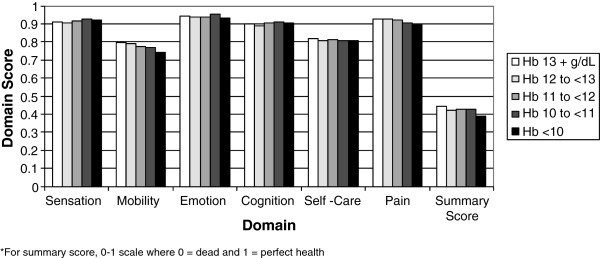
Conclusions: After adjusting for several covariates, LTC residents with anemia, and many of those with moderate to severe declines in Hb level, had significantly poorer outcomes in both ADL functioning and HRQOL. The association between Hb level and the HRQOL measure of MDS-HSI appears to be largely explained by the mobility domain of the HRQOL measure.
Figures
References
-
- World Health Organization. Nutritional Anaemia: Report of a WHO Scientific Group. Geneva, Switzerland: World Health Organization; 1968. - PubMed
Publication types
MeSH terms
Substances
LinkOut - more resources
Full Text Sources
Medical
Research Materials
Miscellaneous
