Interaction between GFR and risk factors for morbidity and mortality in African Americans with CKD
- PMID: 23085727
- PMCID: PMC3531654
- DOI: 10.2215/CJN.03340412
Interaction between GFR and risk factors for morbidity and mortality in African Americans with CKD
Abstract
Background and objectives: The African American Study of Kidney Disease Trial identified risk factors for CKD progression and suggested that GFR level may modify the association between these risk factors and CKD progression or death.
Design, setting, participants, & measurements: Enrollment in the African American Study of Kidney Disease Trial occurred between June of 1995 and September of 2001, with median follow-up of 48.6 months. Among 1094 patients with hypertensive kidney disease in the trial, this study tested whether the association between six previously identified risk factors for CKD progression (or death) and a composite clinical outcome (progression of CKD, ESRD, or death) depends on level of GFR. Multivariate Cox regression was used to control for other baseline risk factors.
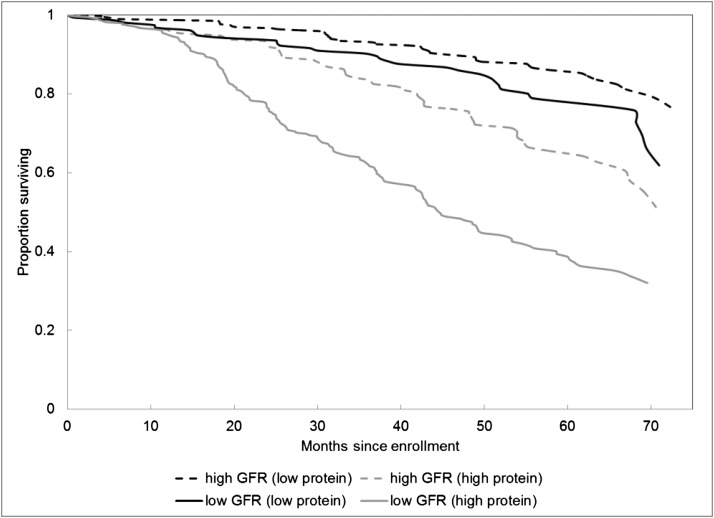
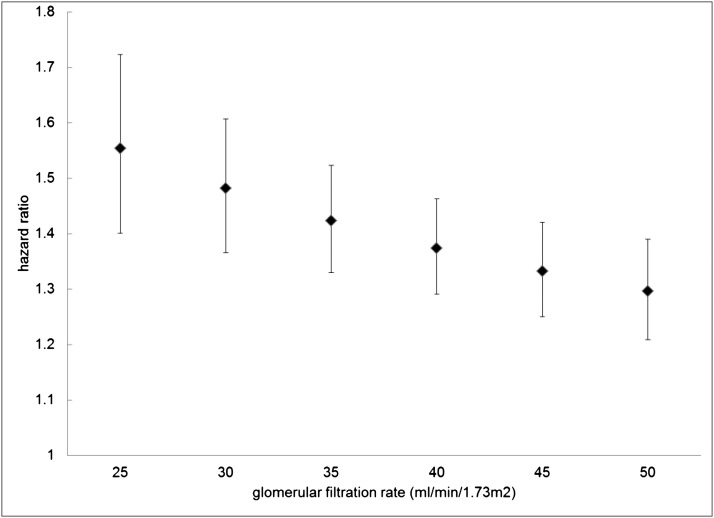
Results: After controlling for baseline risk factors, only proteinuria was more closely associated with the composite clinical outcome at lower levels of GFR (P value for interaction term=0.002); increased hazards of the clinical composite outcome associated with a doubling of proteinuria ranged from 30% (95% confidence interval=21%-39%) with a GFR of 50 to 55% (95% confidence interval=40%-72%) with a GFR of 25.
Conclusions: The magnitude of the association between proteinuria and CKD progression, ESRD, or death in the African American Study of Kidney Disease Trial cohort depends on the level of GFR; proteinuria is a stronger independent predictor of the composite clinical outcome at lower levels of GFR. This finding reinforces that African Americans with proteinuria and lower GFR represent a population at particularly high risk for adverse outcomes.
Figures
Similar articles
-
The relationship between magnitude of proteinuria reduction and risk of end-stage renal disease: results of the African American study of kidney disease and hypertension.Arch Intern Med. 2005 Apr 25;165(8):947-53. doi: 10.1001/archinte.165.8.947. Arch Intern Med. 2005. PMID: 15851648 Clinical Trial.
-
APOL1 Risk Variants, Incident Proteinuria, and Subsequent eGFR Decline in Blacks with Hypertension-Attributed CKD.Clin J Am Soc Nephrol. 2017 Nov 7;12(11):1771-1777. doi: 10.2215/CJN.01180117. Epub 2017 Oct 19. Clin J Am Soc Nephrol. 2017. PMID: 29051146 Free PMC article.
-
Independent or synergistic relationship of proteinuria and glomerular filtration rate on patient and renal survival in patients with glomerulonephritis?J Nephrol. 2014 Dec;27(6):643-51. doi: 10.1007/s40620-014-0074-z. Epub 2014 Mar 8. J Nephrol. 2014. PMID: 24609889
-
Proteinuria and hypertensive nephrosclerosis in African Americans.Kidney Int Suppl. 2004 Nov;(92):S102-4. doi: 10.1111/j.1523-1755.2004.09224.x. Kidney Int Suppl. 2004. PMID: 15485398 Review.
-
Cardiorenal metabolic syndrome in the African diaspora: rationale for including chronic kidney disease in the metabolic syndrome definition.Ethn Dis. 2009 Spring;19(2 Suppl 2):S2-11-14. Ethn Dis. 2009. PMID: 19537345 Review.
Cited by
-
Predictors and the Subsequent Risk of End-Stage Renal Disease - Usefulness of 30% Decline in Estimated GFR over 2 Years.PLoS One. 2015 Jul 15;10(7):e0132927. doi: 10.1371/journal.pone.0132927. eCollection 2015. PLoS One. 2015. PMID: 26177463 Free PMC article.
-
Landmark Linear Transformation Model for Dynamic Prediction with Application to a Longitudinal Cohort Study of Chronic Disease.J R Stat Soc Ser C Appl Stat. 2019 Apr;68(3):771-791. doi: 10.1111/rssc.12334. Epub 2018 Dec 23. J R Stat Soc Ser C Appl Stat. 2019. PMID: 31467454 Free PMC article.
-
Dynamic prediction of time to a clinical event with sparse and irregularly measured longitudinal biomarkers.Biom J. 2020 Oct;62(6):1371-1393. doi: 10.1002/bimj.201900112. Epub 2020 Mar 20. Biom J. 2020. PMID: 32196728 Free PMC article.
-
Association of estimated glomerular filtration rate and proteinuria with all-cause mortality in community-based population in China: A Result from Kailuan Study.Sci Rep. 2018 Feb 1;8(1):2157. doi: 10.1038/s41598-018-20554-3. Sci Rep. 2018. PMID: 29391563 Free PMC article.
References
-
- National Kidney Foundation : K/DOQI clinical practice guidelines for chronic kidney disease: Evaluation, classification, and stratification. Am J Kidney Dis 39[2 Suppl 1]: S1–S266, 2002 - PubMed
-
- Coresh J, Astor BC, Greene T, Eknoyan G, Levey AS: Prevalence of chronic kidney disease and decreased kidney function in the adult US population: Third National Health and Nutrition Examination Survey. Am J Kidney Dis 41: 1–12, 2003 - PubMed
-
- US Renal Data System : USRDS 2009 annual data report: Atlas of end-stage renal disease in the United States. In: National Institutes of Health, Bethesda, MD, US Renal Data System, 2009
-
- Lewis J, Greene T, Appel L, Contreras G, Douglas J, Lash J, Toto R, Van Lente F, Wang X, Wright JT, Jr, AASK Study Group : A comparison of iothalamate-GFR and serum creatinine-based outcomes: Acceleration in the rate of GFR decline in the African American Study of Kidney Disease and Hypertension. J Am Soc Nephrol 15: 3175–3183, 2004 - PubMed
-
- Hunsicker LG, Adler S, Caggiula A, England BK, Greene T, Kusek JW, Rogers NL, Teschan PE: Predictors of the progression of renal disease in the Modification of Diet in Renal Disease Study. Kidney Int 51: 1908–1919, 1997 - PubMed
Publication types
MeSH terms
Grants and funding
LinkOut - more resources
Full Text Sources
Medical