


Effect of Caenorhabditis elegans age and genotype on horizontal gene transfer in intestinal bacteria
- PMID: 23085995
- PMCID: PMC3545540
- DOI: 10.1096/fj.12-218420
Effect of Caenorhabditis elegans age and genotype on horizontal gene transfer in intestinal bacteria
Abstract
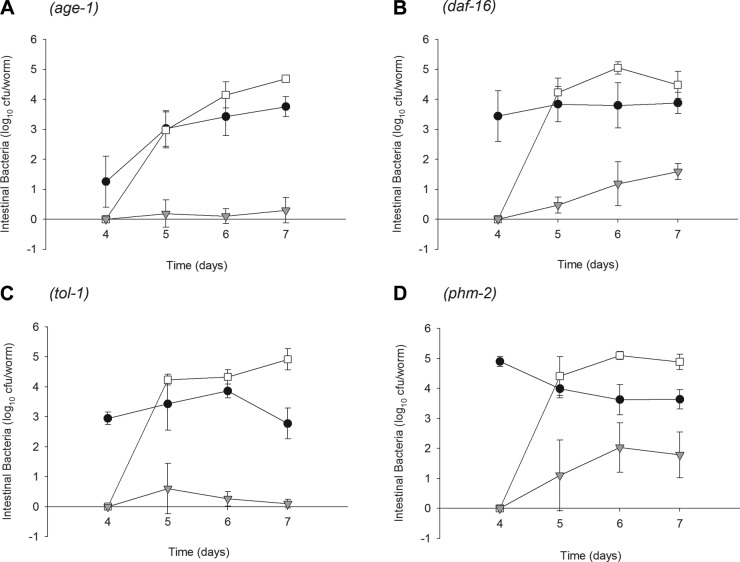
Horizontal gene transfer (HGT) between bacteria occurs in the intestinal tract of their animal hosts and facilitates both virulence and antibiotic resistance. A model in which both the pathogen and the host are genetically tractable facilitates developing insight into mechanistic processes enabling or restricting the transfer of antibiotic resistance genes. Here we develop an in vivo experimental system to study HGT in bacteria using Caenorhabditis elegans as a model host. Using a thermosensitive conjugative system, we provide evidence that conjugation between two Escherichia coli strains can take place in the intestinal lumen of N2 wild-type worms at a rate of 10(-3) and 10(-2) per donor. We also show that C. elegans age and genotype are important determinants of the frequency of conjugation. Whereas ∼1 transconjugant for every 100 donor cells could be recovered from the intestine of N2 C. elegans, for the age-1 and tol-1 mutants, the detected rate of transconjugation (10(-3) and 10(-4) per donor cell, respectively) was significantly lower. This work demonstrates that increased recombination among lumenal microbial populations is a phenotype associated with host aging, and the model provides a framework to study the dynamics of bacterial horizontal gene transfer within the intestinal environment.
Figures



References
-
- Arber W. (2009) Systemic aspects of biological evolution. J. Biotechnol. 144, 242–244 - PubMed
-
- Barkay T., Kritee K., Boyd E., Geesey G. (2010) A thermophilic bacterial origin and subsequent constraints by redox, light and salinity on the evolution of the microbial mercuric reductase. Environ. Microbiol. 12, 2904–2917 - PubMed
-
- Blaser M. J. (1997) The versatility of Helicobacter pylori in the adaptation to the human stomach. J. Physiol. Pharmacol. 48, 307–314 - PubMed
Publication types
MeSH terms
Substances
Grants and funding
LinkOut - more resources
Full Text Sources
