


Decreased glycolytic and tricarboxylic acid cycle intermediates coincide with peripheral nervous system oxidative stress in a murine model of type 2 diabetes
- PMID: 23086140
- PMCID: PMC3665007
- DOI: 10.1530/JOE-12-0356
Decreased glycolytic and tricarboxylic acid cycle intermediates coincide with peripheral nervous system oxidative stress in a murine model of type 2 diabetes
Abstract
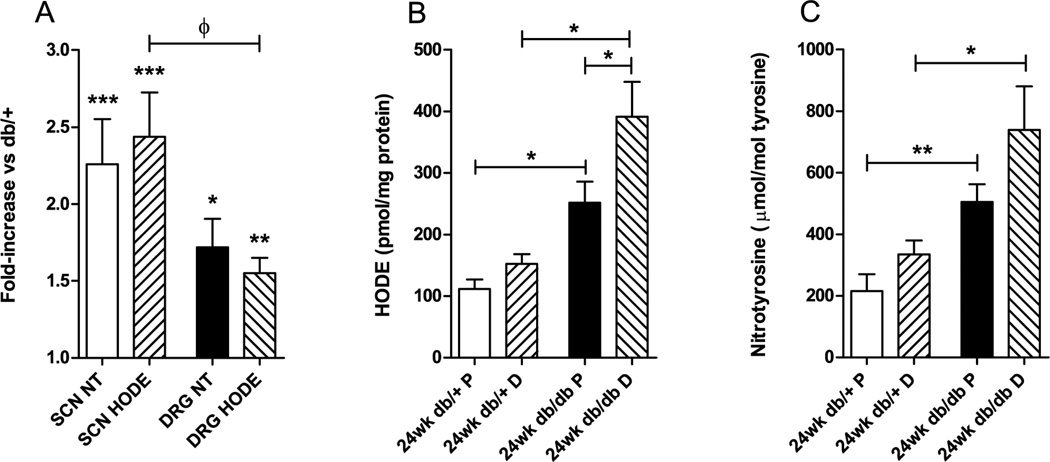
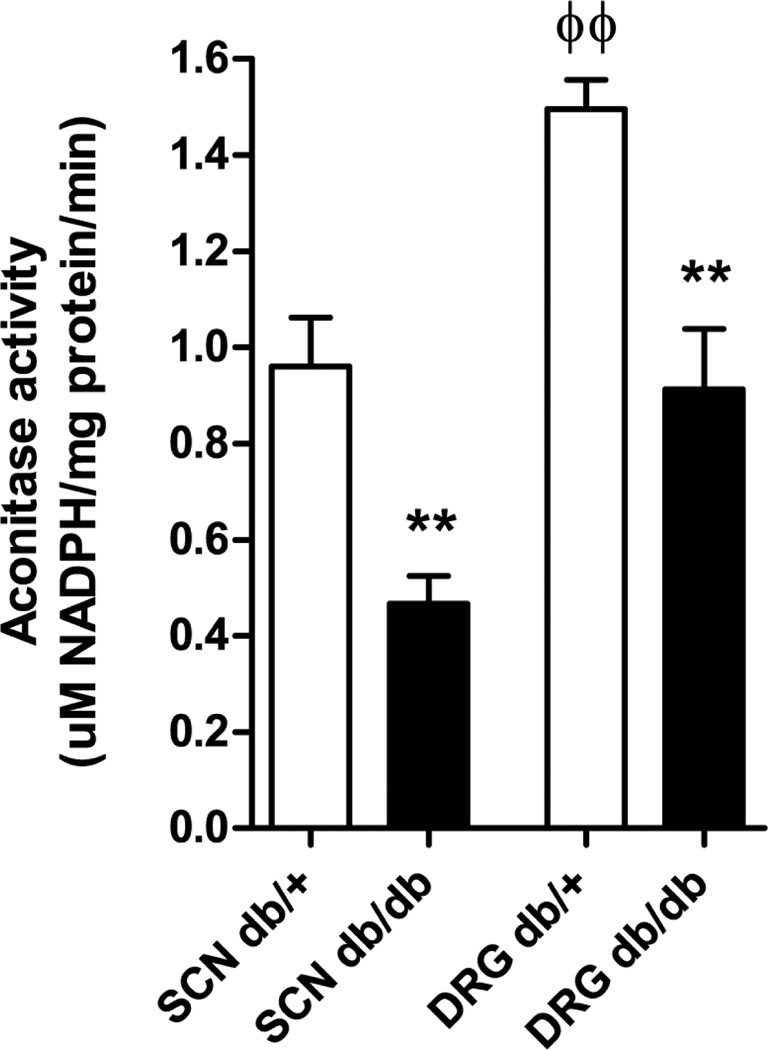
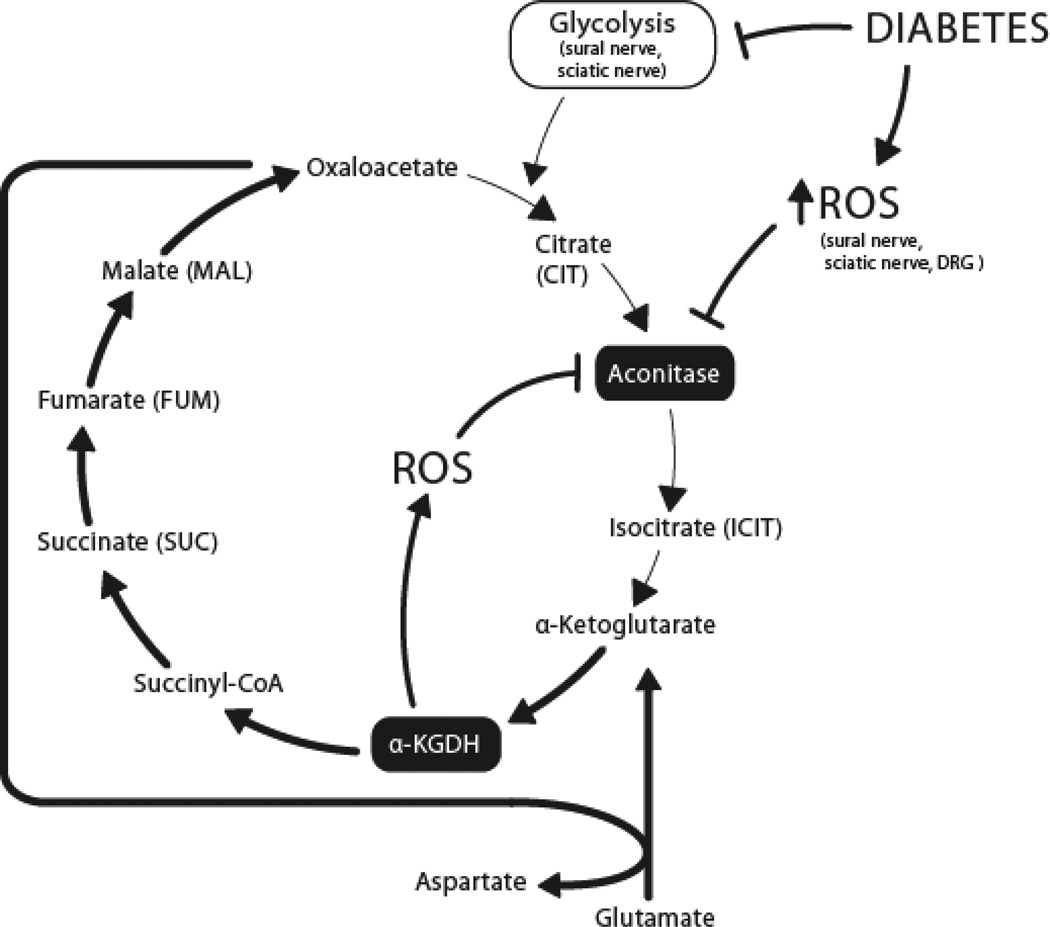
Diabetic neuropathy (DN) is the most common complication of diabetes and is characterized by distal-to-proximal loss of peripheral nerve axons. The idea of tissue-specific pathological alterations in energy metabolism in diabetic complications-prone tissues is emerging. Altered nerve metabolism in type 1 diabetes models is observed; however, therapeutic strategies based on these models offer limited efficacy to type 2 diabetic patients with DN. Therefore, understanding how peripheral nerves metabolically adapt to the unique type 2 diabetic environment is critical to develop disease-modifying treatments. In the current study, we utilized targeted liquid chromatography-tandem mass spectrometry (LC/MS/MS) to characterize the glycolytic and tricarboxylic acid (TCA) cycle metabolomes in sural nerve, sciatic nerve, and dorsal root ganglia (DRG) from male type 2 diabetic mice (BKS.Cg-m+/+Lepr(db); db/db) and controls (db/+). We report depletion of glycolytic intermediates in diabetic sural nerve and sciatic nerve (glucose-6-phosphate, fructose-6-phosphate, fructose-1,6-bisphosphate (sural nerve only), 3-phosphoglycerate, 2-phosphoglycerate, phosphoenolpyruvate, and lactate), with no significant changes in DRG. Citrate and isocitrate TCA cycle intermediates were decreased in sural nerve, sciatic nerve, and DRG from diabetic mice. Utilizing LC/electrospray ionization/MS/MS and HPLC methods, we also observed increased protein and lipid oxidation (nitrotyrosine; hydroxyoctadecadienoic acids) in db/db tissue, with a proximal-to-distal increase in oxidative stress, with associated decreased aconitase enzyme activity. We propose a preliminary model, whereby the greater change in metabolomic profile, increase in oxidative stress, and decrease in TCA cycle enzyme activity may cause distal peripheral nerves to rely on truncated TCA cycle metabolism in the type 2 diabetes environment.
Conflict of interest statement
The authors declare that there is no conflict of interest that could be perceived as prejudicing the impartiality of the research reported.
Figures
Similar articles
-
Advantages of omics approaches for elucidating metabolic changes in diabetic peripheral neuropathy.Front Endocrinol (Lausanne). 2023 Nov 28;14:1208441. doi: 10.3389/fendo.2023.1208441. eCollection 2023. Front Endocrinol (Lausanne). 2023. PMID: 38089620 Free PMC article. Review.
-
Proteomic quantitative study of dorsal root ganglia and sciatic nerve in type 2 diabetic mice.Mol Metab. 2022 Jan;55:101408. doi: 10.1016/j.molmet.2021.101408. Epub 2021 Nov 30. Mol Metab. 2022. PMID: 34856394 Free PMC article.
-
The role of miR-146a in dorsal root ganglia neurons of experimental diabetic peripheral neuropathy.Neuroscience. 2014 Feb 14;259:155-63. doi: 10.1016/j.neuroscience.2013.11.057. Epub 2013 Dec 6. Neuroscience. 2014. PMID: 24316060 Free PMC article.
-
Metabolic Dysfunction Is Restricted to the Sciatic Nerve in Experimental Diabetic Neuropathy.Diabetes. 2016 Jan;65(1):228-38. doi: 10.2337/db15-0835. Epub 2015 Oct 15. Diabetes. 2016. PMID: 26470786
-
Pathogenesis of diabetic neuropathy: bad to the bone.Ann N Y Acad Sci. 2011 Dec;1240:70-6. doi: 10.1111/j.1749-6632.2011.06309.x. Ann N Y Acad Sci. 2011. PMID: 22172042 Free PMC article. Review.
Cited by
-
Altered Metabolome of Lipids and Amino Acids Species: A Source of Early Signature Biomarkers of T2DM.J Clin Med. 2020 Jul 16;9(7):2257. doi: 10.3390/jcm9072257. J Clin Med. 2020. PMID: 32708684 Free PMC article. Review.
-
Cardiovascular Autonomic Neuropathy in Type 1 Diabetes Is Associated With Disturbances in TCA, Lipid, and Glucose Metabolism.Front Endocrinol (Lausanne). 2022 Apr 14;13:831793. doi: 10.3389/fendo.2022.831793. eCollection 2022. Front Endocrinol (Lausanne). 2022. PMID: 35498422 Free PMC article.
-
Exposure to elevated glucose concentrations alters the metabolomic profile of bovine blastocysts.PLoS One. 2018 Jun 20;13(6):e0199310. doi: 10.1371/journal.pone.0199310. eCollection 2018. PLoS One. 2018. PMID: 29924852 Free PMC article.
-
UHPLC-MS-Based Metabolomics Reveal the Potential Mechanism of Armillaria mellea Acid Polysaccharide in and Its Effects on Cyclophosphamide-Induced Immunosuppressed Mice.Molecules. 2023 Dec 5;28(24):7944. doi: 10.3390/molecules28247944. Molecules. 2023. PMID: 38138434 Free PMC article.
-
Advantages of omics approaches for elucidating metabolic changes in diabetic peripheral neuropathy.Front Endocrinol (Lausanne). 2023 Nov 28;14:1208441. doi: 10.3389/fendo.2023.1208441. eCollection 2023. Front Endocrinol (Lausanne). 2023. PMID: 38089620 Free PMC article. Review.
References
-
- Brownlee M. Biochemistry and molecular cell biology of diabetic complications. Nature. 2001;414:813–820. - PubMed
-
- CDCP. National diabetes fact sheet: national estimates and general information on diabetes and prediabetes in the United States. Atlanta, GA: U.S. Department of Health and Human Services, Centers for Disease Control and Prevention; 2011.
Publication types
MeSH terms
Substances
Grants and funding
- 1RC 1NS068182/NS/NINDS NIH HHS/United States
- DP3 DK094292/DK/NIDDK NIH HHS/United States
- DK089503/DK/NIDDK NIH HHS/United States
- P30 DK089503/DK/NIDDK NIH HHS/United States
- RC1 NS068182/NS/NINDS NIH HHS/United States
- U01 DK076160/DK/NIDDK NIH HHS/United States
- P30 DK020572/DK/NIDDK NIH HHS/United States
- U24 DK097153/DK/NIDDK NIH HHS/United States
- 1 DP3 DK094292/DK/NIDDK NIH HHS/United States
- R24 DK082841/DK/NIDDK NIH HHS/United States
- 1 R24 DK082841-01/DK/NIDDK NIH HHS/United States
- 1 UO1 DK076160/DK/NIDDK NIH HHS/United States
LinkOut - more resources
Full Text Sources
Other Literature Sources
Medical
Miscellaneous
