


Combined pesticide exposure severely affects individual- and colony-level traits in bees
- PMID: 23086150
- PMCID: PMC3495159
- DOI: 10.1038/nature11585
Combined pesticide exposure severely affects individual- and colony-level traits in bees
Abstract
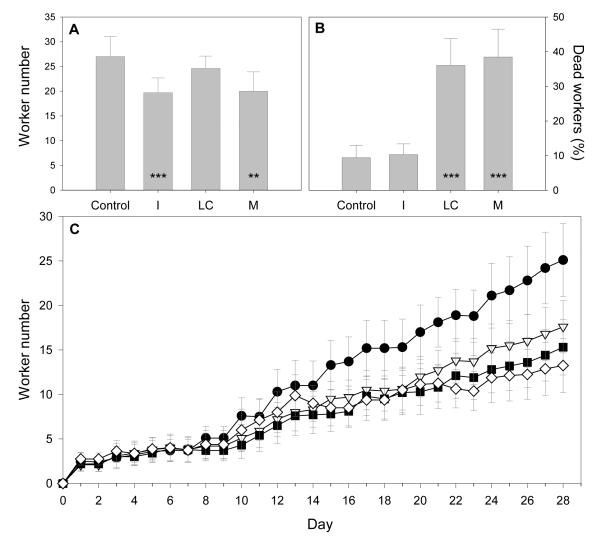
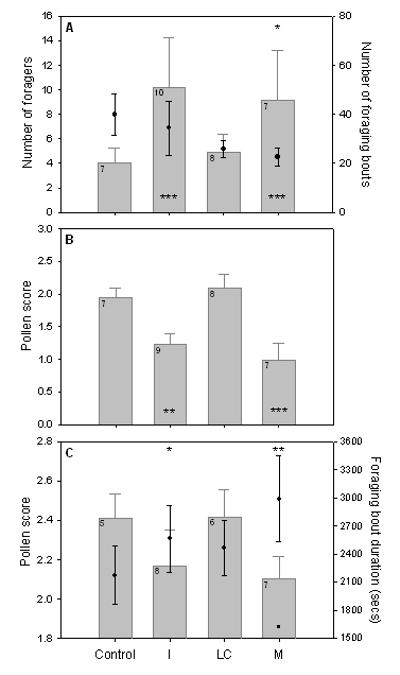
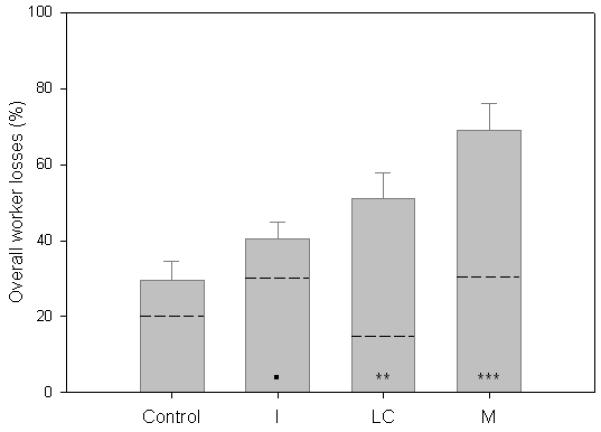
Reported widespread declines of wild and managed insect pollinators have serious consequences for global ecosystem services and agricultural production. Bees contribute approximately 80% of insect pollination, so it is important to understand and mitigate the causes of current declines in bee populations . Recent studies have implicated the role of pesticides in these declines, as exposure to these chemicals has been associated with changes in bee behaviour and reductions in colony queen production. However, the key link between changes in individual behaviour and the consequent impact at the colony level has not been shown. Social bee colonies depend on the collective performance of many individual workers. Thus, although field-level pesticide concentrations can have subtle or sublethal effects at the individual level, it is not known whether bee societies can buffer such effects or whether it results in a severe cumulative effect at the colony level. Furthermore, widespread agricultural intensification means that bees are exposed to numerous pesticides when foraging, yet the possible combinatorial effects of pesticide exposure have rarely been investigated. Here we show that chronic exposure of bumblebees to two pesticides (neonicotinoid and pyrethroid) at concentrations that could approximate field-level exposure impairs natural foraging behaviour and increases worker mortality leading to significant reductions in brood development and colony success. We found that worker foraging performance, particularly pollen collecting efficiency, was significantly reduced with observed knock-on effects for forager recruitment, worker losses and overall worker productivity. Moreover, we provide evidence that combinatorial exposure to pesticides increases the propensity of colonies to fail.
Figures
Comment in
-
Ecology: Bumblebees and pesticides.Nature. 2012 Nov 1;491(7422):43-5. doi: 10.1038/nature11637. Epub 2012 Oct 21. Nature. 2012. PMID: 23086148 No abstract available.
References
-
- Biesmeijer JC, et al. Parallel declines in pollinators and insect-pollinated plants in Britain and the Netherlands. Science. 2006;313:351–354. - PubMed
-
- Kremen C, et al. Pollination and other ecosystem services produced by mobile organisms: a conceptual framework for the effects of land-use change. Ecol. Lett. 2007;10:299–314. - PubMed
-
- Potts SG, et al. Global pollinator declines: trends, impacts and drivers. Trends Ecol. Evol. 2010;25:345–353. - PubMed
References for Methods section
-
- Thompson HM. Assessing the exposure and toxicity of pesticides to bumblebees (Bombus sp.) Apidologie. 2001;32:305–321.
-
- Brittain C, Potts SG. The potential impacts of insecticides on the life-history traits of bees and the consequences for pollination. Basic Appl. Ecol. 2011;12:321–331.
-
- Garthwaite D, Thomas MR, Parrish G, Smith L, Barker I. Pesticide Usage Survey Report 224. Arable crops in Great Britain 2008 (including aerial applications 07-08) Food and Environmental Research Agency; York, UK: 2008.
-
- Garthwaite D, et al. Pesticide Usage Survey Report 235. Arable crops in UK 2010 (including aerial applications 2010) Food and Environmental Research Agency; York, UK: 2010.
-
- Bonmatin JM, et al. A LC/APCI-MS/MS method for analysis of imidacloprid in soils, in plants, and in pollens. Anal. Chem. 2003;75:2027–2033. - PubMed
Publication types
MeSH terms
Substances
Grants and funding
LinkOut - more resources
Full Text Sources
Other Literature Sources
