. 2012 Oct 9:3:205.
doi: 10.3389/fgene.2012.00205. eCollection 2012.

Evolutionary conservation and functional roles of ncRNA

Affiliations

Evolutionary conservation and functional roles of ncRNA

Zhipeng Qu et al. Front Genet. .

Abstract

Non-coding RNAs (ncRNAs) are a class of transcribed RNA molecules without protein-coding potential. They were regarded as transcriptional noise, or the byproduct of genetic information flow from DNA to protein for a long time. However, in recent years, a number of studies have shown that ncRNAs are pervasively transcribed, and most of them show evidence of evolutionary conservation, although less conserved than protein-coding genes. More importantly, many ncRNAs have been confirmed as playing crucial regulatory roles in diverse biological processes and tumorigenesis. Here we summarize the functional significance of this class of "dark matter" in terms its genomic organization, evolutionary conservation, and broad functional classes.

Keywords: evolution; gene regulation; genetic; long ncRNA; molecular; ncRNA; transcription.


Figures
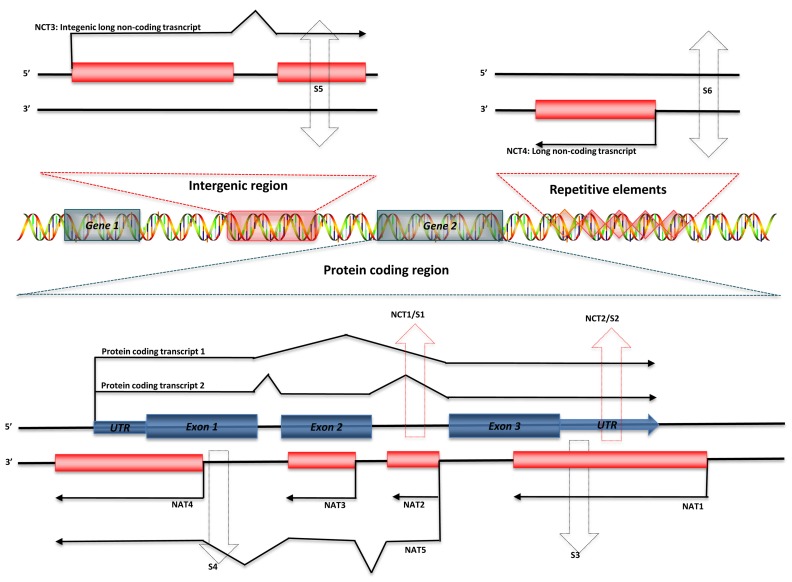
FIGURE 1
FIGURE 1
Genomic organization of regulatory ncRNAs in mammalian genome. Green symbols represent protein-coding transcripts; red symbols represent non-coding transcripts; black dashed arrows represent small ncRNAs; and red dashed arrows represent shared regions transcribed as long ncRNAs or small ncRNAs. Long ncRNAs can be transcribed from: (1) Non-coding regions of protein-coding transcript: intron – NCT1; UTRs – NCT2. (2) Antisense of protein-coding transcripts: convergent (tail–tail) antisense transcript – NAT1; intronic antisense transcript – NAT2; contained antisense transcript – NAT3; divergent (head–head) antisense transcript – NAT4; mixed-model antisense transcript – NAT5. (3) Intergenic region: NCT3. (4) Repetitive elements: NCT4. Small ncRNAs can be transcribed from introns (S1) or UTRs (S2) of protein-coding genes, antisense region of UTRs (S3) or exons (S4), both strands of intergenic regions (S5), and both strands of repetitive elements (S6).
FIGURE 2
FIGURE 2
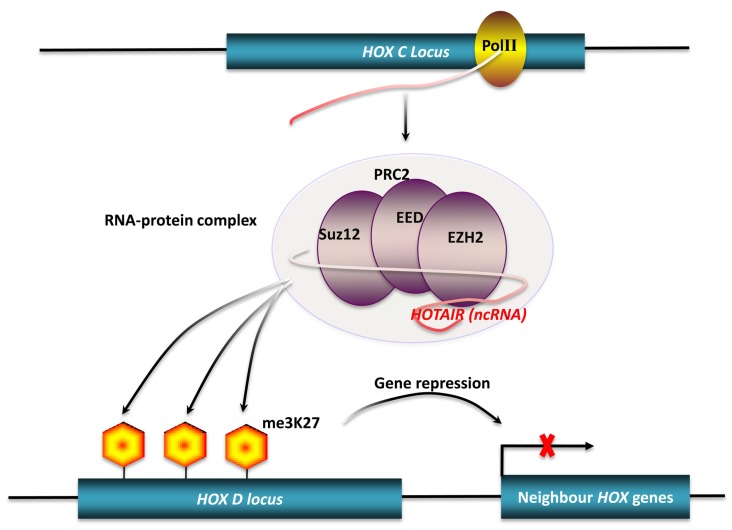
Chromatin modification by long ncRNA.
FIGURE 3
FIGURE 3
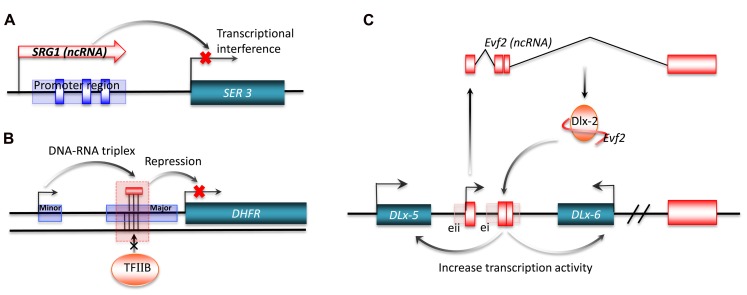
Transcriptional regulation by long ncRNA. Long ncRNAs can conduct transcriptional regulation of target genes by: (A) transcriptional interference. The purple rectangle represents the promoter region for SER3, and the blue boxes are SER3 upstream activating sequence (UAS) elements; (B) interacting with promoters. The short purple rectangle represents the minor promoter, and the long purple rectangle represents the major promoter; (C) interacting with transcriptional factors. ei and eii are two ultraconserved enhancers.
FIGURE 4
FIGURE 4
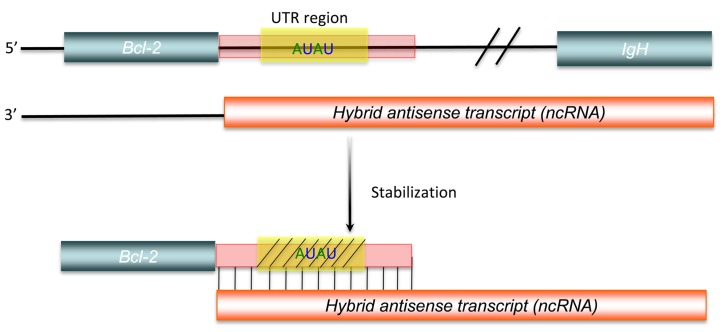
Post-transcriptional regulation by long ncRNA.

References

    1. Amaral P. P., Clark M. B., Gascoigne D. K., Dinger M. E., Mattick J. S. (2010). lncRNAdb: a reference database for long noncoding RNAs. Nucleic Acids Res. 39 D146–D151 - PMC - PubMed
    1. Amaral P. P., Mattick J. S. (2008). Noncoding RNA in development. Mamm. Genome 19 454–492 - PubMed
    1. Araki R., Fukumura R., Sasaki N., Kasama Y., Suzuki N., Takahashi H., et al. (2006). More than 40,000 transcripts, including novel and noncoding transcripts, in mouse embryonic stem cells. Stem Cells 24 2522–2528 - PubMed
    1. Bejerano G., Pheasant M., Makunin I., Stephen S., Kent W. J., Mattick J. S., et al. (2004). Ultraconserved elements in the human genome. Science 304 1321–1325 - PubMed
    1. Beltran M., Puig I., Pena C., Garcia J. M., Alvarez A. B., Pena R., et al. (2008). A natural antisense transcript regulates Zeb2/Sip1 gene expression during Snail1-induced epithelial–mesenchymal transition. Genes Dev. 22 756–769 - PMC - PubMed

LinkOut - more resources