


Chlorhexidine salt-loaded polyurethane orthodontic chains: in vitro release and antibacterial activity studies
- PMID: 23090109
- PMCID: PMC3513458
- DOI: 10.1208/s12249-012-9872-6
Chlorhexidine salt-loaded polyurethane orthodontic chains: in vitro release and antibacterial activity studies
Abstract
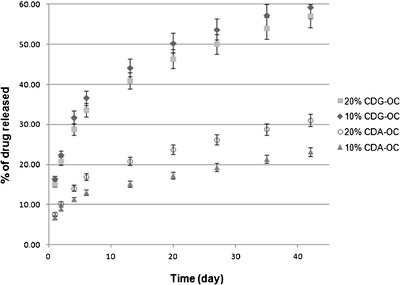
The widespread use of indwelling medical devices has enormously increased the interest in materials incorporating antibiotics and antimicrobial agents as a means to prevent dangerous device-related infections. Recently, chlorhexidine-loaded polyurethane has been proposed as a material suitable for the production of devices which are able to resist microbial contamination. The aim of the present study was to characterize the in vitro release of chlorhexidine from new polymeric orthodontic chains realized with polyurethane loaded with two different chlorhexidine salts: chlorhexidine diacetate or chlorhexidine digluconate. The orthodontic chains constituted of three layers: a middle polyurethane layer loaded with chlorhexidine salt inserted between two layers of unloaded polymer. In vitro release of chlorhexidine diacetate and digluconate from orthodontic chains loaded with 10% or 20% (w/w) chlorhexidine salt was sustained for 42 days and followed Fickian diffusion. The drug diffusion through the polyurethane was found to be dependent not only on chlorhexidine loading, but also on the type of chlorhexidine salt. The antibacterial activity of 0.2% (w/w) chlorhexidine diacetate-loaded orthodontic chain was successfully tested towards clinically isolated biofilm forming ica-positive Staphylococcus epidermidis via agar diffusion test. In conclusion, the chlorhexidine salt-loaded chains could provide an innovative approach in the prevention of oral infections related to the use of orthodontic devices.
Figures

References
-
- Chauvel-Lebert DJ, Auroy P, Bonnaure-Mallet M. Biocompatibility of elastomers. In: Dumitriu S, editor. Polymeric biomaterials. New-York: Marcel Dekker; 2002. pp. 311–360.
-
- Renick MR, Brantley WA, Beck FM, Vig KWL, Webb CS. Studies of orthodontic elastomeric modules. Part 1: glass transition temperatures for representative pigmented products in the as-received condition and after orthodontic use. Am J Orthod Dentofac Orthop. 2004;126(3):337–343. doi: 10.1016/j.ajodo.2003.07.017. - DOI - PubMed
-
- Opsahl Vital S, Haignere-Rubinstein C, Lasfargues J-J, Chaussain C. Caries risk and orthodontic treatment. Int Orthod. 2010;8(1):28–45. - PubMed
MeSH terms
Substances
LinkOut - more resources
Full Text Sources
Other Literature Sources
Medical
Miscellaneous
