


Perinatal outcomes associated with obstructive sleep apnea in obese pregnant women
- PMID: 23090526
- PMCID: PMC3552141
- DOI: 10.1097/AOG.0b013e31826eb9d8
Perinatal outcomes associated with obstructive sleep apnea in obese pregnant women
Abstract
Objective: To investigate the associations between obstructive sleep apnea (OSA) and maternal and neonatal morbidities in a cohort of obese gravid women.
Methods: Participants were enrolled in a prospective observational study designed to screen for OSA and describe the possible risk factors for and outcomes of OSA among obese (body mass index [BMI, calculated as weight (kg)/[height (m)]2] 30 or higher) pregnant women. Women underwent an overnight sleep study using a portable home monitor. Studies were manually scored by a central masked sleep reading center using American Academy of Sleep Medicine diagnostic criteria. An apnea hypopnea index of 5 or more was considered diagnostic of OSA. Perinatal outcomes were compared between women with and without OSA.
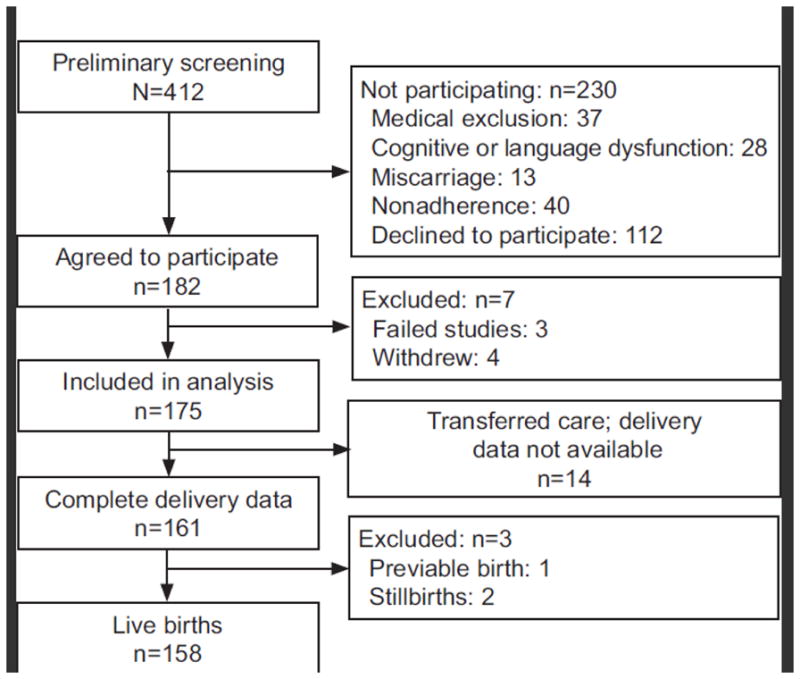
Results: Among 175 women, OSA prevalence was 15.4% (13 mild, 9 moderate, 5 severe). Compared with no OSA (apnea hypopnea index less than 5), the OSA group had a higher BMI (46.8±12.2 compared with 38.1±7.5; P=.002) and more chronic hypertension (55.6% compared with 32.4%, P=.02). Maternal complications included maternal death (n=1, amniotic fluid embolus [no OSA group]) and cardiac arrest (n=1, intraoperative at cesarean delivery [OSA group]). One previable birth and two stillbirths occurred in the no OSA group. Among live births, OSA was associated with more frequent cesarean delivery (65.4% compared with 32.8%; P=.003), preeclampsia (42.3% compared with 16.9%; P=.005), and neonatal intensive care unit admission (46.1% compared with 17.8%; P=.002). After controlling for BMI, maternal age, and diabetes, OSA (odds ratio [OR] 3.55, 95% confidence interval [CI] 1.1-11.3), previous preeclampsia (OR 2.79, 95% CI 1.09-7.19), and hypertension (OR 4.25, 95% CI 1.67-10.77) were associated with development of preeclampsia.
Conclusion: Obstructive sleep apnea among obese pregnant women is associated with more frequent preeclampsia, neonatal intensive care unit admissions, and cesarean delivery.
Level of evidence: II.
Comment in
-
Perinatal outcomes associated with obstructive sleep apnea in obese pregnant women.Obstet Gynecol. 2013 Apr;121(4):875-876. doi: 10.1097/AOG.0b013e31828a6b20. Obstet Gynecol. 2013. PMID: 23635692 No abstract available.
-
In reply.Obstet Gynecol. 2013 Apr;121(4):876. doi: 10.1097/AOG.0b013e31828a6bda. Obstet Gynecol. 2013. PMID: 23635693 No abstract available.
References
-
- Flegal KM, Carroll MD, Kit BK, Ogden CL. Prevalence of Obesity and Trends in the Distribution of Body Mass Index Among US Adults, 1999–2010. JAMA: The Journal of the American Medical Association. 2012 Feb 1;307(5):491–7. - PubMed
-
- Finkelstein EA, Khavjou OA, Thompson H, Trogdon JG, Pan L, Sherry B, et al. Obesity and Severe Obesity Forecasts Through 2030. American Journal of Preventive Medicine June. 2012;42(6) - PubMed
-
- Vricella LK, Louis JM, Mercer BM, Bolden N. Impact of morbid obesity on epidural anesthesia complications in labor. American Journal of Obstetrics and Gynecology. 2011;205(4):370.e1–e6. - PubMed
Publication types
MeSH terms
Grants and funding
LinkOut - more resources
Full Text Sources
Other Literature Sources
Medical
Research Materials
