. 2012 Nov 27;109(48):19763-8.
doi: 10.1073/pnas.1121120109. Epub 2012 Oct 22.

MED12 mutations link intellectual disability syndromes with dysregulated GLI3-dependent Sonic Hedgehog signaling

Affiliations

MED12 mutations link intellectual disability syndromes with dysregulated GLI3-dependent Sonic Hedgehog signaling

Haiying Zhou et al. Proc Natl Acad Sci U S A. .

Abstract

Recurrent missense mutations in the RNA polymerase II Mediator subunit MED12 are associated with X-linked intellectual disability (XLID) and multiple congenital anomalies, including craniofacial, musculoskeletal, and behavioral defects in humans with FG (or Opitz-Kaveggia) and Lujan syndromes. However, the molecular mechanism(s) underlying these phenotypes is poorly understood. Here we report that MED12 mutations R961W and N1007S causing FG and Lujan syndromes, respectively, disrupt a Mediator-imposed constraint on GLI3-dependent Sonic Hedgehog (SHH) signaling. We show that the FG/R961W and Lujan/N1007S mutations disrupt the gene-specific association of MED12 with a second Mediator subunit, CDK8, identified herein to be a suppressor of GLI3 transactivation activity. In FG/R961W and Lujan/N1007S patient-derived cells, we document enhanced SHH pathway activation and GLI3-target gene induction coincident with impaired recruitment of CDK8 onto promoters of GLI3-target genes, but not non-GLI3-target genes. Together, these findings suggest that dysregulated GLI3-dependent SHH signaling contributes to phenotypes of individuals with FG and Lujan syndromes and further reveal a basis for the gene-specific manifestation of pathogenic mutations in a global transcriptional coregulator.


Conflict of interest statement

The authors declare no conflict of interest.

Figures
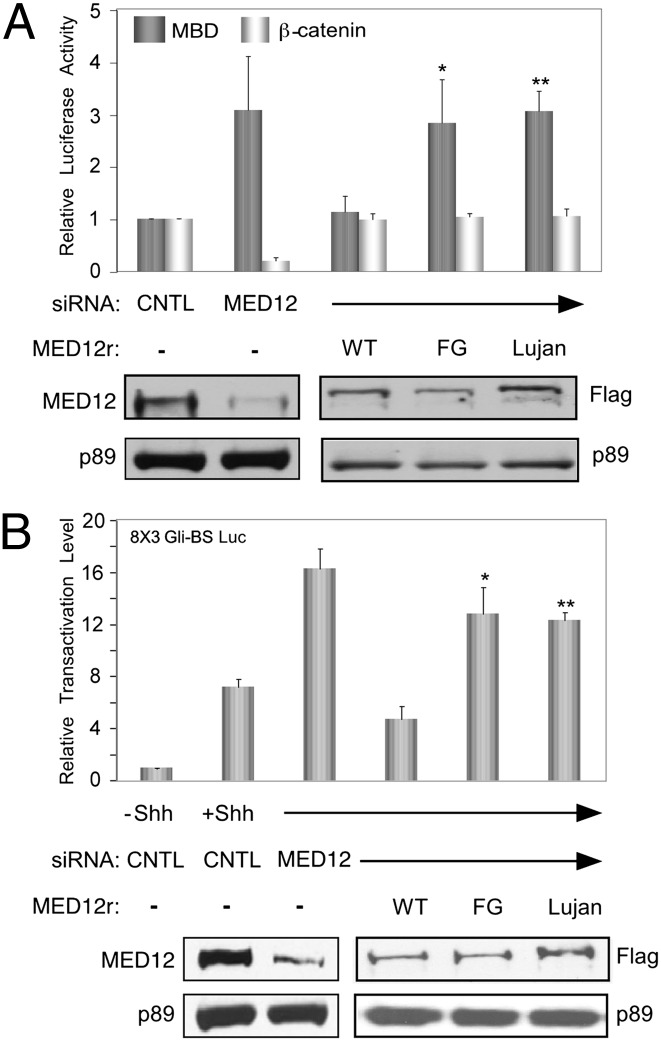
Fig. 1.
Fig. 1.
MED12 mutations R961W and N1007S disrupt a Mediator-imposed constraint on GLI3-dependent Shh signaling. (A and B, Upper) HeLa (A) or CH310T1/2 (B) cells were transfected or electroporated, respectively, with control (CNTL) or MED12-specific siRNA and subsequently transfected with an internal control pact–β-galactosidase expression plasmid along with a pG5-E1B-Luc reporter and either Gal4, Gal4-GLI3 MBD, or Gal4–β-catenin (A) or an 8 × 3′ Gli-BS-Luc reporter and GLI3 (B). Where indicated (MED12r), DNA transfections also included siRNA-resistant WT, FG/R961W, or Lujan/N1007S mutant MED12 expression plasmids. Where indicated in B. CH310T1/2 cells were treated with conditioned medium from control (−Shh) or Shh-expressing (+Shh) 293 cells. Normalized luciferase activities were calculated relative to the luciferase activity obtained in cells transfected with control siRNA and Gal4 (A) or cells transfected with control siRNA and treated with control-conditioned medium (B). For comparative purposes on the same plot in A, the relative luciferase activity for each activator in control siRNA-transfected cells was arbitrarily assigned a value of 1, yielding a relative transactivation level; their corresponding transactivation levels in MED12 siRNA-transfected cells are expressed relative to this value. The actual transactivation levels for Gal4–MBD and Gal4–β-catenin in these experiments averaged 531- and 211-fold, respectively. Data represent the mean ± SEM of at least three independent experiments performed in duplicate. Asterisks denote statistically significant differences compared with MED12r WT (Student t test, *P < 0.05, **P < 0.01). (A and B, Lower) Western blot (WB) analyses of extracts from representative knockdown/rescue assays using antibodies specific for either MED12, the FLAG epitope on MED12r derivatives, or transcription factor (TF) IIH TFIIH p89 as an internal loading control.
Fig. 2.
Fig. 2.
CDK8 kinase activity is required to suppress the Gli3 transactivation domain. HeLa (A) or CH310T1/2 (B and C) cells were transfected or electroporated, respectively, with control (CNTL), MED12-, CDK8-, or MED23-specific siRNAs and subsequently with an internal control pact–β-galactosidase expression plasmid along with a pG5-E1B-Luc reporter and either Gal4 or Gal4–GLI3 MBD (A) an 8 × 3′ Gli-BS-Luc reporter and GLi3 (B) or no plasmid DNA (C). Where indicated (B and C) CH310T1/2 cells were treated with conditioned medium from control (−Shh) or Shh-expressing (+Shh) 293 cells. Normalized luciferase activity is expressed relative to the luciferase activity obtained in cells transfected with control siRNA and Gal4 (A) or cells electroporated with control siRNA and treated with control-conditioned medium (B). Endogenous Gli1 mRNA levels in C were determined by RT-qPCR, normalized to β-actin levels, and expressed relative to the level of Gli1 RNA in cells treated with CNTL siRNA and control-conditioned medium. Data for all transient reporter assays including F represent the mean ± SEM of at least three independent experiments performed in duplicate. Asterisks denote statistically significant differences compared with CNTL siRNA (Student t test, *P < 0.05, **P < 0.01). (D and E) WB analyses of extracts from representative assays in A and B, using antibodies specific for MED12, CDK8, MED23, or TFIIH p89 as an internal loading control. (F, Upper) HeLa cells infected with lentiviruses expressing control (CNTL) or CDK8-specific shRNAs were subsequently transfected with internal control, reporter and activator plasmids as in A. Where indicated (CDK8r), DNA transfections also included siRNA-resistant WT or kinase dead (D173A) CDK8 derivatives. Relative luciferase activities were calculated as described in (A). (F, Lower) WB analysis from a knockdown/rescue assay using antibodies specific for CDK8 or transcription factor (TF) IIEβ as an internal loading control. Endogenous (end) CDK8 and ectopically (ect) expressed FLAG-tagged CDK8r derivatives are indicated.
Fig. 3.
Fig. 3.
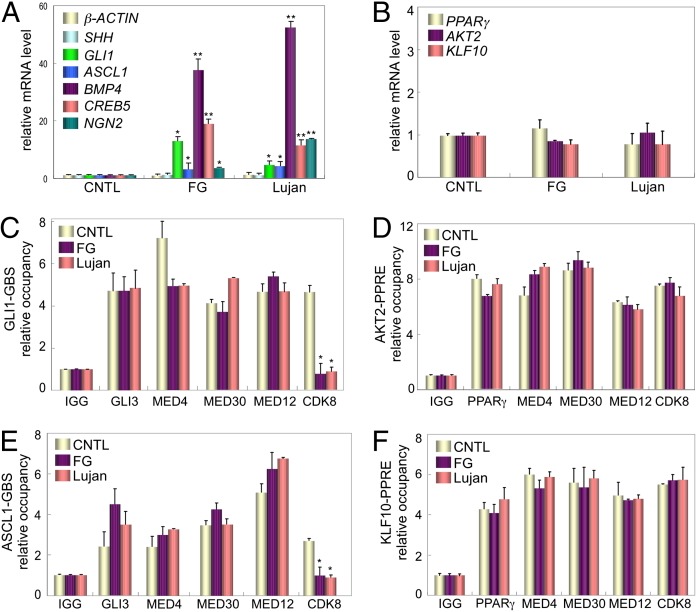
SHH-responsive GLI3-target genes show enhanced expression and impaired CDK8 promoter recruitment in FG and Lujan patient-derived cells. (A and B) RNAs from control (CNTL), FG, and Lujan patient cells treated without cyclopamine (see Fig. S2 for cyclopamine treatment) were used for RT-qPCR. mRNA levels for each gene were normalized to β-actin mRNA and expressed relative to their corresponding mRNA levels in CNTL patient cells. Data represent the mean ± SEM of at least three independent experiments performed in duplicate. Asterisks denote statistically significant differences in the relative mRNA levels for each gene compared with their corresponding levels in CNTL cells (Student t test, *P < 0.05, **P < 0.01). (CF) Soluble chromatin prepared from CNTL, FG, and Lujan patient cells was subjected to immunoprecipitation (IP) using the indicated antibodies. Immunoprecipitated chromatin was analyzed by qPCR using primers flanking GLI binding sites (GBSs) within the GLI1 and ASCL1 genes (C and E) or PPARγ response elements (PPREs) within the AKT2 and KLF10 genes (D and F). DNA occupancy for each protein is expressed relative to control IgG. Data represent the mean ± SEM of at least three independent experiments performed in triplicate. Asterisks denote statistically significant differences in relative DNA occupancy for a given protein compared with that in control (CNTL) patient cells (Student t test, *P < 0.05).
Fig. 4.
Fig. 4.
Soluble mutant MED12-containing Mediator and reconstituted kinase modules show no defect in CDK8 incorporation. (A) Nuclear extracts from control CNTL, FG, or Lujan patient cells were subjected to IP with goat IgG (IgG*), rabbit IgG, or antibodies specific for CDK8 (goat) or MED30 (rabbit) as indicated. Immunoprecipitates were processed by WB analysis using antibodies specific for the indicated Mediator subunits. Input corresponds to 20% of the nuclear extracts used for IP. (B and C) Lysates from High Five insect cells coexpressing the indicated combinations of epitope-tagged kinase module subunits CBP-MED13, MED12-HA (WT/R961W/N1007S), CDK8-FLAG, and 6HIS-CyclinC were subjected to IP with FLAG-specific antibodies. Note that because CDK8 expression is limiting relative to other kinase module subunits during viral infection, WT and mutant MED12 derivatives are thus present in excess levels at the input concentrations used in IPs. (B) Immunoprecipitates were processed by WB analysis using the indicated antibodies. (C) Immunoprecipitates were incubated with a purified GST-3xCTD substrate (corresponding to three heptapeptide repeats from the RNA polymerase II large subunit) in the presence of [γ-32P]ATP before resolution by SDS/PAGE and visualization of 32P-labeled GST-3xCTD by phosphorimager analysis (Upper) and total input GST-3xCTD by Coomassie blue staining (Lower). The amount of 32P-labeled GST-3xCTD catalyzed by each kinase module derivative was quantified and expressed relative to the amount catalyzed by WT MED12-containing module (100%). Values represent the average ± SEM of three independent experiments.
Fig. 5.
Fig. 5.
Schematic model for how XLID mutations in MED12 disrupt a Mediator-imposed constraint GLI3-dependent SHH signaling. (A) In a WT MED12 background, SHH-activated GLI3, through its MBD, physically binds the MED12 interface in Mediator to functionally reverse CDK8-mediated inhibition of GLI3 transactivation activity. The balance achieved between these antagonistic interactions contributes to the level of GLI3-dependent gene expression output in response to SHH. (B) FG/R961W and Lujan/N1007S mutations in MED12 disrupt its ability to recruit CDK8 onto GLI3-target gene promoters, effectively removing a constraint on Gli3 transactivation activity, leading to hyperactivated GLI3-dependent SHH signaling. The unknown fate of cyclin C and MED13 is indicated by a question mark.

Comment in

References

    1. Rogers RC, Stevenson RE, Simensen RJ, Holden KR, Schwartz CE. Finding new etiologies of mental retardation and hypotonia: X marks the spot. Dev Med Child Neurol. 2008;50(2):104–111. - PubMed
    1. Chiurazzi P, Schwartz CE, Gecz J, Neri G. XLMR genes: Update 2007. Eur J Hum Genet. 2008;16(4):422–434. - PubMed
    1. Risheg H, et al. A recurrent mutation in MED12 leading to R961W causes Opitz-Kaveggia syndrome. Nat Genet. 2007;39(4):451–453. - PubMed
    1. Schwartz CE, et al. The original Lujan syndrome family has a novel missense mutation (p.N1007S) in the MED12 gene. J Med Genet. 2007;44(7):472–477. - PMC - PubMed
    1. Spaeth JM, Kim NH, Boyer TG. Mediator and human disease. Semin Cell Dev Biol. 2011;22(7):776–787. - PMC - PubMed

Publication types

MeSH terms

LinkOut - more resources