


Fiber orientation-dependent white matter contrast in gradient echo MRI
- PMID: 23091011
- PMCID: PMC3494918
- DOI: 10.1073/pnas.1211075109
Fiber orientation-dependent white matter contrast in gradient echo MRI
Abstract
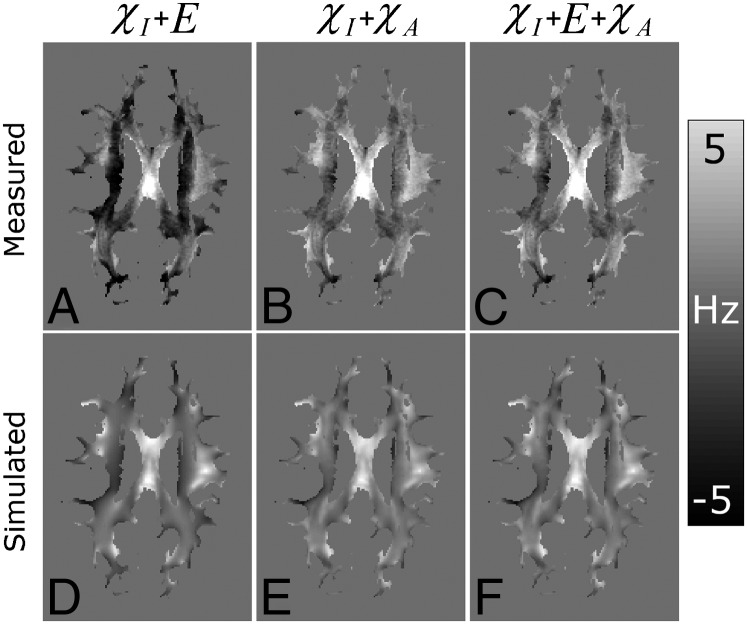
Recent studies have shown that there is a direct link between the orientation of the nerve fibers in white matter (WM) and the contrast observed in magnitude and phase images acquired using gradient echo MRI. Understanding the origin of this link is of great interest because it could offer access to a new diagnostic tool for investigating tissue microstructure. Since it has been suggested that myelin is the dominant source of this contrast, creating an accurate model for characterizing the effect of the myelin sheath on the evolution of the NMR signal is an essential step toward fully understanding WM contrast. In this study, we show by comparison of the results of simulations and experiments carried out on human subjects at 7T, that the magnitude and phase of signals acquired from WM in vivo can be accurately characterized by (i) modeling the myelin sheath as a hollow cylinder composed of material having an anisotropic magnetic susceptibility that is described by a tensor with a radially oriented principal axis, and (ii) adopting a two-pool model in which the water in the sheath has a reduced T(2) relaxation time and spin density relative to its surroundings, and also undergoes exchange. The accuracy and intrinsic simplicity of the hollow cylinder model provides a versatile framework for future exploitation of the effect of WM microstructure on gradient echo contrast in clinical MRI.
Conflict of interest statement
The authors declare no conflict of interest.
Figures


References
-
- Denk C, Hernandez Torres E, MacKay A, Rauscher A. The influence of white matter fibre orientation on MR signal phase and decay. NMR Biomed. 2011;24(3):246–252. - PubMed
-
- Bender B, Klose U. The in vivo influence of white matter fiber orientation towards B(0) on T2* in the human brain. NMR Biomed. 2010;23(9):1071–1076. - PubMed
Publication types
MeSH terms
Grants and funding
LinkOut - more resources
Full Text Sources
Other Literature Sources
