. 2012 Nov 6;109(45):18425-30.
doi: 10.1073/pnas.1212754109. Epub 2012 Oct 22.

Regulation of actin-myosin interaction by conserved periodic sites of tropomyosin

Affiliations

Regulation of actin-myosin interaction by conserved periodic sites of tropomyosin

Bipasha Barua et al. Proc Natl Acad Sci U S A. .

Abstract

Cooperative activation of actin-myosin interaction by tropomyosin (Tm) is central to regulation of contraction in muscle cells and cellular and intracellular movements in nonmuscle cells. The steric blocking model of muscle regulation proposed 40 y ago has been substantiated at both the kinetic and structural levels. Even with atomic resolution structures of the major players, how Tm binds and is designed for regulatory function has remained a mystery. Here we show that a set of periodically distributed evolutionarily conserved surface residues of Tm is required for cooperative regulation of actomyosin. Based on our results, we propose a model of Tm on a structure of actin-Tm-myosin in the "open" (on) state showing potential electrostatic interactions of the residues with both actin and myosin. The sites alternate with a second set of conserved surface residues that are important for actin binding in the inhibitory state in the absence of myosin. The transition from the closed to open states requires the sites identified here, even when troponin + Ca(2+) is present. The evolutionarily conserved residues are important for actomyosin regulation, a universal function of Tm that has a common structural basis and mechanism.


Conflict of interest statement

The authors declare no conflict of interest.

Figures

Fig. 1.
Fig. 1.
Tm mutations at evolutionarily conserved surface residues (23). (A) The rat striated αTm sequence showing conserved b, c, and f residues that were mutated to Ala in P2–P6. Each mutant has three to four mutations within the first-half (red) or second-half (blue) of each period. (B) Tm mutations shown in the 7 Å striated muscle αTm structure (1C1G) (43). Mutations in the first-half of periods 2–6 are in red, and mutations in the second-half are in blue. The periodic repeats do not correspond to the half-turns of the coiled-coil in the 7 Å structure because there are five and three-quarter half-turns of the supercoil per molecule, not seven (43, 44). That is, the half-turns do not correspond to the seven actins along the length of one Tm molecule.
Fig. 2.
Fig. 2.
Filament speeds of actin and actin-Tm in in vitro motility assays. (A) Filament speeds in the absence of NEM-S1 and Tn (black bars) (*P < 0.005 compared with actin, **P < 0.005 and ***P < 0.05 compared with WT Tm, unpaired Student t test); in the presence of NEM-S1 (white bars); and in the presence of Tn + Ca2+ (gray bars). (B and C) Filament speeds at increasing concentrations of NEM-S1. The values are mean ± SD from two to eight experiments (Table 1 and SI Materials and Methods). The data with no error bars are from one experiment. An antimyosin subfragment 2 monoclonal antibody was bound to nitrocellulose-coated glass cover-slips before incubation with chicken skeletal myosin (40 μg/mL) at 4 °C for 2 h. The myosin was subjected to “dead-head” removal before incubation (Fig. S1). The cover-slips were transferred to 15-μL drops of 2 nM rhodamine-phalloidin–labeled chicken skeletal actin or actin-Tm (1 µM Tm) or actin-Tm-Tn (1 µM Tm, 1.3 µM Tn) in motility buffer in a small parafilm ring fixed on an alumina slide. Movement of actin filaments from 1 to 2 min of continuous video were recorded from several fields for each experiment and analyzed with semiautomated filament tracking programs (SI Materials and Methods). NEM-S1 was added to actin-Tm at the indicated concentrations. The Tn + Ca2+ experiments were in the presence of 0.2 mM CaCl2. The Tn − Ca2+ experiments were in the presence of 0.2 mM EGTA and showed complete inhibition of motion (Table S1). Assay conditions: 25 mM imidazole, pH 7.6, 25 mM KCl, 4 mM MgCl2, 7.6 mM MgATP, 50 mM DTT, 0.5% methyl cellulose, and an oxygen scavenger system (0.1 mg/mL glucose oxidase, 0.02 mg/mL catalase, 2.5 mg/mL glucose); Temperature: 27 °C.
Fig. 3.
Fig. 3.
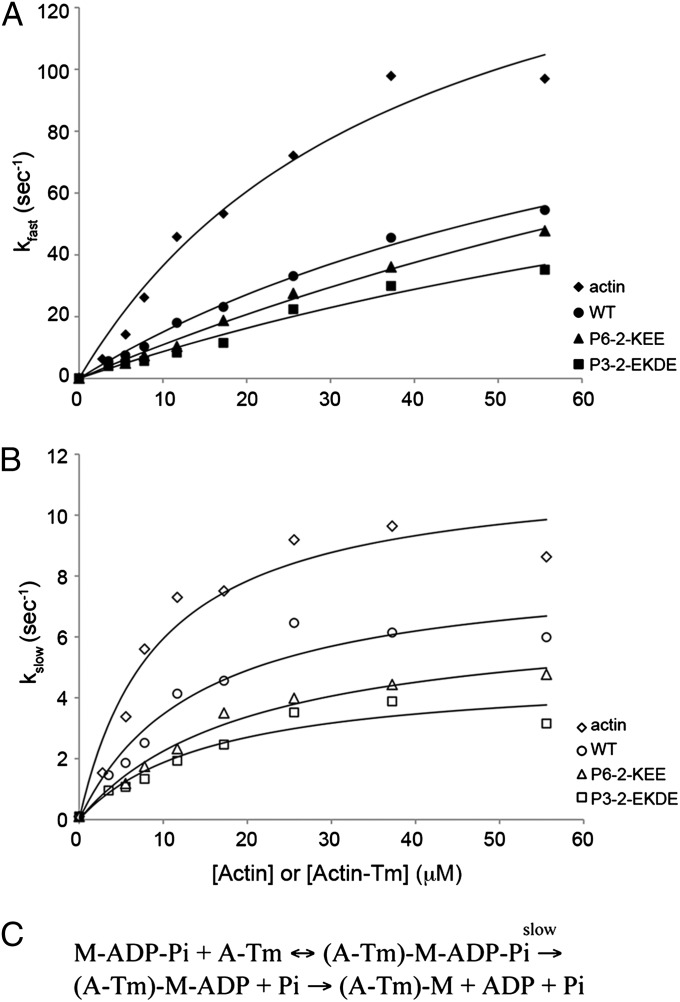
Rate of dissociation of mdADP from actin-myosin-S1-mdADP-Pi or actin-Tm-myosin-S1-mdADP-Pi. Double mixing stopped-flow experiments were performed as described in SI Materials and Methods. 6 μM myosin-S1 and 4 µM mdADP were mixed, incubated for 1 s, and then mixed with actin or actin-Tm and 1 mM ATP. The actin-Tm complexes were preformed at molar ratios (Tm:actin) of 1:5 for WT and P6-2-KEE, and 1:2.5 for P3-2-EKDE, to ensure that the actin was saturated with Tm. (A) Dependence of kfast on actin or actin-Tm concentration. The data were fit to the equation: kfast = kfast(max)/(1 + Kact,fast/[actin]) + k0 to obtain values for kfast(max) and kfast(max)/Kact,fast (Table 1). (B) Dependence of kslow on actin or actin-Tm concentration. The data were fit to the equation: kslow = kslow(max)/(1 + Kact,slow/[actin]) + k0 to obtain values for kslow(max) and kslow(max)/Kact,slow (Table 1). k0 = 0.1 s−1 was measured in the absence of actin. kfast is associated with the attachment of actin to myosin-ADP-Pi (M-ADP-Pi), followed by product dissociation, and kslow is associated with the attachment of actin to myosin-ATP, followed by hydrolysis and product dissociation. (C) Scheme showing the steps of the actomyosin ATPase cycle, with M-ADP-Pi binding to A-Tm, followed by product dissociation. Assay conditions: 5 mM MOPS, pH 7, 2 mM MgCl2, 1 mM DTT, 20 mM KAc. Temperature: 20 °C.
Fig. 4.
Fig. 4.
Excimer fluorescence and LS change of actin-(PIA-Tm) during titrations with myosin S1 in the absence of nucleotide. 3 μM F-actin and 0.5 µM PIA-Tm were combined and titrations carried out by addition of myosin S1 and monitoring the LS at 350 nm and the PIA excimer fluorescence at 485 nm after each addition of S1 in the same cuvette. The fraction S1 bound was calculated from the change in LS, and the fractional fluorescence change was calculated from the change in excimer fluorescence, normalized relative to the values at saturation (Fig. S3). The binding of S1 to actin-(PIA-Tm) saturates at a 1:1 stoichiometry of S1 to actin, but the excimer fluorescence change of PIA in response to S1 binding is complete before the actin filament is saturated with S1. The data for each Tm are from two independent experiments. The apparent cooperative unit size (n) was obtained by comparing the experimental curves with model curves for different n (dashed lines), using the equation, fopen = 1−(1 − fbound)n (32). Assay conditions: 25 mM imidazole, pH 7.6, 25 mM KCl, 4 mM MgCl2, 5 mM DTT.
Fig. 5.
Fig. 5.
Molecular model for actin-Tm-myosin interaction in the open state. The model was constructed by docking high-resolution Tm crystal structures (33, 34) in a 8 Å rigor actin-Tm-myosin S1 complex determined by cryo-EM (10). A minor modification was made in the axial and rotational alignment of Tm in the EM model by positioning crystal structures of Tm fragments to optimize electrostatic interactions of the mutated Tm residues in second-half of P3–P6 with charged residues on actin and myosin, while maintaining the azimuthal alignment. The radial distance between Tm and F-actin is 40 Å (10). Interactions of Tm with actin (green) and myosin (red) are shown in P3–P6: (A) EM structure of actin-Tm-myosin S1 (PDB ID 4A7F) (10) showing few interactions of the mutated Tm residues in P3–P4 with actin and myosin, and (B and C) crystal structure of Tm fragments including P3–P4 (PDB ID 2B9C) (B), and P5–P6 (PDB ID 2D3E) (C) (33, 34) positioned in the EM structure of actin-Tm-myosin S1 (PDB ID 4A7F), showing more optimal electrostatic interactions of mutated Tm residues with actin and myosin (Movie S1). The Tm molecule in the EM structure is shown in gray and the crystal structures of Tm that were positioned in the EM structure are shown in blue (B and C). The side-chains of the mutated Tm residues are shown in white and have blue labels. The side-chains of actin and myosin are labeled as A and M, respectively. Based on this model, in P3-2-EKDE (B), residues E114 and K118 can interact with K238, E226, D311 of actin, and K118, D121, and E122 can interact with D312, K295, K300 of myosin. In P4-2-EEEE (B), E150 and E156 can interact with K238 of actin, and E156, E163, and E164 with K295, K300 of myosin. E195 and K198 in P5-2-EKNK (C), and K233, E234, and E240 in P6-2-KEE (C) can interact with K238, E226, and D311 of actin and D312, K295, and K300 of myosin. The model was constructed using the University of California at San Francisco Chimera package (45), and is provided as a structural model for discussion of the results.

References

    1. Pollard TD, Cooper JA. Actin, a central player in cell shape and movement. Science. 2009;326(5957):1208–1212. - PMC - PubMed
    1. Wang CL, Coluccio LM. New insights into the regulation of the actin cytoskeleton by tropomyosin. Int Rev Cell Mol Biol. 2010;281:91–128. - PMC - PubMed
    1. Gunning P, O’Neill G, Hardeman E. Tropomyosin-based regulation of the actin cytoskeleton in time and space. Physiol Rev. 2008;88(1):1–35. - PubMed
    1. Clayton JE, Sammons MR, Stark BC, Hodges AR, Lord M. Differential regulation of unconventional fission yeast myosins via the actin track. Curr Biol. 2010;20(16):1423–1431. - PubMed
    1. Ostap EM. Tropomyosins as discriminators of myosin function. Adv Exp Med Biol. 2008;644:273–282. - PubMed

Publication types

MeSH terms

LinkOut - more resources