


Patterns of use and short-term complications of breast brachytherapy in the national medicare population from 2008-2009
- PMID: 23091103
- PMCID: PMC3675700
- DOI: 10.1200/JCO.2012.43.5297
Patterns of use and short-term complications of breast brachytherapy in the national medicare population from 2008-2009
Abstract
Purpose: Brachytherapy has disseminated into clinical practice as an alternative to whole-breast irradiation (WBI) for early-stage breast cancer; however, current national treatment patterns and associated complications remain unknown.
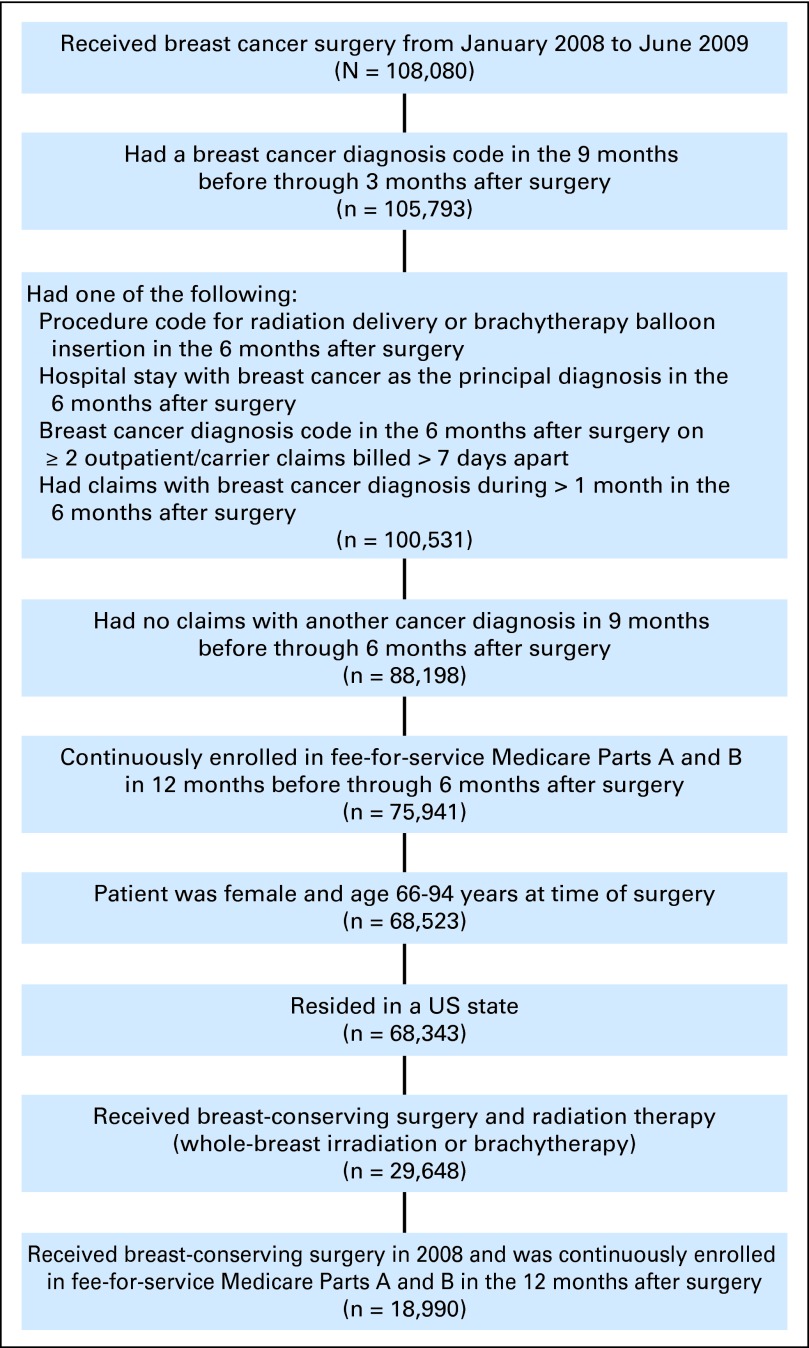
Patients and methods: We constructed a national sample of Medicare beneficiaries ages 66 to 94 years who underwent breast-conserving surgery from 2008 to 2009 and were treated with brachytherapy or WBI. We used hospital referral regions (HRRs) to assess national treatment variation and an instrumental variable analysis to compare complication rates between treatment groups, adjusting for patient and clinical characteristics. We compared overall, wound and skin, and deep-tissue and bone complications between brachytherapy and WBI at 1 year of follow-up.
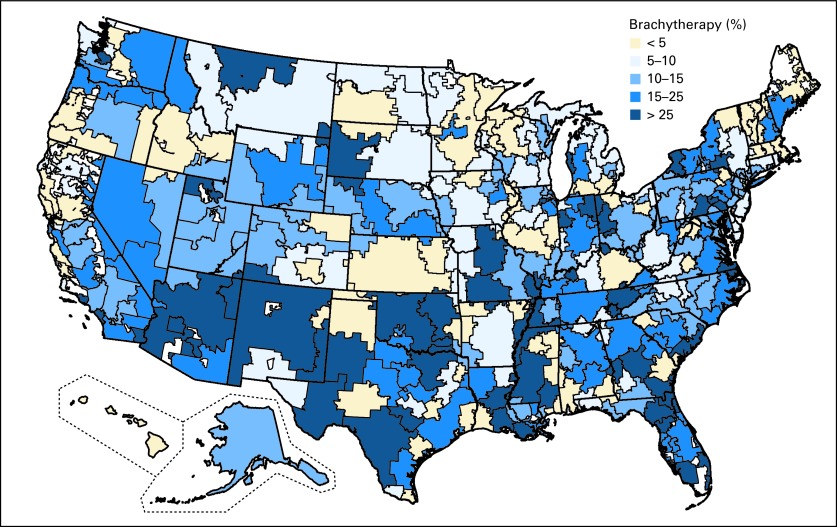
Results: Of 29,648 women in our sample, 4,671 (15.8%) received brachytherapy. The percent of patients receiving brachytherapy varied substantially across HRRs, ranging from 0% to over 70% (interquartile range, 7.5% to 23.3%). Of women treated with brachytherapy, 34.3% had a complication compared with 27.3% of women undergoing WBI (P < .001). After adjusting for patient and clinical characteristics, 35.2% of women treated with brachytherapy (95% CI, 28.6 to 41.9) had a complication compared with 18.4% treated with WBI (95% CI, 15.5 to 21.3; P value for difference, <.001). Brachytherapy was associated with a 16.9% higher rate of wound and skin complications compared with WBI (95% CI, 10.0 to 23.9; P < .001), but there was no difference in deep-tissue and bone complications.
Conclusion: Brachytherapy is commonly used among Medicare beneficiaries and varies substantially across regions. After 1 year, wound and skin complications were significantly higher among women receiving brachytherapy compared with those receiving WBI.
Conflict of interest statement
Authors' disclosures of potential conflicts of interest and author contributions are found at the end of this article.
Figures
Comment in
-
When hope hinders science and patient-centered care.J Clin Oncol. 2012 Dec 10;30(35):4283-4. doi: 10.1200/JCO.2012.45.4660. Epub 2012 Oct 22. J Clin Oncol. 2012. PMID: 23091102 No abstract available.
-
When retrospective comparative effectiveness research hinders science and patient-centered care.J Clin Oncol. 2013 Jun 10;31(17):2226-7. doi: 10.1200/JCO.2012.47.6911. Epub 2013 May 13. J Clin Oncol. 2013. PMID: 23669221 No abstract available.
-
Reply to L.W. Cuttino et al.J Clin Oncol. 2013 Jun 10;31(17):2227-9. doi: 10.1200/JCO.2013.49.0441. J Clin Oncol. 2013. PMID: 23901421 No abstract available.
-
[Evaluation of (balloon) brachytherapy for partial breast irradiation in breast cancer based on current meta-analyses].Strahlenther Onkol. 2013 Oct;189(10):899-901. doi: 10.1007/s00066-013-0425-z. Strahlenther Onkol. 2013. PMID: 23963208 German. No abstract available.
References
-
- NIH consensus conference: Treatment of early-stage breast cancer. JAMA. 1991;265:391–395. - PubMed
-
- Vaidya JS, Joseph DJ, Tobias JS, et al. Targeted intraoperative radiotherapy versus whole breast radiotherapy for breast cancer (TARGIT-A trial): An international, prospective, randomised, non-inferiority phase 3 trial. Lancet. 2010;376:91–102. - PubMed
-
- Bartelink H, Horiot JC, Poortmans P, et al. Recurrence rates after treatment of breast cancer with standard radiotherapy with or without additional radiation. N Engl J Med. 2001;345:1378–1387. - PubMed
-
- Abbott AM, Habermann EB, Tuttle TM. Trends in the use of implantable accelerated partial breast irradiation therapy for early stage breast cancer in the United States. Cancer. 2011;117:3305–3310. - PubMed
Publication types
MeSH terms
Grants and funding
LinkOut - more resources
Full Text Sources
Medical
